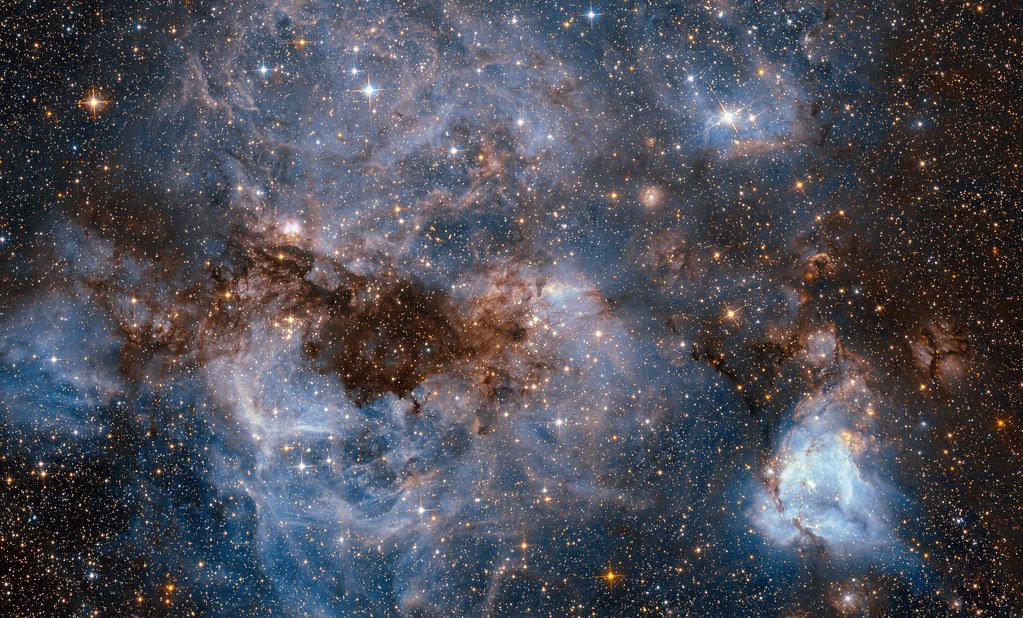
Chaotic Orbits Challenge Long-Held Assumptions (Image Credits: Flickr)
The Small Magellanic Cloud gleams in the southern sky as one of the Milky Way’s closest companions, a dwarf galaxy long prized by astronomers for its pristine features. Recent observations revealed its stars wandering in disarray, defying expectations for orderly rotation around the core. University of Arizona researchers now pinpoint the cause to a violent head-on collision with its larger sibling, the Large Magellanic Cloud, hundreds of millions of years ago.[1][2]
Chaotic Orbits Challenge Long-Held Assumptions
Stars in most galaxies trace neat paths around the center, much like planets orbiting a sun. Yet in the Small Magellanic Cloud, these motions appeared utterly random, a puzzle that stumped observers for decades.[3] Data from the Hubble Space Telescope and Europe’s Gaia satellite captured this disorder, showing stellar velocities scattered rather than aligned in rotation.
The galaxy’s gas, meanwhile, seemed to spin in a disk, fueling confusion since stars typically inherit such patterns from their gaseous birthplace. This mismatch hinted at recent turmoil. Astronomers cataloged the Small Magellanic Cloud’s stars and mapped its gas for over 50 years, yet the core dynamics eluded clear explanation until now.[1]
A Head-On Collision Rewrites History
Himansh Rathore, a graduate student at the University of Arizona’s Steward Observatory, led the team that simulated the encounter. Their models depicted the smaller galaxy plowing straight through the Large Magellanic Cloud’s disk roughly 100 to 200 million years ago. The larger galaxy’s gravity tore apart the intruder’s structure, flinging stars into erratic trajectories.[2]
Hydrodynamical simulations matched real-world properties: gas content, stellar masses, and positions relative to the Milky Way. The clash injected massive energy, stretching the Small Magellanic Cloud into an elongated form with a tidal tail. This event, part of ongoing interactions among the three galaxies spanning hundreds of millions of years, left lasting scars.[3]
Gas Under Pressure: The Illusion Exposed
The collision’s ram pressure from the Large Magellanic Cloud’s dense gas battered the intruder’s clouds. “Imagine sprinkling water droplets on your hand and moving it through the air – as the air rushes past, the droplets get blown off because of the pressure it exerts,” Rathore explained. Something similar disrupted the Small Magellanic Cloud’s gas rotation entirely.[1]
Stretching along the line of sight created an optical trick: gas flows toward and away from Earth mimicked rotation from our vantage. The galaxy now boasts unusual depth, two gas density peaks, and a separation between its photometric and kinematic centers by thousands of light-years. These features align perfectly with post-collision models.
- Unruly stellar motions lacking central rotation.
- Apparent gas disk from stretched structure.
- Elongated shape with tidal tails.
- Excessive line-of-sight depth versus sky projection.
- Gas more disturbed than stars due to pressure.
From Textbook Example to Cosmic Survivor
Astronomers once hailed the Small Magellanic Cloud as a prime analog for early universe dwarfs – small, gas-rich, and metal-poor. Gurtina Besla, the study’s senior author and Steward Observatory professor, noted, “The SMC went through a catastrophic crash that injected a lot of energy into the system. It is not a ‘normal’ galaxy by any means.”[2] This revelation urges reevaluation of such benchmarks.
The team devised new tools to decode scrambled motions in disrupted systems, applicable beyond this pair. A companion 2025 study linked the event to a tilted bar in the Large Magellanic Cloud, offering a novel dark matter probe through gravitational tilts.
| Feature | Pre-Collision Expectation | Post-Collision Reality |
|---|---|---|
| Stellar Motion | Orderly rotation | Random, disordered |
| Gas Behavior | Stable disk | Stretched, illusory spin |
| Shape | Irregular dwarf | Elongated with tails |
Key Takeaways
- The Small Magellanic Cloud’s chaos stems from a direct disk-piercing collision with the Large Magellanic Cloud.
- This event challenges its role as a standard for primordial galaxies.
- New simulations and analysis tools illuminate violent galaxy interactions.
This discovery offers a rare glimpse into galaxy evolution caught mid-transformation, reminding us that cosmic snapshots hide dynamic histories. As the Small Magellanic Cloud continues reshaping, it underscores the brutality of gravitational dances in our local cosmic neighborhood. What do you think about this galactic drama? Tell us in the comments.