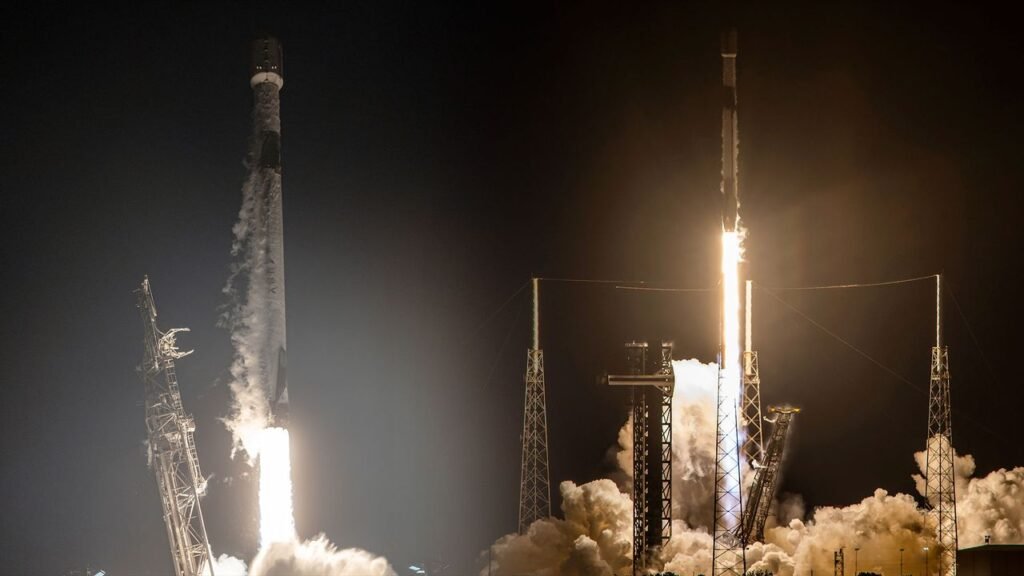

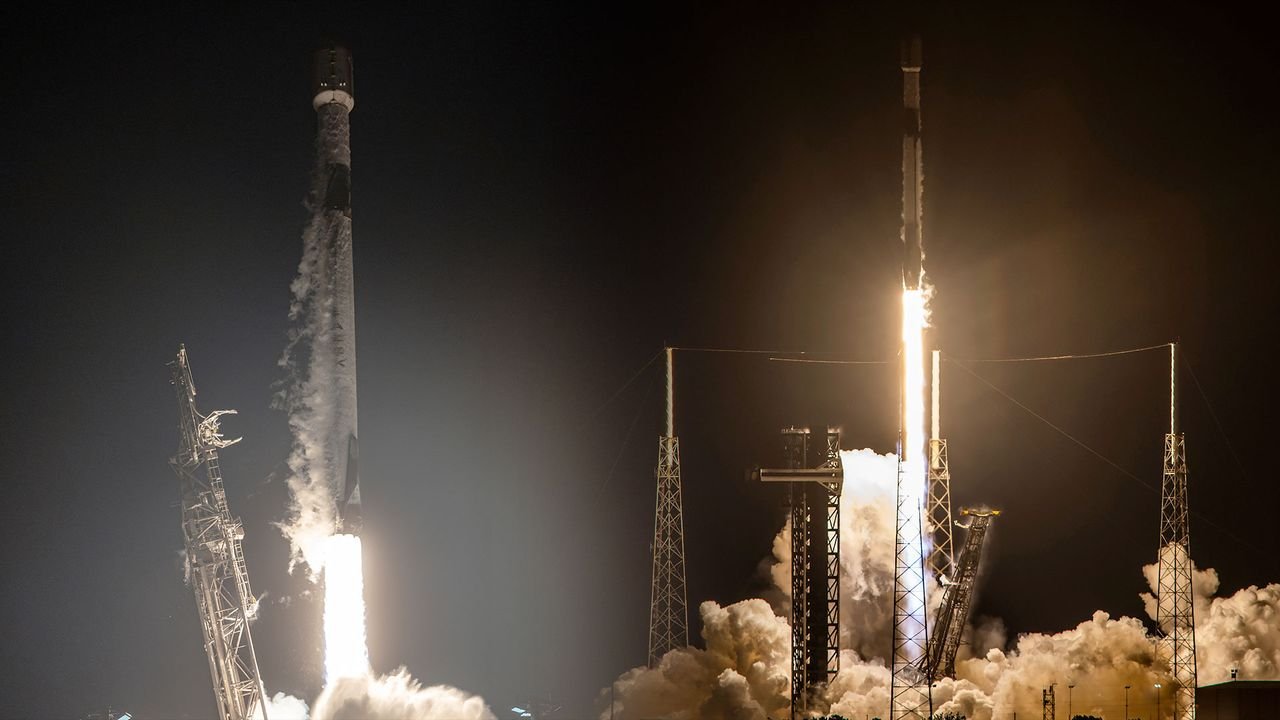
California Nighttime Spectacle Ignites the Sequence (Image Credits: Cdn.mos.cms.futurecdn.net)
SpaceX completed two Starlink missions in quick succession from opposite U.S. coasts, deploying satellites to bolster its global internet constellation.
California Nighttime Spectacle Ignites the Sequence
Vandenberg Space Force Base served as the stage for the first liftoff on February 14, 2026, at 8:59 p.m. EST.[1][2] A Falcon 9 rocket, powered by first-stage booster B1081 on its 22nd flight, soared into the evening sky from Space Launch Complex 4 East.[1] This marked the 600th Falcon 9 launch in the vehicle’s history.[2]
The mission, designated Starlink 17-13, successfully released its payload of Starlink satellites into low-Earth orbit roughly an hour after departure.[1] Spectators along California’s central coast witnessed the bright trail arching westward toward the Pacific.
Florida’s Predawn Power Play Follows Suit
Cape Canaveral Space Force Station hosted the second launch early on February 16, 2026, at 2:59 a.m. EST.[1] Booster B1090, marking its 10th reuse, propelled another Falcon 9 skyward from Space Launch Complex 40.[1] Satellite deployment occurred about an hour post-liftoff, confirming the mission’s success.[1]
This flight represented SpaceX’s 19th Falcon 9 launch of 2026 and the 602nd overall.[1] Overcast skies earlier in the evening gave way to favorable conditions for the overnight attempt.
Precision Recoveries Highlight Reusability
Both first stages executed flawless autonomous landings on respective droneships.[1] B1081 touched down on “Of Course I Still Love You” in the Pacific Ocean more than eight minutes after liftoff from California.[2]
Meanwhile, B1090 settled on “A Shortfall of Gravitas” in the Atlantic following the Florida ascent.[1]
| Mission | Booster | Flights | Droneship |
|---|---|---|---|
| California (Feb. 14) | B1081 | 22nd | OCISLY |
| Florida (Feb. 16) | B1090 | 10th | ASOG |
Starlink’s Orbiting Network Gains Momentum
These missions added to the Starlink fleet, which now exceeds 9,600 active satellites providing broadband to remote regions.[1] The satellites support advanced features like direct-to-cell connectivity and in-flight Wi-Fi.
- Target underserved areas worldwide
- Enable seamless global coverage
- Facilitate emerging services such as satellite texting
- Reduce reliance on terrestrial infrastructure
SpaceX’s rapid deployment pace underscores its dominance in the commercial space sector.
Key Takeaways
- Two successful launches in 48 hours from Vandenberg and Cape Canaveral.
- Perfect booster recoveries extend reusability records.
- Starlink constellation surpasses 9,600 satellites for enhanced global internet.
SpaceX’s dual-coast triumphs signal an accelerating push toward ubiquitous satellite broadband. What impact do you see these expansions having on connectivity? Share your thoughts in the comments.