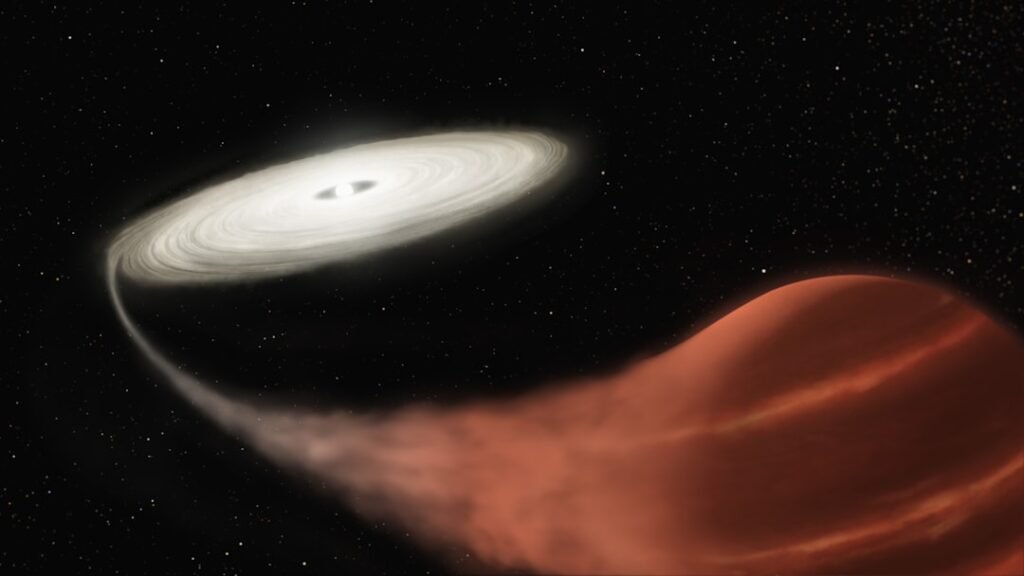

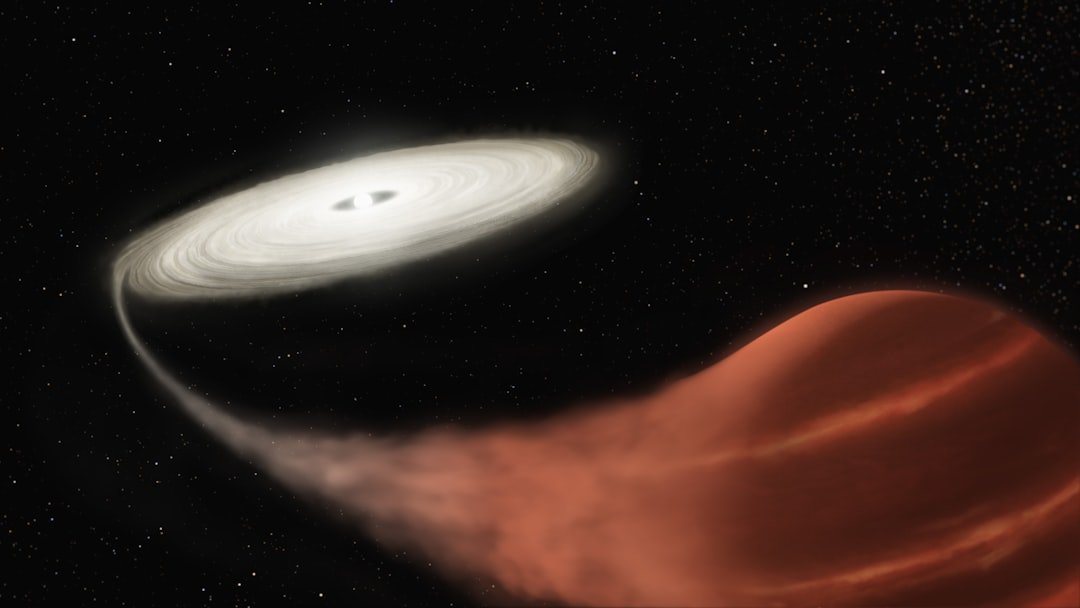
A Cosmic Outburst Stands Out (Image Credits: Unsplash)
China’s Einstein Probe satellite captured an extraordinary X-ray transient on July 2, 2025, that researchers interpret as a possible intermediate-mass black hole disrupting a white dwarf star billions of light-years away.[1][2]
A Cosmic Outburst Stands Out
The Wide-field X-ray Telescope aboard the probe spotted a rapidly varying source during a routine sky survey, prompting immediate alerts to observatories worldwide. This event, labeled EP250702a or GRB 250702B, peaked at a luminosity of about 3 × 1049 erg per second – one of the brightest such flares on record.[1] NASA’s Fermi Gamma-ray Space Telescope simultaneously registered gamma-ray bursts from the same sky position, but prior data revealed persistent X-ray emission from the site nearly a day earlier – a feature absent in typical gamma-ray bursts.
Fifteen hours after the initial signal, intense X-ray flares erupted, followed by a dramatic decline tracked by the probe’s Follow-up X-ray Telescope over 20 days. The source’s brightness fell by more than 100,000 times, while its spectrum softened from hard to soft X-rays, signaling a shift in the emission mechanism.[3]
Timeline of a Stellar Demise
Analysis pieced together a sequence that set this event apart from known phenomena. Ground- and space-based telescopes confirmed its position in the outskirts of a distant galaxy, roughly eight billion light-years distant, rather than at the core where supermassive black holes reside.[2]
- Day before bursts: Steady X-ray emission detected by Wide-field X-ray Telescope.
- July 2, 2025: Rapidly varying X-ray source triggers alerts; gamma-ray bursts follow.
- 15 hours later: Peak X-ray flares with extreme luminosity.
- Over 20 days: Brightness drops dramatically; spectrum evolves to softer X-rays.
- Multi-wavelength follow-ups pinpoint galactic outskirts location.
These traits – early X-ray precursor, rapid variability, and off-center position – defied standard models for gamma-ray bursts or typical stellar disruptions.
The Disruptive Power of an Intermediate Black Hole
Scientists from China’s National Astronomical Observatories and international partners, including The University of Hong Kong, converged on a leading explanation: tidal forces from an intermediate-mass black hole, weighing between hundreds and tens of thousands of solar masses, stretched and fragmented the dense white dwarf. The debris fueled a relativistic jet aligned toward Earth, producing the observed emissions.[4]
“This early X-ray signal is crucial. It tells us this was not an ordinary gamma-ray burst,” stated Dr. Dongyue Li, first author from the National Astronomical Observatories.[1] Simulations by HKU researchers confirmed the model’s fit, matching jet energies and decay timescales. Fermi data capped the black hole’s mass below 75,000 solar masses, ruling out supermassive alternatives.[2]
The event outshone known tidal disruptions by factors of 10 to 100 in peak luminosity and decayed far faster, consistent only with a white dwarf’s extreme density resisting full immediate consumption.
Collaboration Fuels Breakthrough
Over 300 scientists from more than 40 institutions analyzed the data, with key contributions from HKU’s Professor Lixin Dai and team. “The white dwarf–intermediate-mass black hole model can most naturally explain its rapid evolution and extreme energy output,” Dai noted.[1] The findings appeared as a cover story in Science Bulletin.
Einstein Probe’s lobster-eye optics enabled the wide-field sensitivity that caught this fleeting event, underscoring China’s role in transient astronomy alongside partners like ESA and NASA’s observatories.
Key Takeaways
- First potential direct evidence of intermediate-mass black hole-white dwarf tidal disruption.
- Event EP250702a peaked brighter than most known transients, faded in days.
- Highlights Einstein Probe’s power for extreme cosmic captures.
This potential first sighting bridges gaps in black hole demographics, revealing how intermediate-mass objects – possible seeds for larger ones – interact with compact stars. It promises deeper probes into accretion, jets, and multi-messenger signals. What implications do you see for future black hole hunts? Share in the comments.