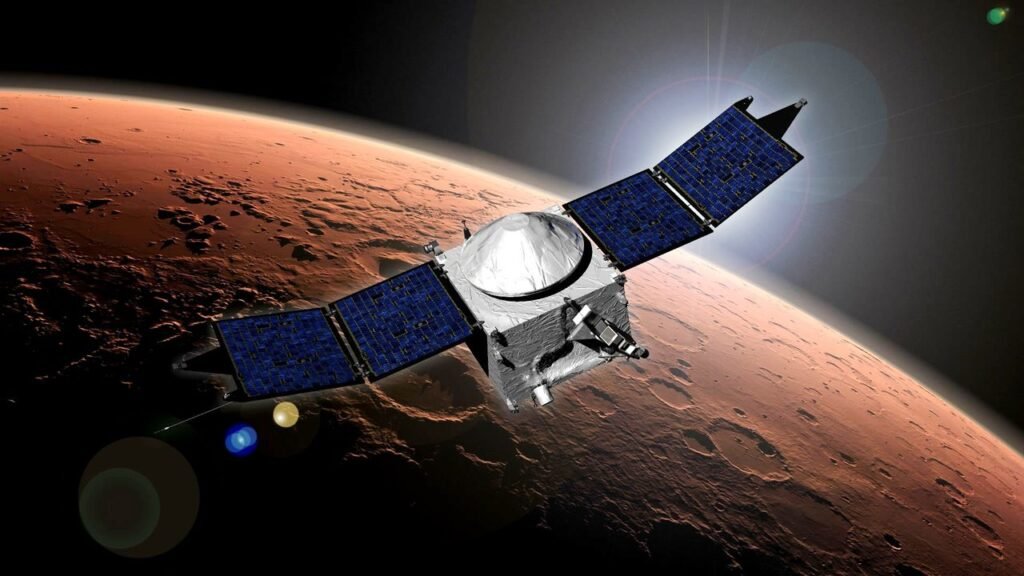

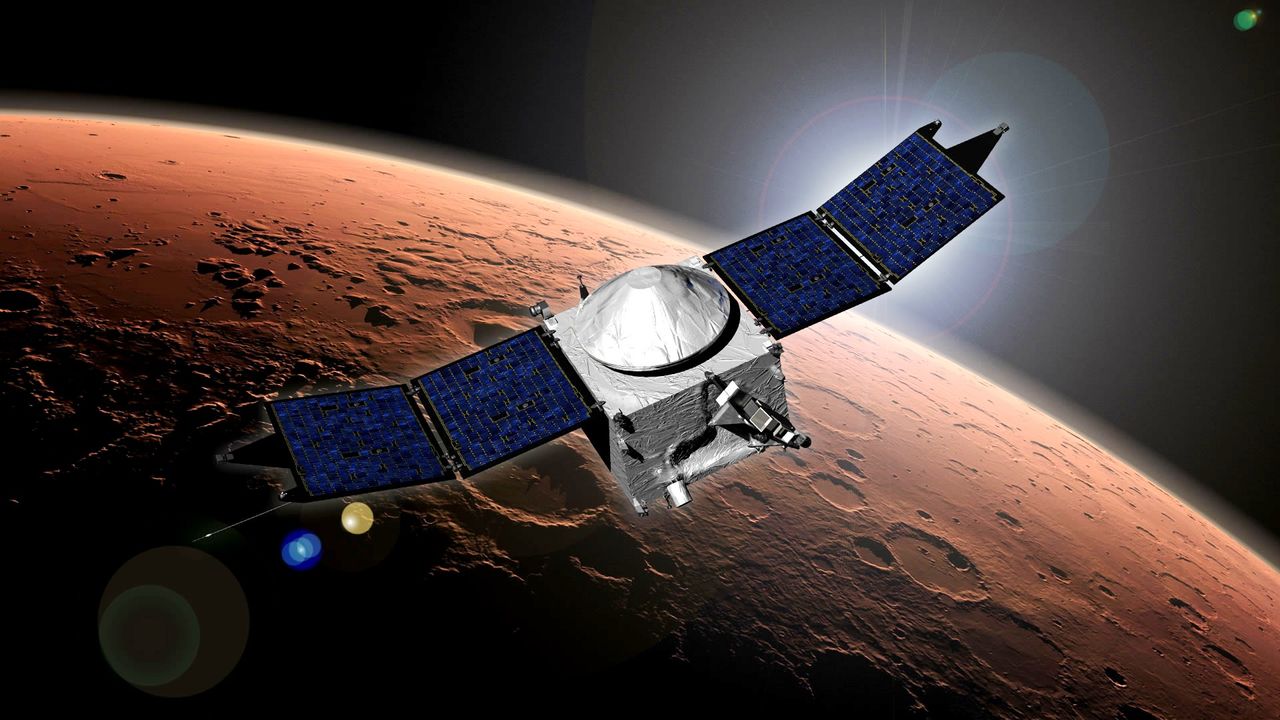
The Sudden Loss of Contact (Image Credits: Cdn.mos.cms.futurecdn.net)
NASA’s long-serving MAVEN mission to Mars has entered a troubling phase of silence, with the spacecraft now suspected of uncontrolled rotation in its orbit.
The Sudden Loss of Contact
The MAVEN spacecraft, which has been studying Mars’s upper atmosphere since 2014, abruptly stopped communicating with Earth on December 6, 2025. Engineers at NASA’s Jet Propulsion Laboratory initially traced the issue to the probe’s position behind the Red Planet during a routine orbit. As the spacecraft emerged from that shadow, no signals returned, prompting immediate concern among mission controllers.
Teams quickly activated backup protocols to scan for any faint transmissions, but the silence persisted. Early assessments suggested a possible onboard anomaly, though the exact cause remained unclear. This event marked a significant interruption in MAVEN’s decade-long data collection, which has provided invaluable insights into Mars’s atmospheric evolution.
Signs of Unstable Rotation
Recent telemetry analysis revealed that MAVEN appears to be spinning, a condition that could explain the ongoing communication blackout. The rotation rate, estimated at several degrees per second, likely misaligns the spacecraft’s antennas away from Earth-based receivers. Such spinning often results from momentum wheel failures or power fluctuations, common risks for aging satellites in deep space.
Mission specialists noted that the probe’s solar arrays might still be generating power, given its stable orbit at about 4,000 miles from Mars. However, without direct confirmation, assumptions remain tentative. This development adds urgency to recovery efforts, as prolonged spinning could deplete onboard resources and jeopardize the mission’s future.
NASA’s Recovery Operations Underway
NASA’s Deep Space Network has been actively attempting to reacquire the signal since the initial loss. Engineers devised a series of commands to potentially halt the spin and realign the spacecraft, sending them during optimal orbital windows. Collaboration with international partners has expanded the listening windows, increasing chances of detection.
Previous safe mode events on MAVEN, such as one in 2022, demonstrated the team’s ability to recover operations swiftly. Current efforts focus on isolating the anomaly without risking further instability. Updates from the mission blog indicate steady progress, though no breakthrough has occurred as of December 17, 2025.
Key aspects of the recovery strategy include:
- Monitoring for intermittent signals during the spacecraft’s daily passes over Earth-facing positions.
- Testing alternative communication frequencies to bypass potential hardware glitches.
- Simulating scenarios on ground replicas of MAVEN to predict responses to corrective commands.
- Assessing orbital decay risks if the spin persists unchecked.
- Coordinating with other Mars missions for relay support if contact resumes.
Implications for Mars Exploration
MAVEN’s role in relaying data from surface rovers like Perseverance underscores the stakes of this silence. The orbiter has facilitated over 1,000 relay sessions, ensuring critical communications from the Martian surface reach Earth. A prolonged outage could disrupt ongoing surface operations, though backup relays exist through other assets.
Beyond immediate concerns, the incident highlights the vulnerabilities of extended space missions. MAVEN’s instruments continue to gather data on solar wind interactions with Mars’s atmosphere, even if unsent. Resuming contact would allow scientists to analyze recent observations, potentially revealing new details about the planet’s climate history.
Key Takeaways
- MAVEN lost contact on December 6, 2025, and remains silent despite intensive recovery attempts.
- Suspected spinning is complicating signal acquisition, but the spacecraft’s orbit appears stable.
- The mission’s scientific legacy, including atmospheric studies and rover support, hangs in the balance.
As NASA persists in its quest to revive MAVEN, the episode serves as a reminder of the delicate balance in deep-space exploration. This resilient probe has already transformed our understanding of Mars; restoring it could yield even more discoveries. What aspects of the MAVEN mission intrigue you most? Share your thoughts in the comments.
Jan loves Wildlife and Animals and is one of the founders of Animals Around The Globe. He holds an MSc in Finance & Economics and is a passionate PADI Open Water Diver. His favorite animals are Mountain Gorillas, Tigers, and Great White Sharks. He lived in South Africa, Germany, the USA, Ireland, Italy, China, and Australia. Before AATG, Jan worked for Google, Axel Springer, BMW and others.