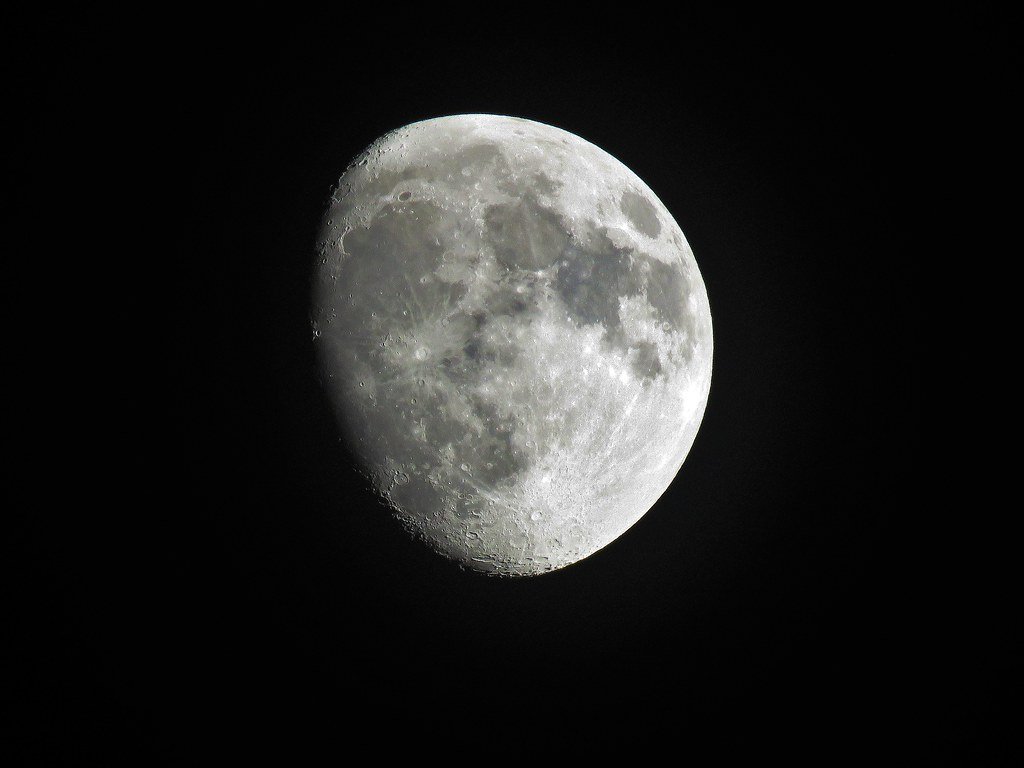
Long-Standing Quest for Lunar Water Ice (Image Credits: Flickr)
Researchers have pursued signs of water ice in the Moon’s permanently shadowed regions for years, viewing these dark craters as potential goldmines for future explorers. A recent study leveraging high-resolution images from the ShadowCam instrument delivered a sobering update: no widespread evidence emerged for thick layers of near-surface ice. The findings, drawn from detailed scans of polar craters, force scientists to reassess long-held assumptions about lunar resources and their accessibility.[1][2]
Long-Standing Quest for Lunar Water Ice
Permanently shadowed regions, or PSRs, dot the Moon’s polar areas, where deep craters block sunlight indefinitely due to the body’s minimal axial tilt and thin exosphere. Temperatures there plummet below 100 K, creating ideal cold traps for volatiles like water ice. Previous missions provided tantalizing hints – NASA’s LCROSS impactor detected water vapor in 2009, while instruments on Chandrayaan-1, Kaguya, and Lunar Reconnaissance Orbiter spotted elevated hydrogen signals and patchy low-level ice.[2]
These detections fueled optimism for Artemis program bases, where ice could supply drinking water, oxygen, and rocket fuel. Yet indirect methods left ambiguities about ice form, depth, and quantity. Confirmation on Mercury and Ceres heightened expectations that the Moon followed suit, but lunar evidence remained sparse and contested.[1]
ShadowCam’s Advanced Scrutiny of Dark Craters
The Korea Pathfinder Lunar Orbiter, launched in 2022, carried ShadowCam – a NASA-developed camera designed to peer into lightless PSRs using scattered sunlight from nearby illuminated terrain. A team led by Shuai Li of the University of Hawaii at Manoa analyzed calibrated radiance images at resolutions under 2 meters per pixel. They targeted PSRs across the 80° to 90° latitude bands at both poles, creating mosaics and stereo pairs to measure phase-angle-dependent brightness.[2]
Water ice stands out optically: it reflects more visible light than typical lunar regolith and exhibits strong forward scattering, where brightness peaks when viewed near the direction of incoming light. Laboratory tests and radiative transfer models set detection thresholds – about 20 to 30 weight percent for reflectance boosts and roughly 5 to 10 percent for scattering signatures, given ShadowCam’s precision.[1] Researchers scoured for anomalies unexplained by boulders, fresh craters, or ejecta, cross-checking against sunlit analogs.
What the Scans Revealed – or Didn’t
No regions showed clear ice signals exceeding the 20 to 30 weight percent threshold. Bright spots, often 10 to 100 percent more radiant, traced back to rocky outcrops, mass wasting, or impact debris rather than ice. In specific sites like Cabeus crater, Hermite A, and de Gerlache PSR, forward-scattering anomalies hinted at possible ice mixtures above 10 percent in tiny patches, but these proved rare.[2]
“We found no evidence of widespread water ice in PSRs at abundances above the detection limit of 20 to 30 wt % but could not rule out widespread low-content water ice,” the authors stated in their Science Advances paper.[2] Upper limits pegged surficial ice well below hopes for exploitable deposits. The table below summarizes detection capabilities:
| Method | Detection Threshold (wt% ice) | Key Sites Tested |
|---|---|---|
| Reflectance Enhancement | 20–30 | Polar PSRs (80°–90°) |
| Forward Scattering | 5–10 | Cabeus, Hermite A, de Gerlache |
- Common bright features matched non-ice geology in lit areas.
- Scattering ratios around 0.8 (versus over 1 for regolith) flagged candidates.
- Impacts may excavate buried ice, explaining isolated spots.
Ramifications for Moon Missions and Science
The absence of abundant surficial ice tempers prospects for quick resource extraction at polar landing sites. Crewed outposts might need to drill deeper or process diffuse mixtures, complicating logistics under Artemis timelines. Still, low-level ice below 10 percent aligns with some prior spectroscopic hints and could suffice with advanced tech.[1]
Broader insights emerge on solar system dynamics: why do lunar PSRs lag behind Mercury’s thick deposits? Delivery via comets and micrometeorites may balance with destruction processes like sputtering or impacts. Li’s team plans to refine algorithms for sub-1 percent detection, paving the way for upcoming landers.
Key Takeaways
- No widespread surficial ice above 20–30 wt% in examined PSRs.
- Possible low-abundance ice (<10 wt%) in small areas, pending confirmation.
- Boosts need for next-gen instruments in future lunar missions.
This study underscores the value of direct, high-fidelity observations in unraveling lunar mysteries. While no jackpot surfaced, the door stays open for modest reserves that could still transform exploration. What do you think about these findings? Share in the comments.