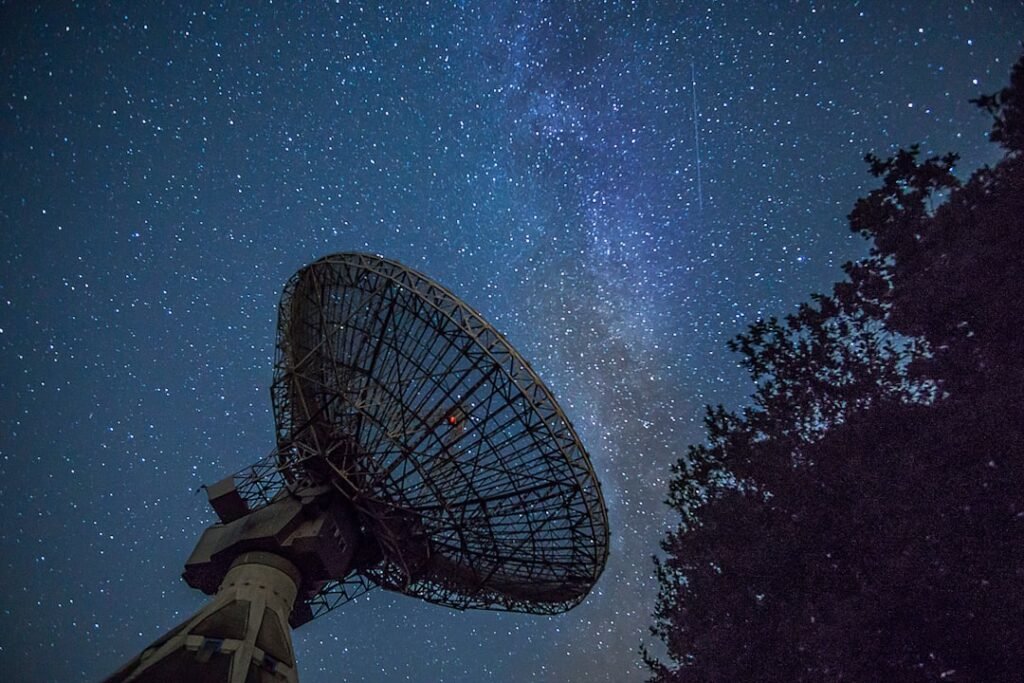


A Landmark in Citizen Science (Image Credits: Unsplash)
For over two decades, a global network of volunteers has sifted through vast streams of cosmic data in pursuit of signs from distant worlds.
A Landmark in Citizen Science
Millions of everyday computer users transformed their idle machines into a powerful tool for astronomical discovery. The SETI@home project, launched in 1999, harnessed this distributed computing power to analyze radio signals captured by the now-defunct Arecibo Observatory in Puerto Rico. Volunteers downloaded software that processed chunks of data during downtime, contributing to one of the most ambitious searches for extraterrestrial intelligence in history.
By the time Arecibo collapsed in 2020, the project had accumulated terabytes of information spanning 11 years of observations. Participants worldwide scanned for narrowband signals – brief, focused bursts that could indicate artificial origins rather than natural cosmic noise. This collaborative effort not only democratized science but also generated an unprecedented dataset for researchers to mine.
The scale of involvement underscored a shared human curiosity about our place in the universe. Families, students, and professionals alike joined, turning screensavers into stargazing sentinels. As the project winds down, its impact lingers in the annals of space exploration.
Distilling Billions into Breakthrough Candidates
Researchers faced a monumental task: parsing 12 billion potential signals of interest from the Arecibo archive. Advanced algorithms and human oversight whittled this mountain down step by step, eliminating interference from satellites, aircraft, and earthly electronics. What remained were anomalies that defied easy explanation, prompting deeper scrutiny.
Now, only 100 signals stand out as worthy of intensive follow-up. These candidates exhibit traits like unusual frequency patterns or origins from specific sky regions, far from known human sources. Teams at the SETI Institute and partner institutions will deploy additional telescopes to reobserve these points in the sky.
The process highlighted the project’s efficiency. Early filters caught obvious terrestrial contaminants, while later stages focused on astrophysical puzzles. Volunteers’ contributions proved invaluable, accelerating analysis that might have taken decades on traditional supercomputers.
Unraveling the Mysteries of These Signals
Each of the 100 signals carries a story of cosmic intrigue. Some pulse at frequencies associated with hydrogen emissions, a logical choice for interstellar communication due to its universality. Others appear modulated in ways that mimic engineered transmissions, though natural explanations like pulsars remain possible.
Verification demands rigorous testing. Scientists cross-reference positions against star catalogs and monitor for repetition – key hallmarks of intentional signals. If any prove non-human, it could rewrite our understanding of the cosmos.
- Frequency specificity: Narrow bands suggest deliberate tuning.
- Spatial isolation: Origins in empty interstellar voids.
- Temporal behavior: Bursts that align with no known phenomena.
- Polarization patterns: Unusual twists in signal orientation.
- Strength variability: Fluctuations hinting at directed beams.
While excitement builds, caution tempers expectations. Past candidates, like the famous Wow! signal from 1977, ultimately faded without confirmation. Still, these 100 represent the project’s strongest leads yet.
The Road Ahead for Extraterrestrial Exploration
With SETI@home concluding its primary phase, attention shifts to next-generation efforts. Projects like Breakthrough Listen continue the hunt using modern facilities such as the Green Bank Telescope. Machine learning now aids in real-time signal detection, building on the crowdsourced foundation.
Funding and collaboration remain crucial. International partnerships expand coverage to optical and infrared spectra, broadening the search beyond radio waves. As technology advances, the odds of detecting technosignatures – any evidence of alien technology – improve steadily.
The Arecibo data’s legacy endures, archived for future analysis. Emerging quantum computing could revisit these signals with fresh insights. Meanwhile, public engagement persists through apps and online platforms, keeping the dream of contact alive.
Key Takeaways
- SETI@home mobilized millions, processing Arecibo’s vast radio dataset over 21 years.
- The final 100 signals demand targeted observations to rule out natural causes.
- This era’s end paves the way for AI-enhanced, multi-wavelength searches.
As humanity peers deeper into the stars, these 100 signals remind us of the universe’s vast unknowns. One breakthrough could unite us in wonder, reshaping our cosmic narrative. What do you think about the potential of these discoveries? Share your thoughts in the comments.