
Imagine waking up one day and learning that our entire solar system might be the scarred aftermath of a long‑forgotten cosmic collision. Not a gentle nudge, not a small asteroid, but something enormous, invisible, and powerful enough to bend orbits, reshape worlds, and fling planets out like loose screws from a spinning machine. That’s the kind of possibility some scientists are seriously entertaining when they ask whether system.
This idea sounds like science fiction, but it grows out of real mysteries: tilted planets, broken belts of debris, strange orbits at the edge of the Sun’s reach, and timelines of mass extinction on Earth that line up suspiciously well with cosmic upheaval. Step by step, researchers are piecing together a picture that suggests our solar system hasn’t always been the neat, clockwork layout we see in astronomy textbooks. It may be more like a crime scene: stable now, but with evidence of past chaos hiding in plain sight.
The Solar System Is Weirder Than Textbooks Admit
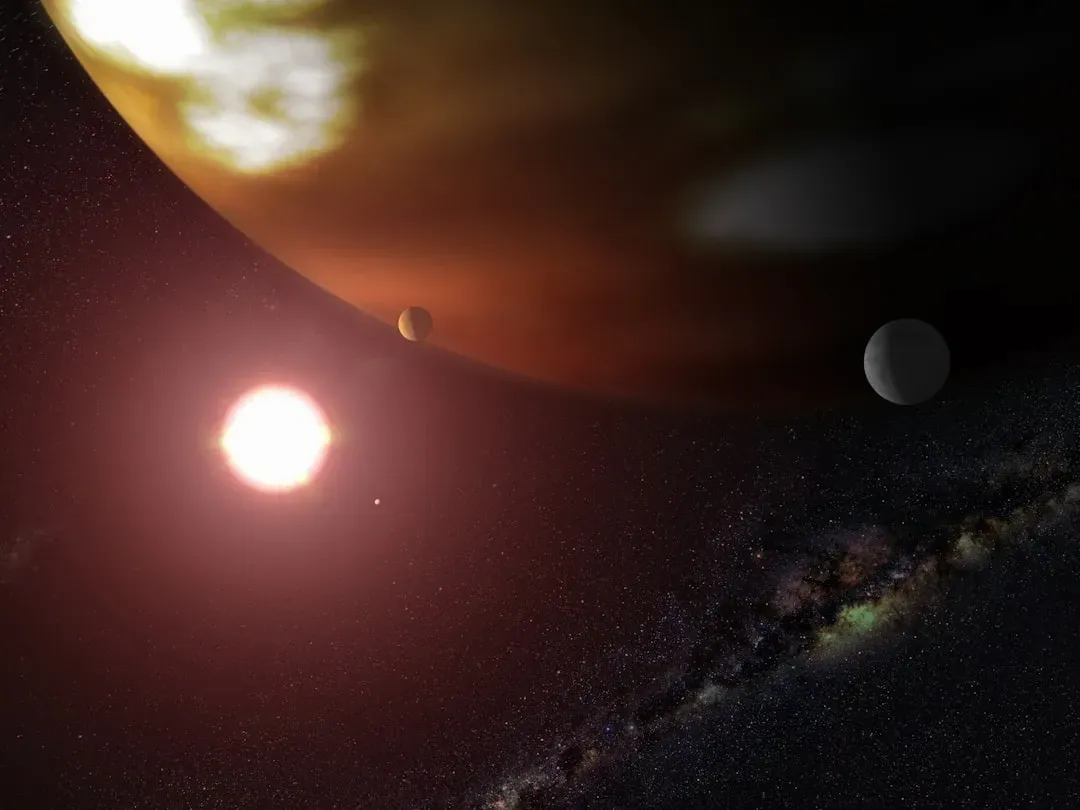
At first glance, the solar system looks orderly: planets circle the Sun in roughly the same plane, in the same direction, like calm lanes on a cosmic highway. But when scientists look closely, the details don’t quite fit the simple story. Uranus rolls around the Sun on its side, Venus spins backwards compared to most planets, and even the Sun itself is slightly tilted relative to the plane of the planets. It’s like walking into a tidy room and noticing a few chairs mysteriously knocked over.
These odd tilts and spins suggest that something violent and asymmetrical happened in the past. Gravity is normally a smoothing force: over billions of years, it tends to iron out chaos and settle things into stable patterns. So when major bodies end up misaligned or rotating the wrong way, it implies massive collisions, close encounters, or gravitational bullying by something big. Instead of a calm, pre‑planned system, the history of the solar system starts to look more like a rough neighborhood where past brawls left permanent scars.
Giant Impacts: The Invisible Wreckage Behind Familiar Worlds
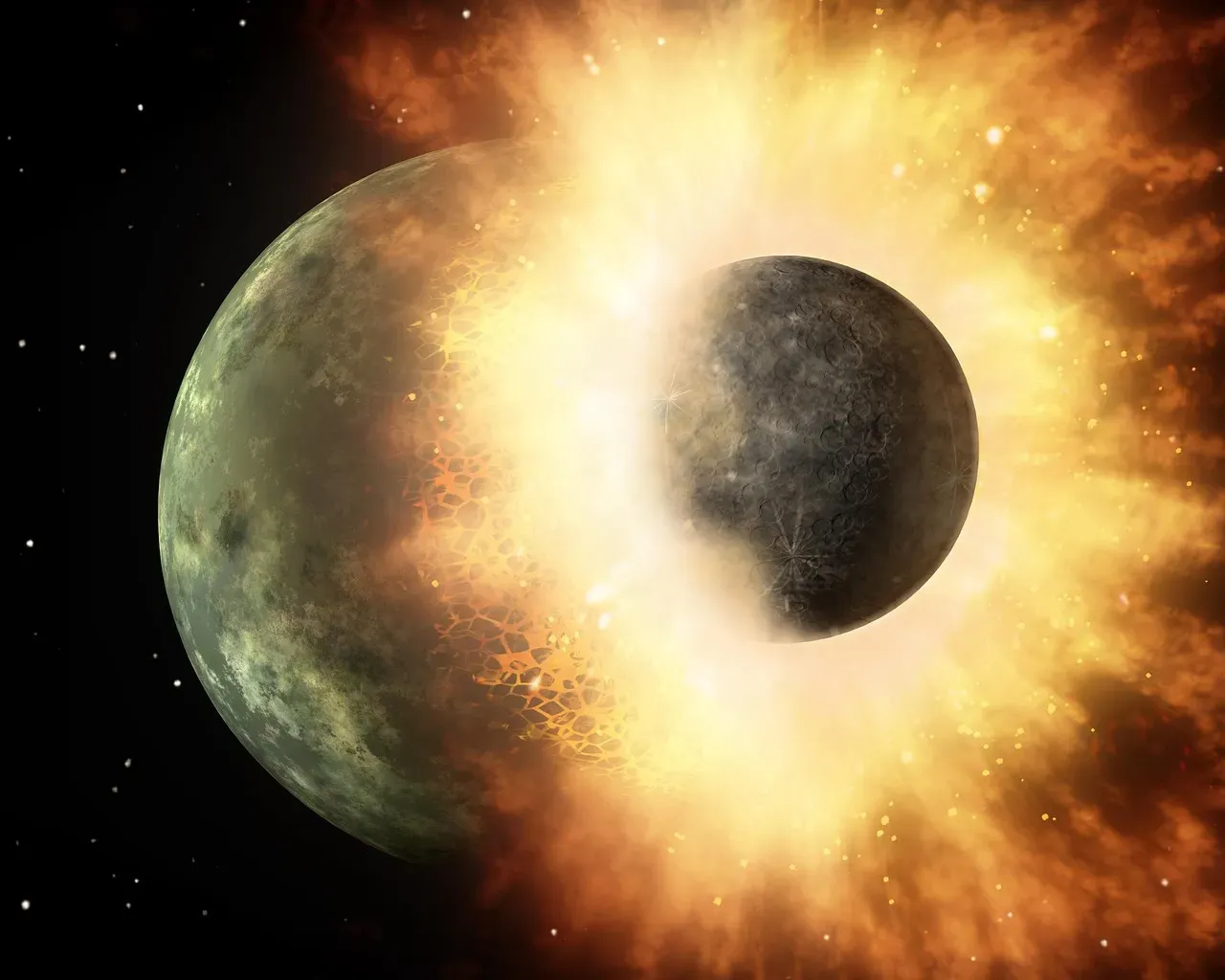
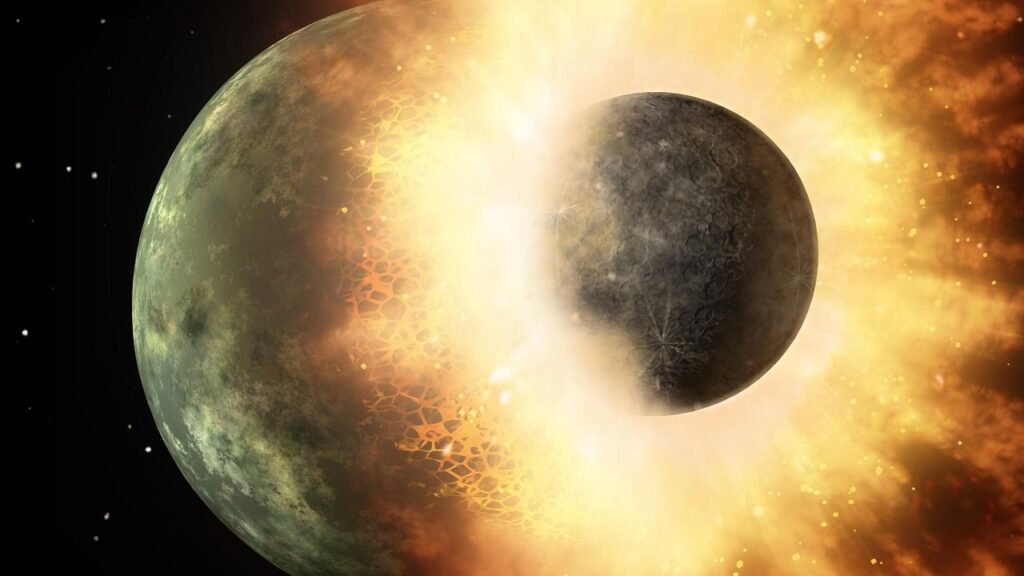
One of the strongest clues that something huge disrupted our system is already baked into the story of our own planet. The leading explanation for the Moon’s origin is that a Mars‑sized object slammed into the early Earth more than four billion years ago, ejecting a halo of molten rock that eventually clumped together into the Moon. That’s not a gentle event; it’s the kind of hit that can melt crust, change tilt, and reset a world’s entire future. And Earth wasn’t the only victim of such violence.
Mercury’s oversized iron core suggests it may once have been a larger planet stripped of much of its outer rock by a titanic collision. Uranus’s extreme sideways tilt almost begs for a story where a massive impact knocked it over in slow motion. These examples hint that the solar system’s early days were crowded with large planetary embryos smashing into one another. If a single collision can remake a planet, imagine what a chain of such events, or a badly timed arrival of one more giant body, could have done to the entire architecture of the system.
The Nice Model: A Late Gravitational Meltdown
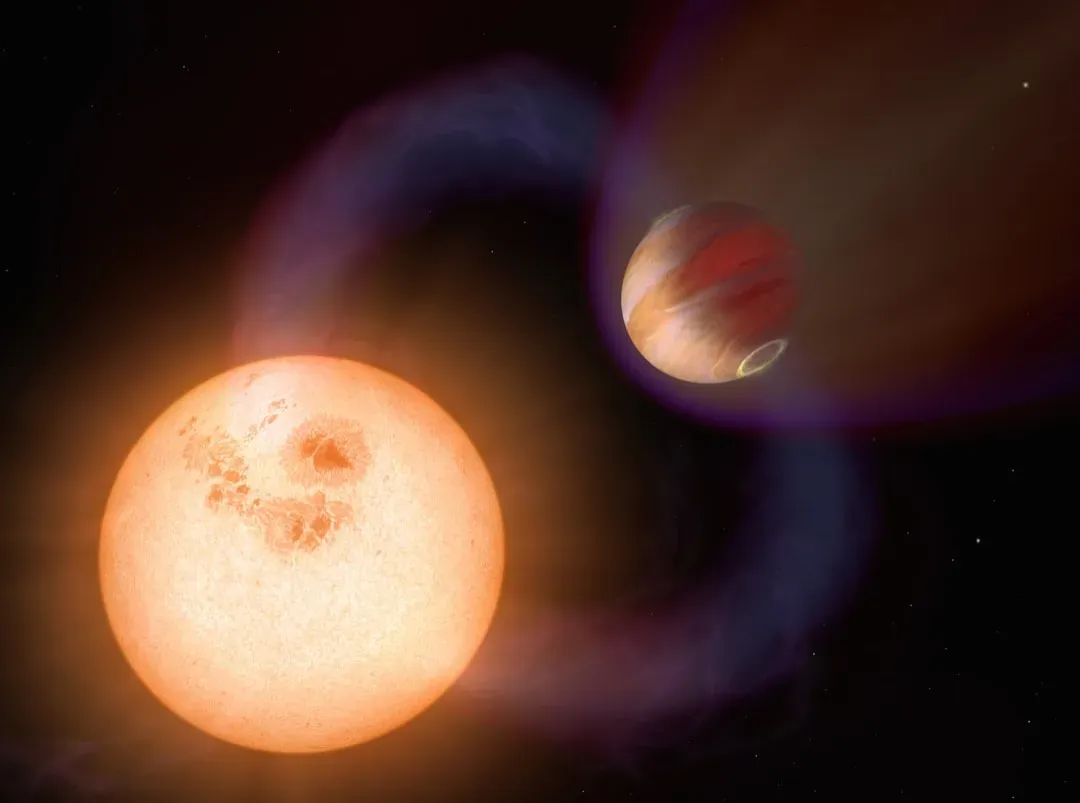
To explain why the giant planets sit where they do and why we have belts of rocky and icy debris scattered around the Sun, many scientists use what’s known as the Nice model (named after the city in France). In this scenario, the giant planets – Jupiter, Saturn, Uranus, and Neptune – didn’t form where we see them now. Instead, they slowly migrated, pulled by countless interactions with swarms of smaller bodies. Then, at some point, the whole configuration hit a tipping point and went temporarily insane.
According to this model and its later refinements, there was a phase when the outer planets likely scattered violently, swapping positions and flinging huge numbers of icy bodies inward and outward. This could have destabilized orbits and even ejected at least one ice giant from the solar system entirely. For a while, space near the Sun would’ve been bombarded with incoming debris, which might line up with periods of heavy cratering on the Moon and potentially with some of Earth’s own early disasters. The solar system we know today may be what’s left after that gravitational meltdown finally cooled down.
Planet Nine and the Mystery of Strange Orbits
Out beyond Neptune, far past the familiar planets, lie small icy worlds whose orbits behave in strange and lopsided ways. A cluster of these distant objects follows elongated paths that seem oddly aligned, as if something heavy were tugging on them from the dark. Some researchers suspect the culprit could be a hidden super‑Earth or mini‑Neptune, often called Planet Nine, lurking in the outer solar system. If that planet exists, it would be a prime candidate for a massive disruptor.
Simulations suggest such a planet could have been scattered to the outer reaches long ago, perhaps during the same unstable phase that shuffled Jupiter and the other giants. Its gravity would still be shaping orbits today, subtly warping the solar system’s edges like an unseen hand moving pieces on a board. Others argue that the odd orbits could arise from the combined gravitational pull of many smaller objects instead of one big one. Either way, the fact that the outer solar system looks so irregular hints that something – single or collective – has been stirring the pot for a very long time.
Stars, Flybys, And The Sun’s Shaky Childhood
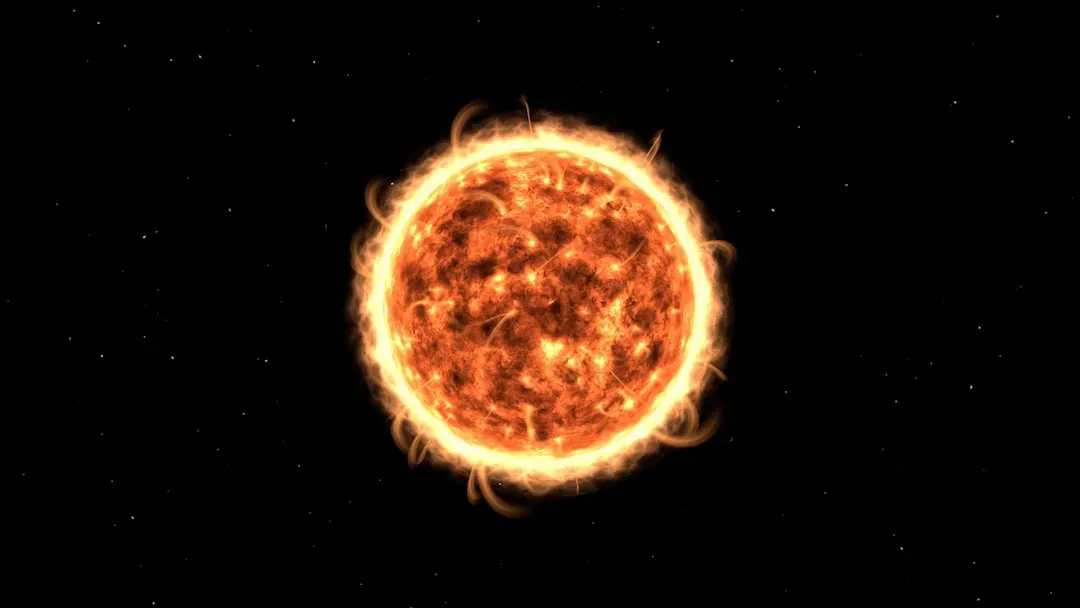
The Sun likely formed in a stellar nursery crowded with other newborn stars, not alone in empty space. In such environments, stars can pass relatively close to one another on astronomical scales, with their gravity nudging surrounding disks and planets. A nearby flyby from another star, even one far outside Pluto’s orbit, could be enough to tilt or stretch distant orbits, truncate the outer disk, or disturb comets in a way that leaves fingerprints for billions of years. It wouldn’t feel like a crash from our point of view, but the gravitational consequences could be enormous.
Some models show that a well‑timed stellar encounter early in the solar system’s history might help explain why our system’s outer edge seems so sharply defined and why certain distant objects follow such extreme paths. On longer timescales, as the Sun orbits the center of the Milky Way, it passes through denser and thinner regions of gas, dust, and stars. These galactic tides and occasional stellar neighbors can jostle the distant Oort Cloud, possibly triggering waves of comets that head inward toward the inner planets. In this way, even the broader galaxy may have taken a turn disrupting our cosmic backyard.
Extinctions, Craters, And Earth’s Dangerous Sky
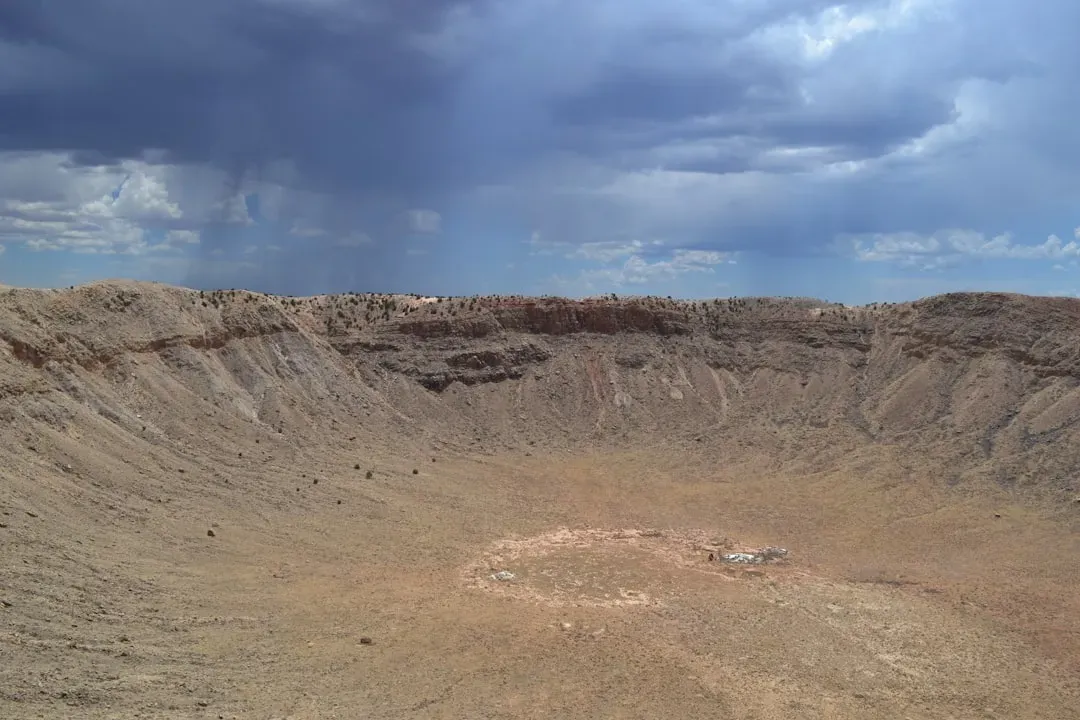
When scientists map out large impact craters on Earth and compare them with geological records, a pattern begins to emerge: mass extinctions and major impacts often seem to arrive in clusters rather than in completely random isolation. There have been debates about whether these clusters happen at roughly repeating intervals, perhaps tied to the Sun’s motion through the galaxy or to periodic disturbances in the Oort Cloud sending more comets our way. While the details are contested, nobody doubts that Earth’s biological history has been punched repeatedly by space rocks.
The dinosaur‑ending impact about sixty‑six million years ago is the most famous, but it’s only one part of a much longer story. Some researchers explore whether large‑scale shifts in the solar system’s architecture – like early planet migrations or late surges of cometary bombardment – could have set the stage for multiple eras of heightened risk. From this angle, Earth’s history looks like a dialogue between geology and astronomy: continents drift, volcanoes erupt, and above all, the shifting gravity of a restless solar system occasionally turns the sky into a weapon. Life survives, adapts, and diversifies, but always under the shadow of what space might throw at us next.
The New Telescopes Hunting For Fossils In Space
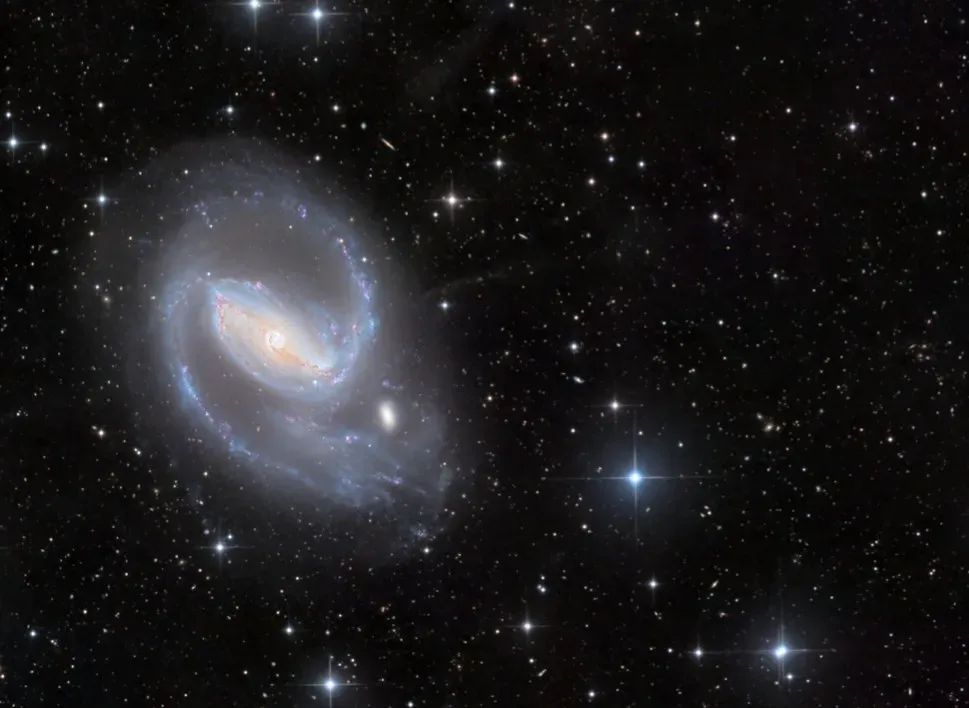
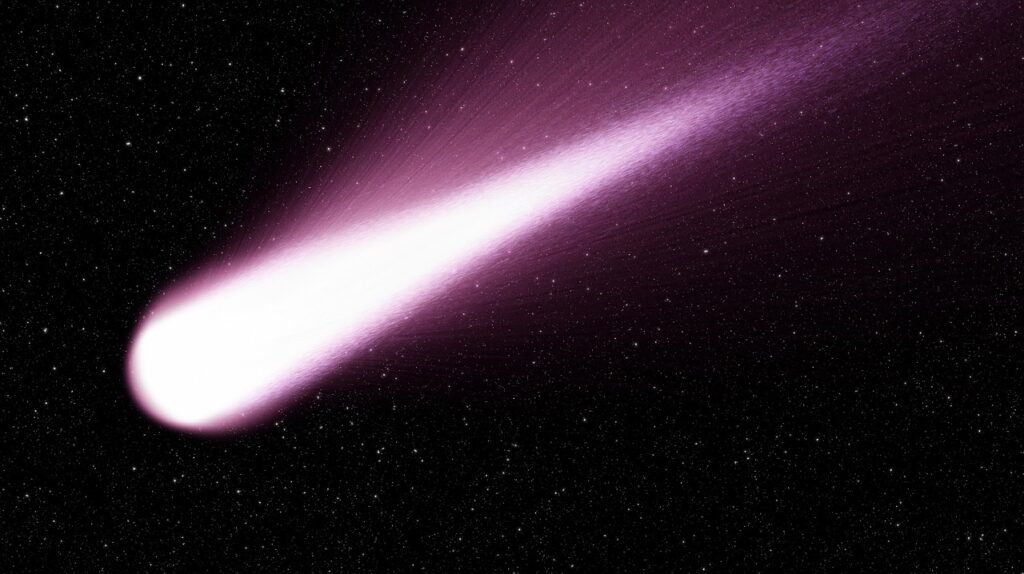
In the last few years, new and upcoming observatories have changed how we search for the solar system’s buried past. Powerful surveys scan the sky night after night, tracking faint, distant objects whose orbits hold clues to past disruptions. Instruments that can see in infrared and other wavelengths reveal dusty debris, comet tails, and subtle structures in the asteroid belt and beyond. Each newly discovered object is like a fossil, preserving a tiny piece of the gravitational story that shaped its path.
At the same time, studying other planetary systems around distant stars lets scientists compare our home with a much wider sample. Astronomers routinely see young systems where giant planets migrate, disks are torn apart, and debris rings show signs of violent reshaping. Some stars clearly bear the scars of engulfed planets or recent collisions. By placing the solar system in this broader context, researchers can test whether our past disruptions were unusual or just one more variation on a common cosmic theme. In many ways, the universe is showing us that chaos is not the exception; it might be the rule.
A Calm System With A Chaotic Past
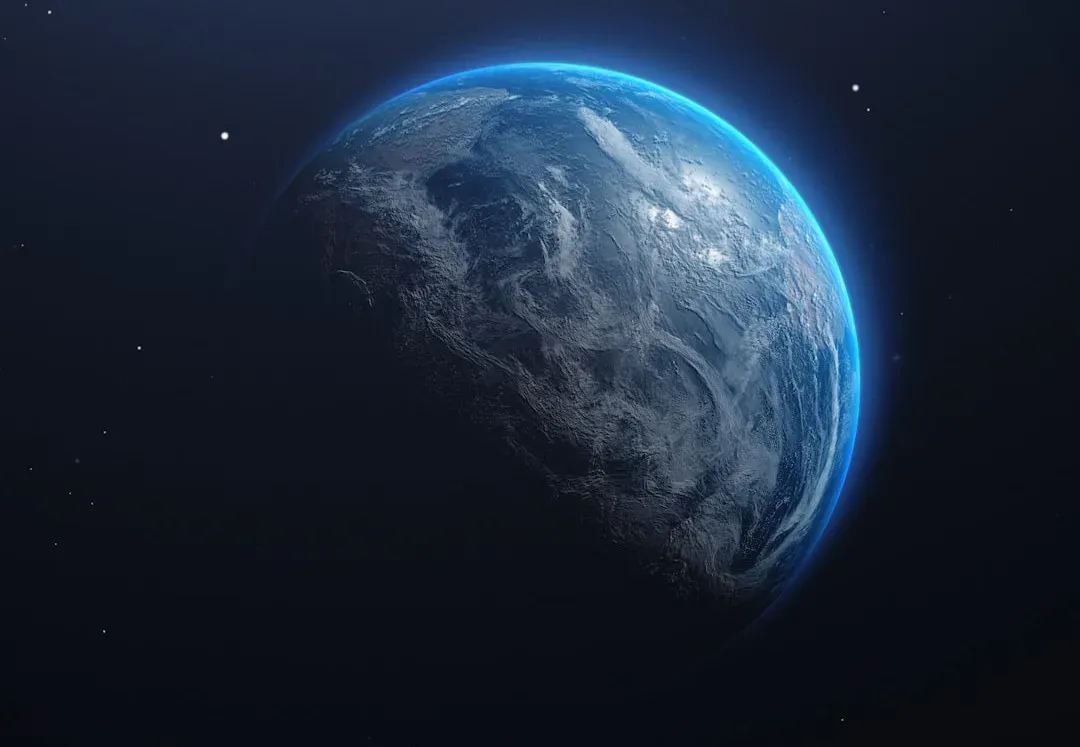
Today’s solar system looks stable enough that we can launch spacecraft, predict eclipses centuries ahead, and trust that Earth’s orbit won’t suddenly go wild. But beneath that calm surface lies a record of giant impacts, migrating planets, possible ejected worlds, stellar flybys, and distant gravitational tugs that may still be unfolding. The idea that something huge once disrupted our solar system isn’t just a wild guess; it’s a way of connecting scattered clues into a coherent, if still incomplete, narrative. Our planets’ tilts, the scars on their surfaces, and the strange behavior of distant icy objects all point to a more dramatic history than we were first taught.
As new telescopes map the sky and fresh simulations rewind and replay the solar system’s early days, we may get closer to identifying the culprits behind that ancient disruption – whether it was a hidden giant planet, a rogue star’s close pass, internal instability, or some combination of all of them. In the end, the most unsettling realization might be that our own existence is tied to that chaos: without collisions, migrations, and reshuffling, Earth and its life could have turned out very differently, or not at all. When you look up at the night sky now, does it feel more like a peaceful ceiling or the quiet aftermath of a storm you never knew had happened?