
Something passed through our cosmic neighborhood a long time ago, and it left a mess. Not the kind you can sweep under a rug, but the kind that reshapes planetary orbits, flings icy bodies into chaos, and leaves scientists scratching their heads for decades trying to explain why the outer solar system looks so oddly scrambled. The clues were hiding in plain sight, scattered across the edges of our solar system like breadcrumbs from a very violent picnic.
What researchers have uncovered is both thrilling and slightly unsettling. The architecture of our solar system, something most of us assume has always been stable and predictable, may have been violently disrupted by a passing star. The implications reach far beyond astronomy textbooks. Let’s dive in.
The Outer Solar System Has Always Been a Little Too Weird
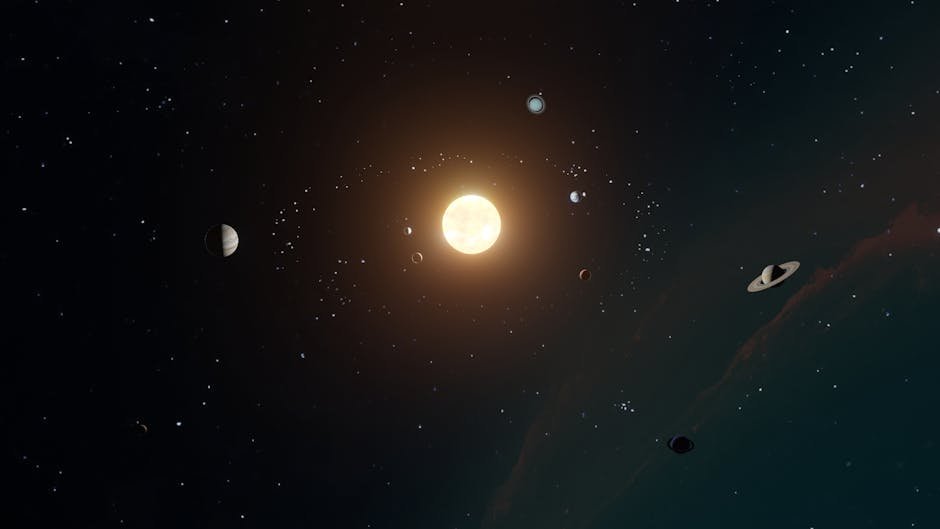
Here’s the thing: for years, planetary scientists noticed that the orbits of distant objects in the outer solar system just didn’t add up. The Kuiper Belt, that sprawling ring of icy debris beyond Neptune, contains objects moving in ways that standard solar system formation models simply cannot explain on their own. It’s like finding furniture rearranged in a locked room.
Some of these objects have orbits that are oddly elongated, tilted at strange angles, or clustered together in ways that suggest something external once pushed them around. For a long time, the leading theory was the presence of an undiscovered planet, the so-called Planet Nine. Honestly, that explanation always felt a bit too convenient. New research points toward something far more dramatic and, in a strange way, more satisfying.
Enter the Rogue Star Theory
A study published in early 2024 put forward a compelling case that a rogue star, a star not gravitationally bound to any solar system, passed relatively close to our own Sun hundreds of millions of years ago. Close in astronomical terms doesn’t mean next-door-neighbor close. We’re talking about a distance that still kept it far beyond the planets we know, but near enough to exert a meaningful gravitational tug on the outermost regions of our solar system.
Think of it like a large truck driving past a row of bicycles parked on a sidewalk. The truck doesn’t hit any of them, but the air pressure and vibration alone can topple a few. That’s roughly the kind of gravitational disturbance researchers believe this stellar intruder caused. The effects weren’t immediate or catastrophic in an explosive sense. They were subtle, long-lasting, and deeply etched into the structure of the outer solar system we observe today.
What the Computer Simulations Revealed
To test this theory, researchers ran detailed computer simulations modeling how a nearby stellar flyby would affect the distribution of objects in the outer solar system. The results were striking. When a star passed at the right distance and angle, the simulations reproduced the observed clustering of distant Kuiper Belt objects with remarkable accuracy.
This is significant because reproducing observational data through independent modeling is one of the strongest forms of scientific validation available. The simulations didn’t just vaguely match the data. They matched the specific orbital signatures that had puzzled astronomers for so long. I think what makes this particularly exciting is that it reduces the need to invoke an unseen, undetected Planet Nine to explain the anomalies. A one-time stellar visitor could account for much of what we see.
The Oort Cloud Got Hit the Hardest
If the Kuiper Belt took a nudge, the Oort Cloud, that vast, spherical shell of icy bodies surrounding our solar system at truly enormous distances, took a full-on shove. The Oort Cloud is so far from the Sun that even a relatively distant stellar flyby could dramatically alter the trajectories of objects sitting out there in gravitational near-silence.
Researchers believe the passing star may have stripped away or significantly disturbed a portion of the Oort Cloud, sending some objects flying into interstellar space and redirecting others on long, looping paths that occasionally bring them close to the inner solar system as long-period comets. This could explain why we sometimes see comets arriving from unexpected directions, with orbital histories that seem disconnected from the neat structure of the solar system closer to home. It’s a genuinely strange thought, that the comets occasionally lighting up our night sky may carry the fingerprints of a star that visited billions of years ago.
Could This Explain the Planet Nine Mystery?
The Planet Nine hypothesis has been floating around since roughly 2016, when Caltech astronomers Konstantin Batygin and Mike Brown proposed that a large, unseen planet far beyond Neptune was responsible for the gravitational clustering of distant Kuiper Belt objects. The idea captured enormous public imagination. Let’s be real, who doesn’t want there to be a secret ninth planet lurking in the dark?
The rogue star theory doesn’t entirely kill the Planet Nine idea, but it does offer a competing explanation that requires no undiscovered planet at all. If a passing star could produce the same gravitational signatures, then perhaps we’ve been searching for a ghost that doesn’t exist. It’s hard to say for sure, because the evidence is indirect either way. Still, the elegance of a single stellar flyby explaining multiple anomalies at once is scientifically appealing in a way that’s difficult to dismiss.
How Long Ago Did This Actually Happen?
Pinpointing the exact timing of a stellar flyby that occurred in the deep past is genuinely difficult, and researchers acknowledge this openly. Current estimates place the event somewhere in the range of tens to hundreds of millions of years ago, though some models allow for even earlier timeframes reaching back into the first billion years of the solar system’s history.
The challenge is that gravitational effects on the outer solar system evolve slowly and can be partially obscured by other influences over geological timescales. Tracing the precise moment a star passed by is a bit like trying to figure out exactly when a stone was thrown into a pond by studying the ripples on the shore an hour later. The ripples are real, the stone was definitely thrown, but the exact moment is somewhat blurred. Researchers are continuing to refine their models with new observational data from telescopes like the Vera C. Rubin Observatory, which is expected to dramatically expand our catalog of outer solar system objects in the coming years.
What This Means for Our Understanding of Earth’s History
It’s tempting to think of stellar flybys as purely an astronomical curiosity, something that affects icy rocks billions of miles away and has nothing to do with life down here on Earth. That assumption may be wrong. A disrupted Oort Cloud could increase the frequency of long-period comets entering the inner solar system, and an uptick in comet impacts has been linked by some researchers to mass extinction events in Earth’s geological record.
The connection is not firmly established, and scientists are careful not to overclaim. However, the possibility that a passing star indirectly influenced life on Earth by reshuffling the trajectories of distant icy bodies is the kind of idea that makes you stare at the ceiling at night. Our planet’s story, it turns out, may have been written not just by its geology and biology, but by a stranger that passed through our cosmic neighborhood and never stopped to say hello.
Conclusion: The Universe Is a Far Less Stable Place Than We Imagined
What this research ultimately tells us is that the solar system we live in is not a pristine, undisturbed clockwork mechanism ticking along in isolation. It has scars. It has a history of disruption, and the evidence for that disruption is quietly encoded in the orbits of distant ice and rock that most people will never see or think about.
I find that strangely humbling. We tend to think of space as static, as a backdrop rather than an active participant in our story. The rogue star theory challenges that comfort. The cosmos has bumped into us before, and statistically speaking, it will again. The question isn’t really whether our solar system has been disturbed. It’s how many times, and what each disturbance set in motion.
What do you think, does the idea of a rogue star reshaping our cosmic neighborhood change the way you see the night sky? Drop your thoughts in the comments below.