
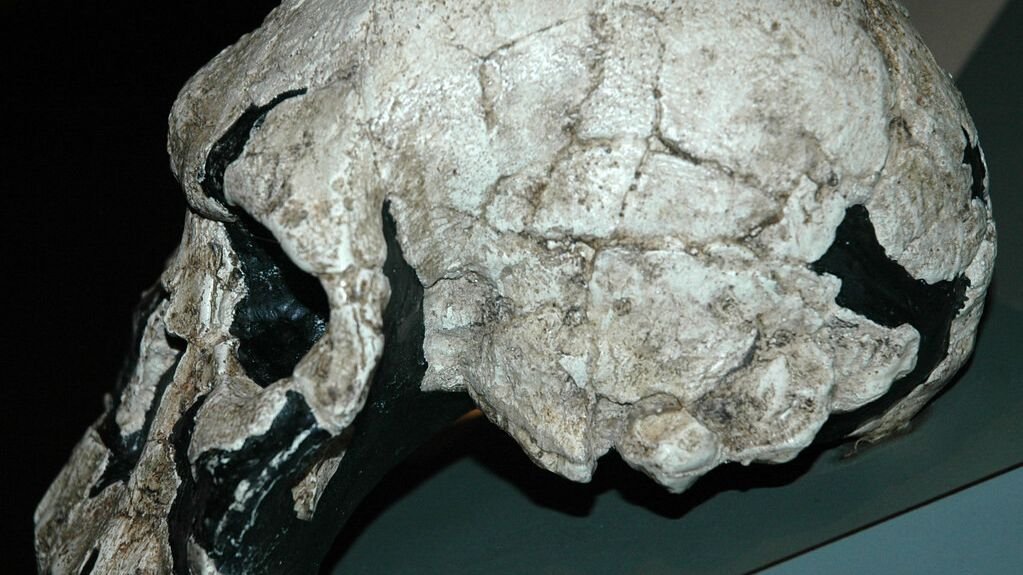

Few questions in science cut as deep as this one: what does it actually mean to be human? It sounds philosophical, almost poetic. Honestly, though, it’s one of the most fiercely debated topics in paleoanthropology, and the answer keeps shifting every time researchers dig something new out of the ground.
At the center of this debate stands a small, ancient creature that has carried the title of “earliest human” for decades. Its name is Homo habilis, which translates roughly to “handy man.” The more scientists study it, the less certain they are that it deserves to sit in our family tree at all. Let’s dive in.
A Discovery That Changed Everything We Thought We Knew
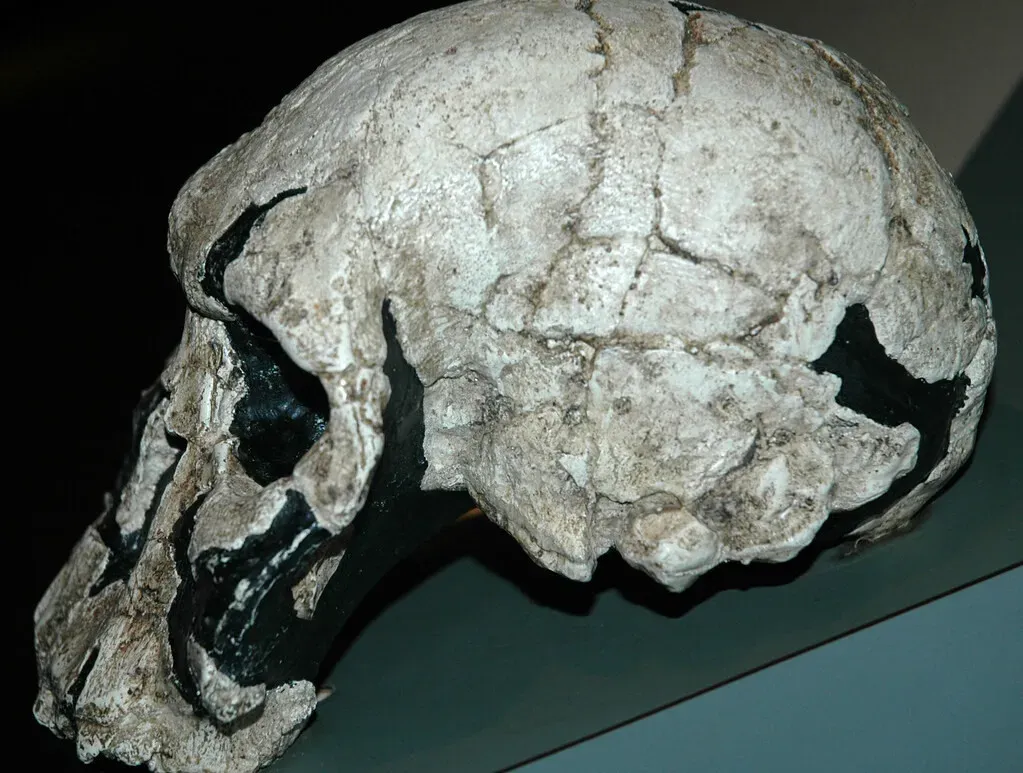
Picture this: it’s 1960, and the Olduvai Gorge in Tanzania is baking under the African sun. A young Jonathan Leakey, son of the legendary Louis and Mary Leakey, uncovers fragments of a jaw and skull that don’t quite match anything previously found. The bones are roughly 1.8 million years old, and they belong to a creature that seems to straddle two worlds simultaneously.
Louis Leakey, along with Philip Tobias and John Napier, formally named the species Homo habilis in 1964. They believed these fossils represented the first true member of our genus, Homo, based largely on the assumption that this creature had made the primitive stone tools scattered across the gorge. That link between toolmaking and humanity felt obvious at the time.
Here’s the thing though: the debate over whether Homo habilis truly belongs in the genus Homo started almost immediately and has never really stopped. Some researchers at the time thought the placement was premature, even reckless. The argument has only intensified since.
The Brain, The Body, and the Blurry Line
One of the main reasons Homo habilis was placed in the Homo genus was its brain size. Its cranial capacity was noticeably larger than that of the australopiths, the earlier ape-like ancestors that walked upright but retained many primate features. This bigger brain seemed like a meaningful leap forward, a kind of cognitive upgrade that separated it from the past.
The problem is that the body told a completely different story. Homo habilis had long arms relative to its legs, small stature, and curved finger bones that suggest it likely still spent significant time climbing in trees. Think of it less like a proto-human and more like an australopith with a slightly bigger head. That’s a harsh comparison, but it’s not an unfair one.
The mosaic of features makes classification genuinely hard. It possessed traits from two very different evolutionary worlds, and scientists are still arguing about which world it truly belonged to.
Was “Handy Man” Actually the Toolmaker?
The name “handy man” wasn’t chosen randomly. When Homo habilis was identified, the Olduvai Gorge was littered with what are known as Oldowan tools, the oldest recognizable stone tool technology on record, dating back as far as roughly 2.6 million years. The logical assumption was that the creature found near those tools must have made them.
It’s a reasonable assumption, but assumptions have a way of crumbling in archaeology. More recent discoveries have complicated this picture significantly. Fossils attributed to australopiths and other non-Homo species have been found in association with similar tools, raising the uncomfortable possibility that toolmaking was not the exclusive domain of our genus at all.
If Homo habilis wasn’t the sole toolmaker, then a large part of the justification for calling it human starts to wobble. It’s a bit like finding out the person you gave the award to wasn’t the one who did the work.
A Species in Chaos: The Classification Problem
Let’s be real: the fossil record for Homo habilis is a mess. Specimens attributed to the species vary so wildly in size, shape, and structure that some researchers have argued we are actually looking at two or more entirely different species lumped under one name. This isn’t a minor technical quibble. It strikes at the heart of what this creature even was.
Some scientists proposed splitting the group, placing smaller specimens into a separate species called Homo rudolfensis, named after fossils found near Lake Rudolf (now Lake Turkana) in Kenya. That split has never been universally accepted either, and the debate continues with remarkable intensity. Honestly, the more you read about it, the more it feels like everyone is arguing about whether to call the same blurry photograph a cat or a dog.
The variation seen in Homo habilis fossils is so extreme that if similar variation were observed in a living primate population today, biologists would almost certainly classify those individuals as separate species without hesitation.
The Australopith Problem: Too Primitive to Be Called Human?
The australopiths, creatures like the famous Australopithecus afarensis (the species that includes the iconic “Lucy” fossil), are generally considered our pre-human ancestors. They walked upright but had small brains, ape-like facial features, and spent time both on the ground and in the trees. They are not classified as Homo. The question that haunts the study of Homo habilis is this: how different was it, really?
Several analyses of its skeletal anatomy have concluded that Homo habilis was far more australopith-like than human-like. Its wrist structure, its shoulder anatomy, the proportions of its limbs all point to an animal still deeply adapted to an arboreal lifestyle. That’s not what we typically picture when we say “human.”
Some researchers have gone as far as suggesting that Homo habilis should be removed from the Homo genus entirely and reclassified as an australopith. That would be a seismic shift in how we understand human origins and would push the origin of true humanity forward in time by hundreds of thousands of years.
What Genetics and New Technology Are Revealing
Unfortunately, direct genetic analysis of Homo habilis remains out of reach. DNA simply does not survive for nearly two million years under the conditions these fossils have endured, particularly in the warm, humid environments of sub-Saharan Africa. That’s a frustrating limitation, because genomic data has been revolutionary in clarifying relationships between more recent species like Neanderthals and modern humans.
What researchers do have is increasingly sophisticated imaging technology and refined methods of morphological analysis. CT scanning of fossil skulls has allowed scientists to digitally reconstruct brain shapes and compare them with extraordinary detail. These studies have revealed that while the brain of Homo habilis was larger than its predecessors, its organization may have been less human-like than previously believed.
The technology keeps improving, and it’s likely that our understanding will shift again within the next decade. Every new fossil found in East Africa seems to add another layer of complexity rather than simplifying the picture. It’s hard to say for sure, but I think we are still very far from a final answer.
Why It Still Matters That We Can’t Decide
You might wonder why any of this matters beyond academic debate. After all, the creature has been dead for well over a million years. Here’s the thing: how we define humanity shapes how we understand ourselves, our origins, and even our relationship to other living species. The boundary we draw around the word “human” is not purely scientific. It carries deep philosophical and even ethical weight.
If Homo habilis is reclassified and removed from Homo, it forces us to ask where the real transition to humanity happened. It potentially pushes the origin of our genus forward significantly in time, to creatures like Homo erectus, which had a much more convincingly human anatomy. That changes the entire narrative of our species’ story.
I think the discomfort around this debate is itself revealing. We want a clear origin story. We want a definitive moment when “human” began. The fossil record, stubbornly and brilliantly, refuses to give us one so easily.
Where the Debate Stands Today
As of 2026, the scientific community remains genuinely divided. Many paleoanthropologists still accept Homo habilis as the earliest member of the Homo genus, largely out of convention and the sheer weight of decades of literature built on that classification. Others argue passionately that the evidence no longer supports keeping it there.
New fossils continue to emerge from East African sites like Olduvai Gorge, the Omo Valley in Ethiopia, and the shores of Lake Turkana in Kenya. Each discovery adds data, but also tends to deepen complexity rather than resolve it. The most recent analyses suggest a bushy, branching evolutionary tree rather than a clean, linear progression from ape to human.
What’s perhaps most striking is that a species named nearly sixty years ago, studied by generations of brilliant scientists, still resists a definitive answer. That says something profound about just how messy and marvelous the story of human evolution really is. What would you have guessed: that our earliest ancestor might not even count as human? Tell us in the comments.


