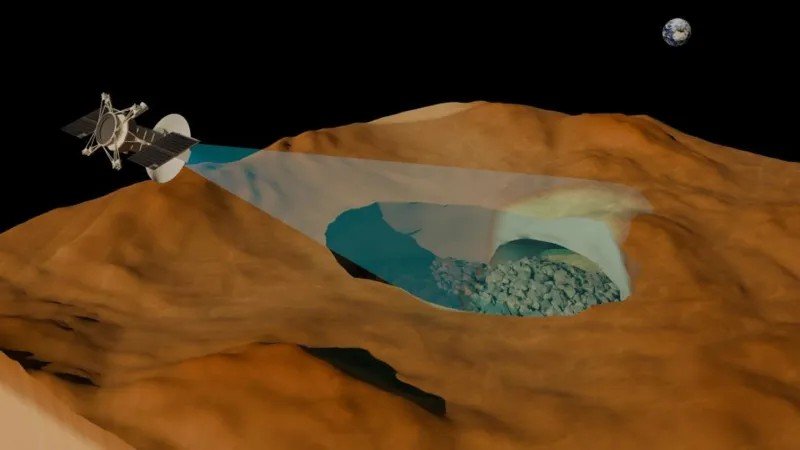
A Hidden Cavern Emerges from Decades-Old Data (Image Credits: Sciencenews.org)
Venus – Planetary scientists uncovered the first confirmed subsurface lava tube on the planet’s scorching surface through a fresh analysis of radar data from NASA’s Magellan spacecraft.[1][2]
A Hidden Cavern Emerges from Decades-Old Data
The revelation came when researchers at Italy’s University of Trento applied advanced radar imaging techniques to Magellan mission images captured between 1990 and 1992. Those scans mapped 98 percent of Venus’ cloud-shrouded terrain using synthetic aperture radar.[1] Distinct patterns – a deep shadow paired with an asymmetric bright return – signaled a collapsed roof, or skylight, exposing an underground void.
This feature stood out amid pit chains on the western flank of Nyx Mons, a shield volcano spanning 362 kilometers across. The team identified radar signals penetrating at least 300 meters into the conduit before fading, confirming an open cavity.[3] Such signatures matched known lava tube skylights on Earth, bolstering the interpretation.
Dimensions That Dwarf Earthly Counterparts
The skylight measured roughly 1,545 meters by 1,070 meters, with a collapse depth estimated at 450 meters. Inside, the conduit averaged 938 meters wide, with a roof at least 150 meters thick and an empty void extending no less than 375 meters high.[1]
Researchers noted the structure’s scale exceeded typical terrestrial examples. The surrounding collapse chain hinted at a subsurface network stretching up to 45 kilometers, though only a portion near the skylight received direct confirmation.[3]
- Skylight size: 1,545 m × 1,070 m
- Average conduit width: 938 m
- Roof thickness: ≥150 m
- Void height: ≥375 m
- Visible extension: ≥300 m
- Potential full length: 45 km
Venus Stands Apart in Solar System Volcanism
Unlike Earth, where lava tubes rarely surpass tens of meters wide, Venus’ lower gravity and denser atmosphere fostered larger formations from low-viscosity basaltic flows. The newly detected pyroduct aligned with predictions for Venus’ expansive lava channels.[1]
Comparisons highlighted its uniqueness. Lunar pits reached similar sizes, but Martian volumes fell orders of magnitude smaller, while Earth’s Corona tube system spanned just 7.6 kilometers long and 28 meters wide at most.[1]
| World | Typical Width | Example Volume (m³) |
|---|---|---|
| Venus | ~1 km | 7.56 × 10⁵ |
| Earth | 10-30 m | 101-102 |
| Mars | Smaller | ~104 |
| Moon | Up to ~1 km | Comparable |
Paving the Way for Future Probes
The find validated long-held theories about Venus’ intense volcanism, which reshaped its surface without clear plate tectonics. Lead researcher Lorenzo Bruzzone noted, “Our analyses reveal the existence of a large and open subsurface conduit in the Nyx Mons region. This feature is hypothesized to be a pyroduct, characterized by a diameter of about 1 km, a roof thickness of at least 150 m and an empty void height of no less than 375 m.”[1]
Upcoming missions will build on this. NASA’s VERITAS and ESA’s EnVision, both slated for launch by 2031, carry higher-resolution radars to hunt more tubes and probe deeper.[2] These could reveal networks shielding against Venus’ hellish conditions – pressures 93 times Earth’s and temperatures melting lead.
Key Takeaways
- First direct radar evidence of a Venusian lava tube, larger than most solar system analogs.
- Revives 30-year-old Magellan data with modern techniques.
- Boosts prospects for EnVision and VERITAS to map subsurface geology.
This discovery underscores Venus’ volcanic legacy and invites deeper scrutiny of our neighboring world’s buried secrets. What potential do these caves hold for unraveling planetary formation? Share your thoughts in the comments.