Since its discovery in July 2025 as it sped through our solar system at interstellar velocities, the object known as 3I/ATLAS has ignited both scientific curiosity and wild speculation about its origins — from natural comet to hypothetical alien probe. But recent deep scanning for technosignatures, part of an international effort to test whether the visitor broadcasts artificial signals, delivered a clear result: no signs of extraterrestrial technology have been detected.
Astronomers emphasize that while the lack of alien signals may disappoint those hoping for cosmic company, the data instead reinforces the object’s classification as a natural interstellar comet and highlights how rare and valuable such visitors are for understanding the broader galaxy.
A Rare Interstellar Visitor Under Scrutiny
3I/ATLAS is only the third confirmed interstellar object observed passing through our solar system, after 1I/‘Oumuamua and 2I/Borisov, making it a once-in-a-generation opportunity for direct study of material from beyond our star’s gravitational influence. Detected on July 1, 2025, the object passed within approximately 167 million miles (1.7 AU) of Earth on December 19, drawing unprecedented attention.
Its high inbound speed, unusual trajectory and bright coma — a cloud of gas and dust surrounding its nucleus — prompted researchers across disciplines to monitor its behavior closely using optical telescopes and powerful radio instruments.
The Green Bank Telescope Listens for Signals
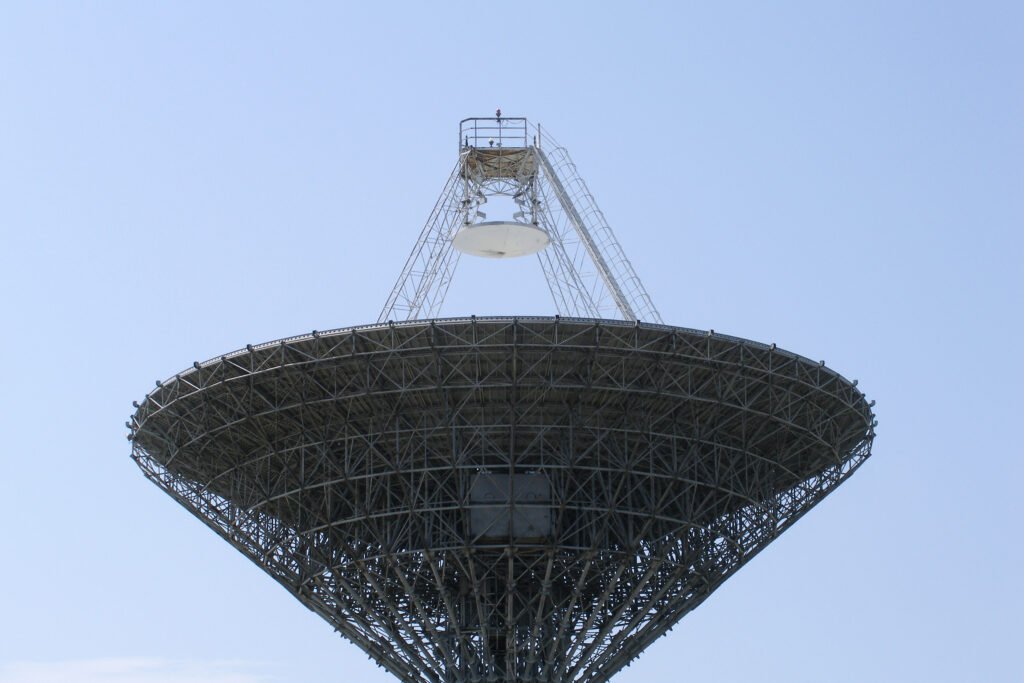
To test claims that 3I/ATLAS might be transmitting signs of intelligent origin, scientists with the Breakthrough Listen project pointed the Green Bank Telescope (GBT) — the world’s largest steerable radio telescope — at the object less than a day before its closest Earth approach. This search spanned 1–12 gigahertz, a range often used in the search for extraterrestrial communications.
Out of more than 471,000 initial detection candidates, careful analysis showed all would-be “events” were attributable to known terrestrial radio interference or background noise, with no isolated continuous signals emerging from the object’s direction. Researchers concluded there were no credible technosignatures above roughly the power of a small flashlight in these frequency bands coming from 3I/ATLAS.
Comet-Like Behavior Dominates Observations
Alongside the radio silence, multiwavelength observations from instruments like NASA’s space telescopes and ground-based observatories have shown that 3I/ATLAS behaves in ways consistent with typical cometary physics. Its coma — consisting of sublimated gas and dust — and other spectroscopic signals reflect volatile activity driven by solar heating rather than engineered emissions.
Independent detections of radio emissions from hydroxyl (OH) radicals — a byproduct of water ice sublimation — using archived and ongoing radio data further affirm a natural cometary origin, not alien technology, as the source of its signals.
The Scientific Community Responds to Speculation
Despite the nondetections, some researchers — most notably Harvard astrophysicist Avi Loeb — have continued to point out oddities in the object’s behavior, including its size, brightness fluctuations and trajectory nuances, arguing for careful, open-minded examination. Loeb has even suggested ranking the object’s potential artificiality on his own speculative “Loeb scale,” though most mainstream astronomers remain skeptical.
NASA and other space agencies have publicly emphasized that existing evidence supports a cometary classification, and that speculation about artificial origins, while scientifically allowable as a thought experiment, is not backed by data.
What 3I/ATLAS Still Teaches Us
Even if 3I/ATLAS turns out to be a completely natural visitor, its passage offers valuable insights into the diversity of planetary system formation across the galaxy. Interstellar objects bring with them compositions, structures and volatile inventories shaped by star systems far older and chemically distinct from our own.
Studying such bodies helps refine models of how materials are ejected from distant systems, how comets evolve in deep space, and how common interstellar visitors might be — knowledge that enriches our understanding of cosmic history and the processes that shape it.
Science Triumphs Over Speculation
The search for alien technosignatures in 3I/ATLAS ultimately came up empty — not for lack of trying, but because the best evidence still points to a natural comet. In an era where internet speculation often outpaces scientific consensus, this case is a reminder that extraordinary claims require extraordinary evidence.
Yet there is nothing disappointing about that conclusion. Instead, 3I/ATLAS illustrates the power of careful observation and rigorous analysis to distinguish between wishful thinking and genuine discovery. As astronomers gather more data on this object and future interstellar visitors, we deepen our grasp of the cosmos — not by chasing conjecture, but by celebrating the surprising richness of the natural universe.