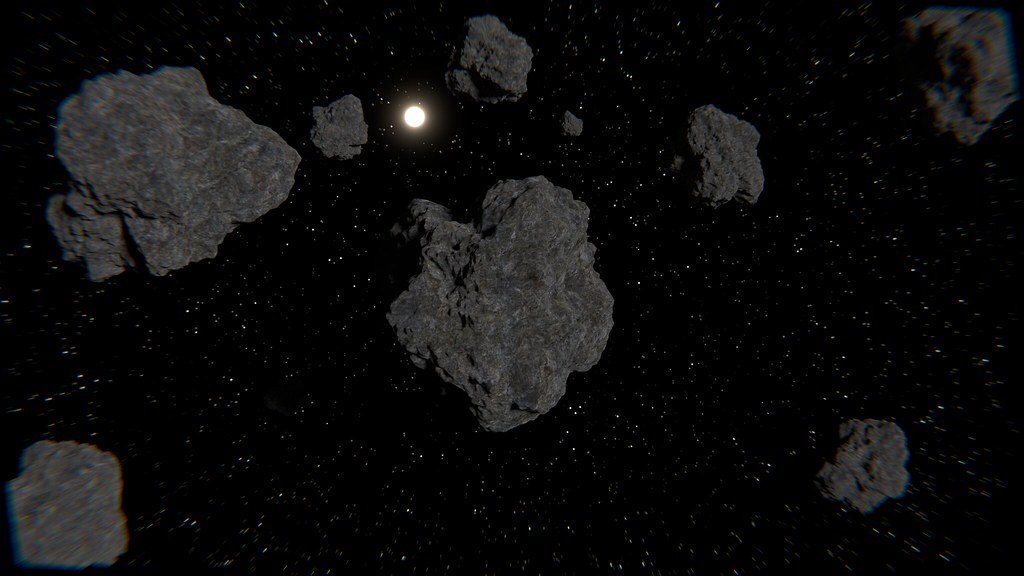
Pristine Samples Reveal Ancient Secrets (Image Credits: Flickr)
Japanese researchers uncovered a remarkable trove within samples from the asteroid Ryugu: all five nucleobases that form the foundation of DNA and RNA. This discovery, detailed in a study published on March 16, 2026, suggests these vital molecules originated in the depths of space billions of years ago.[1][2] The pristine material, returned to Earth in 2020, offers fresh evidence that asteroids could have seeded our planet with the chemistry needed for life.
Pristine Samples Reveal Ancient Secrets
A 4.5-billion-year-old fragment of the early solar system now holds clues to life’s beginnings. Scientists analyzed two tiny samples from Ryugu, a carbon-rich asteroid explored by Japan’s Hayabusa2 spacecraft. Each sample, weighing mere milligrams, came from separate touchdown sites during the 2019 mission.[1]
Handled in ultra-clean laboratories to prevent earthly contamination, the grains underwent extraction with water and hydrochloric acid. Advanced chemical techniques then confirmed the presence of the nucleobases in comparable quantities across both specimens. The Japan Aerospace Exploration Agency (JAXA) and the Japan Agency for Marine-Earth Science and Technology (JAMSTEC) curated the 5.4 grams of material returned in December 2020. This careful process ensured the findings reflected Ryugu’s original composition.[2][3]
What Are These Genetic Building Blocks?
Nucleobases serve as the “letters” in the genetic alphabet, pairing up to encode life’s instructions in DNA and RNA. The complete set includes two purines and three pyrimidines. Researchers identified them unequivocally, even detecting structural isomers that ruled out lab contamination.[4]
- Adenine (A): A purine essential for both DNA and RNA.
- Guanine (G): The other purine, pairing with cytosine.
- Cytosine (C): A pyrimidine found in DNA and RNA.
- Thymine (T): DNA-specific pyrimidine, pairing with adenine.
- Uracil (U): RNA’s version of thymine, pairing with adenine.
These molecules combine with sugars and phosphates to create nucleotides, the true monomers of genetic material. Their detection in Ryugu marks the first time all five appeared together in an asteroid sample analyzed under pristine conditions.[5]
Connecting to Earlier Cosmic Clues
Prior studies laid the groundwork for this revelation. In 2023, the same Ryugu samples yielded uracil, hinting at broader organic riches.[6] NASA’s OSIRIS-REx mission then reported all five nucleobases in Bennu samples in 2025, echoing Ryugu’s profile.
Meteorites provided earlier hints, though contamination concerns lingered. The Murchison meteorite, which fell in Australia in 1969, proved rich in purines, while the 1864 Orgueil meteorite from France favored pyrimidines. Variations in nucleobase ratios may stem from factors like ammonia levels in the asteroids’ formative environments.
| Asteroid/Meteorite | Key Nucleobases Noted | Sample Era |
|---|---|---|
| Ryugu | All five | 2020 return |
| Bennu | All five | 2025 analysis |
| Murchison | Purines dominant | 1969 fall |
| Orgueil | Pyrimidines dominant | 1864 fall |
This table highlights how Ryugu and Bennu stand out for their balanced, complete inventories.[1]
Bridging Space Chemistry to Earth’s Beginnings
The Ryugu findings strengthen the theory of panspermia, where asteroids bombarded early Earth with prebiotic molecules. Carbonaceous asteroids like Ryugu preserve solar system relics, showcasing diverse chemistries that could have sparked life’s emergence. The nucleobases’ extraterrestrial origin challenges purely terrestrial formation models.
Differences among samples underscore the early solar system’s chemical variety. Ammonia and other factors likely influenced nucleobase synthesis in these ancient bodies. As researchers noted in the Nature Astronomy paper, such discoveries illuminate how life’s ingredients spread across the cosmos.[2]
Future missions will probe deeper, but Ryugu’s haul already reshapes origin-of-life debates. For more details, see the original reporting on EarthSky.[1]
This cosmic connection reminds us that humanity’s story may trace back to the stars. What role did these space travelers play in making Earth habitable? The evidence points to a universe primed for biology.
Key Takeaways
- All five nucleobases – adenine, guanine, cytosine, thymine, uracil – appeared in Ryugu samples from 2020.
- The find supports asteroid delivery of life’s precursors to early Earth around 4.5 billion years ago.
- Pristine analysis confirms extraterrestrial origins, building on Bennu and meteorite data.
What do you think about these cosmic building blocks? Share your thoughts in the comments.