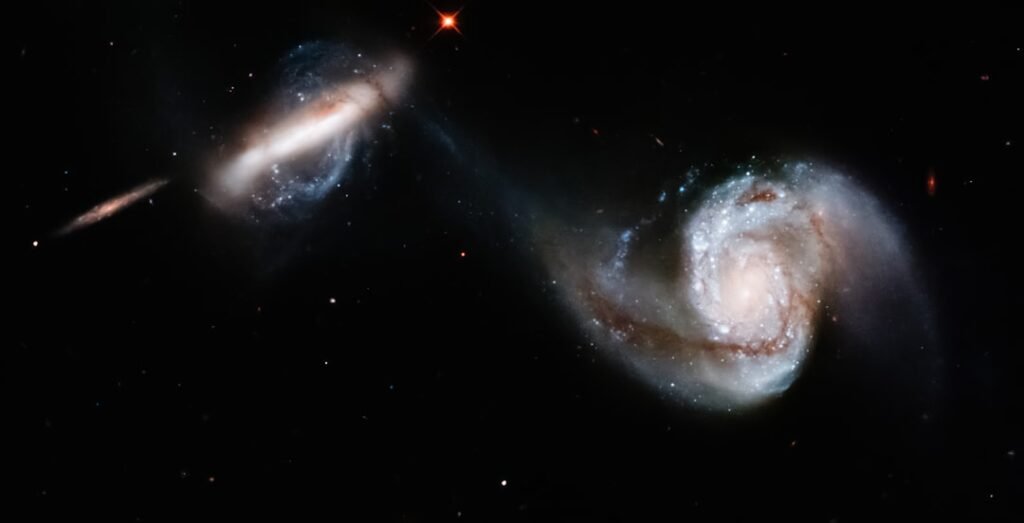

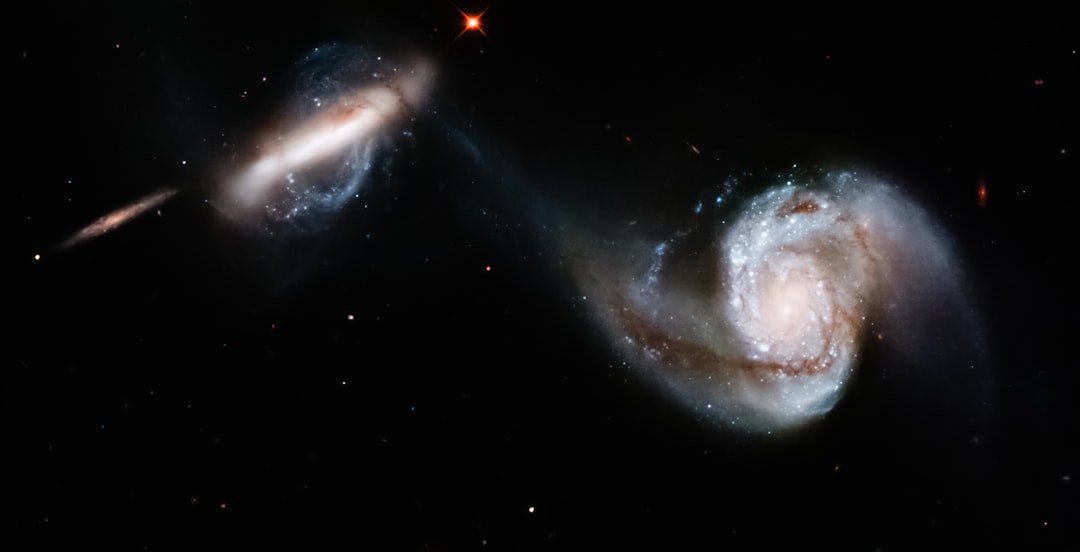
Spotting the Ghostly DF9 in a Faint Trail (Image Credits: Unsplash)
Astronomers have pinpointed a third galaxy in the NGC 1052 field that lacks dark matter, strengthening evidence for a rare formation process driven by high-speed collisions between dwarf galaxies. This ultra-diffuse galaxy, designated NGC 1052-DF9, aligns perfectly with two predecessors in a linear trail, suggesting they originated from the same violent event. The finding, reported in a recent preprint on arXiv, underscores dark matter’s tangible nature and reshapes understandings of galaxy evolution.[1]
Spotting the Ghostly DF9 in a Faint Trail
Researchers led by Michael A. Keim and Pieter van Dokkum from Yale University identified NGC 1052-DF9 through meticulous observations of faint, diffuse structures. This galaxy sits squarely between NGC 1052-DF2 and NGC 1052-DF4, completing a straight-line sequence of ultra-diffuse galaxies. Its stars orbit at velocities consistent with visible matter alone, showing no need for invisible dark matter to hold it together.[1]
The NGC 1052 field hosts these elusive objects, which are vast yet sparsely populated with stars. DF9’s position in the trail hints at a shared history, where disruptive forces stripped away dark matter halos. Telescopes like Hubble have previously verified distances to similar galaxies, ruling out measurement errors.[1]
From DF2 to DF9: A Growing Chain of Anomalies
The saga began in 2018 with NGC 1052-DF2, a galaxy roughly the size of the Milky Way but containing only about 200 million solar masses in stars – roughly 500 times fewer than expected. Pieter van Dokkum’s team first reported its dark matter deficiency, sparking debate. NGC 1052-DF4 followed, sharing DF2’s peculiar traits and linear alignment.[1]
Now DF9 joins them, forming an unmistakable pattern. These galaxies appear ghostly because their low stellar density lets background light pierce through. The trio’s configuration defies random chance, pointing to a coordinated origin event.
- NGC 1052-DF2: Discovered 2018, Milky Way-sized with minimal stars.
- NGC 1052-DF4: Confirmed similar properties, positioned in trail.
- NGC 1052-DF9: Latest find, fills gap between the two.[1]
Unpacking the Bullet Dwarf Collision Scenario
The “Bullet Dwarf” theory proposes that two gas-rich dwarf galaxies slammed into each other at thousands of kilometers per second. Dark matter, interacting solely through gravity, sails through unscathed while colliding gas clouds merge and ignite starbursts. This separation leaves behind dark matter-deprived remnants strung out in a trail.[1]
Such events mirror the famous Bullet Cluster on larger scales but occur among dwarfs. The process explains the observed linearity and shared deficiencies. Observations confirm Newtonian gravity suffices for their dynamics, without dark matter’s gravitational pull.
- Two dwarf galaxies approach at high velocity.
- Dark matter halos interpenetrate harmlessly.
- Normal matter collides, shocks, and forms stars.
- Star-forming clumps trail behind, dark matter-free.
Observational Clues Seal the Case
Spectroscopic data from ground-based telescopes measured DF9’s stellar velocities, matching predictions from visible mass alone. The galaxies’ faintness demands long exposures, but precision instruments revealed no dark matter signature. Hubble’s distance confirmations for DF2 dispelled early doubts about proximity effects.[1]
The linear tail formation stands as compelling evidence for a singular collision. Team members analyzed the NGC 1052 group’s dynamics, finding consistency with this model. Future kinematics for fainter trail members could extend the chain.
Challenging Alternatives, Affirming Dark Matter
This discovery undermines Modified Newtonian Dynamics (MOND), which eliminates dark matter by tweaking gravity laws. DF2’s initial report fueled MOND proponents, but the accumulating evidence favors physical separation. Dark matter emerges not as a mirage but a separable substance.[1]
The findings highlight the universe’s brutality in forging galaxies. Dwarf interactions, once overlooked, reveal extreme processes. For more details, see the arXiv preprint or the Phys.org coverage.[2]
Key Takeaways
- Three dark matter-free galaxies form a trail in NGC 1052, likely from one collision.
- Bullet Dwarf theory explains separation of normal and dark matter.
- Result supports dark matter’s existence over MOND alternatives.
These dark matter orphans illuminate the cosmos’s violent underbelly, proving that even invisible components play by physical rules. As observations probe deeper into the trail, more revelations may follow. What implications do you see for galaxy formation theories? Share your thoughts in the comments.