
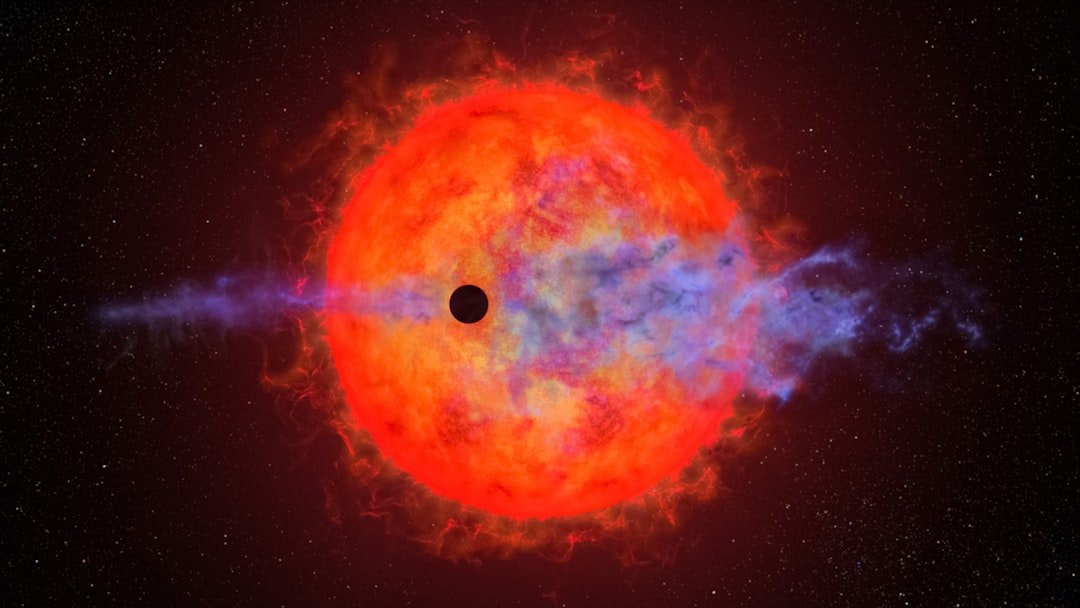
A Stellar Fossil Pushes Boundaries (Image Credits: Unsplash)
Astronomers recently pinpointed one of the most chemically primitive stars known, nestled within the ancient Pictor II ultra-faint dwarf galaxy. This stellar relic, designated PicII-503, harbors iron at levels less than one-fortiethousandth those found in the Sun, marking the lowest such abundance recorded in any ultra-faint dwarf galaxy.[1][2] The find illuminates how the universe’s earliest stars seeded their successors with vital heavy elements, reshaping cosmic chemistry in the aftermath of the Big Bang.
A Stellar Fossil Pushes Boundaries
Researchers described the detection of PicII-503 as teetering “at the edge of what we thought possible.”[1] This star stands out not just for its scarcity of iron but also for record-low calcium levels outside the Milky Way. Its carbon content, however, surges dramatically, boasting a carbon-to-iron ratio more than 1,500 times that of the Sun.
PicII-503 resides on the fringes of Pictor II, a relic galaxy over 10 billion years old that holds only a few thousand stars. Such ultra-faint dwarfs represent pristine snapshots of the early universe, largely untouched by later mergers or star formation bursts. The star’s composition flags it as a second-generation object, born from gas laced with debris from the first stars’ supernovae.
Unlike modern stars enriched by billions of years of stellar recycling, PicII-503 clings to a sparse palette of heavy elements. This purity allowed scientists to trace direct imprints from Population III stars, the universe’s inaugural heavy-element producers.
Tracing the Chemical Blueprint
The star’s elemental profile reveals a telling story. Iron and calcium appear in trace amounts, while lighter carbon dominates. These patterns suggest enrichment from low-energy supernovae, where heavier nuclei collapsed back into remnants, ejecting only lighter fare.
- Iron abundance: < 1/40,000th of the Sun’s
- Calcium: Lowest measured beyond Milky Way halo
- Carbon enhancement: C/Fe ratio > 1,500 solar
- Overall metallicity: Extreme metal-poor, [Fe/H] unprecedented in dwarf galaxies
Such signatures challenge models of pair-instability supernovae, which would have hurled metals beyond Pictor II’s weak gravity. Instead, gentler explosions kept enrichment local, fueling stars like PicII-503.[2]
| Element | Abundance Relative to Sun |
|---|---|
| Iron (Fe) | < 1/40,000 |
| Calcium (Ca) | Record low outside Milky Way |
| Carbon (C) | C/Fe > 1,500x |
From Survey to Spectacular Confirmation
The breakthrough stemmed from the DECam MAGIC survey, a 54-night campaign on the Víctor M. Blanco 4-meter Telescope at Cerro Tololo Inter-American Observatory. Specialized filters honed in on calcium absorption lines, sifting metal-poor candidates amid hundreds near Pictor II.
“Without data from MAGIC, it would have been impossible to isolate this star,” noted lead researcher Anirudh Chiti, Brinson Prize Fellow at Stanford University.[1] Follow-up spectroscopy on the Magellan/Baade Telescope and ESO’s Very Large Telescope sealed the analysis, quantifying abundances with precision.
Additional data from the Dark Energy Survey and ESA’s Gaia mission refined Pictor II’s structure. The team, spanning institutions like University of Chicago and NSF NOIRLab, published findings in Nature Astronomy on March 16, 2026.
Bridging Early Cosmos to Modern Galaxies
PicII-503 forges a vital link to carbon-enhanced metal-poor stars populating the Milky Way’s halo. These halo wanderers likely hail from ancient dwarfs like Pictor II, accreted over eons. The star validates theories tying such chemistry to first-star ejecta. “What excites me the most is that we have observed an outcome of the very initial element production in a primordial galaxy,” Chiti remarked. This primordial forging laid groundwork for complex chemistry, planets, and life.
Ultra-faint dwarfs like Pictor II evade disruption, preserving fossil records. Future surveys, including NSF-DOE Rubin Observatory’s Legacy Survey of Space and Time, promise more such relics.[1]
Key Takeaways
- PicII-503 holds the lowest iron in any ultra-faint dwarf galaxy, a pristine second-generation survivor.
- Its chemistry points to low-energy supernovae from Population III stars.
- The discovery connects early dwarf galaxies to Milky Way halo stars.
As cosmic archaeologists unearth these time capsules, the narrative of universal evolution sharpens. PicII-503 underscores how fleeting first stars ignited enduring stellar chains. This rare find invites reflection on our cosmic origins. What other secrets might ancient dwarfs hold? Share your thoughts in the comments.