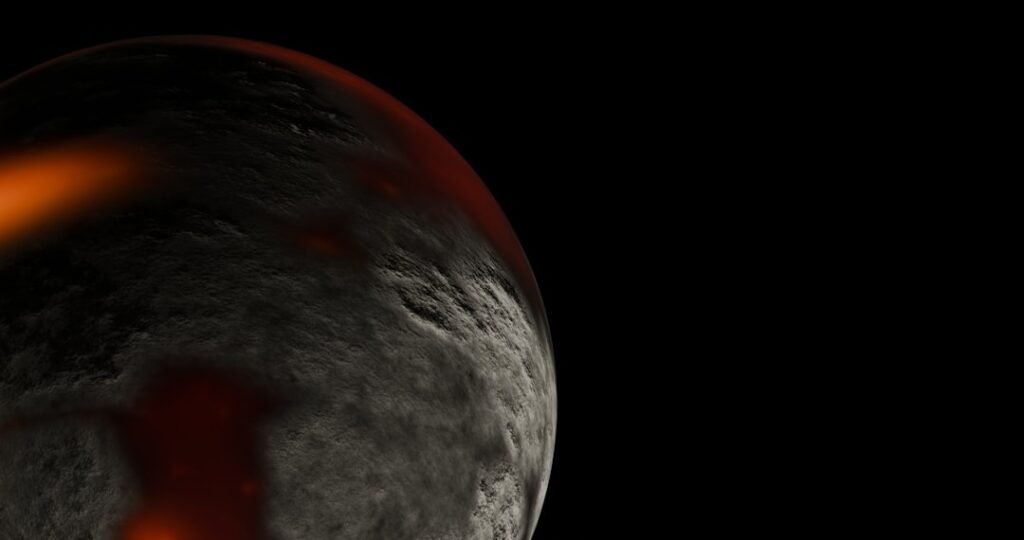

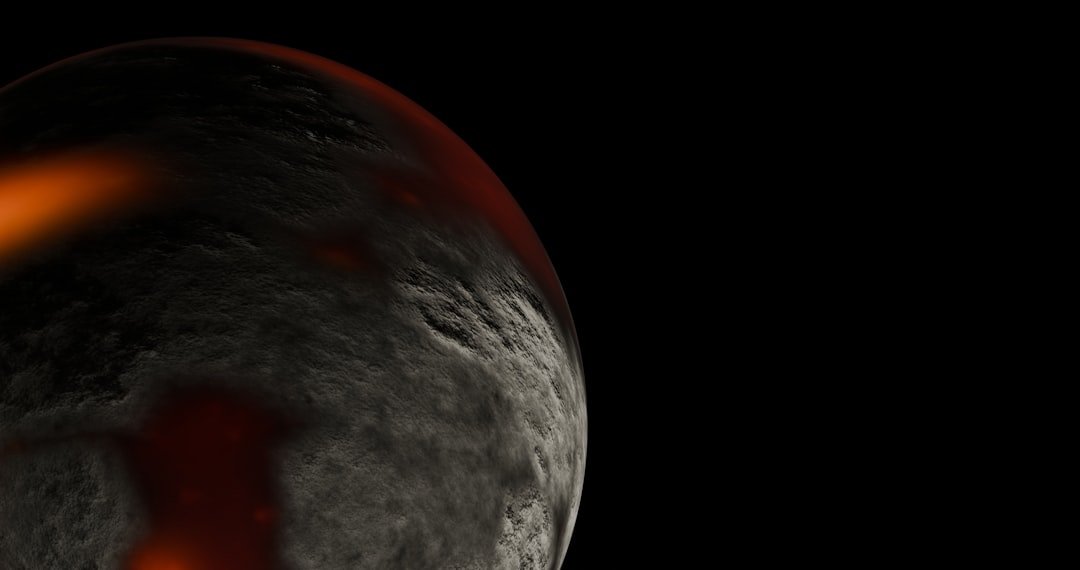
A World of Fire and Fumes (Image Credits: Unsplash)
Astronomers recently turned their gaze to a super-Earth 35 light-years from our solar system, uncovering evidence of a planet with a vast subsurface ocean of molten rock and an atmosphere laden with sulphur gases. This world, known as L 98-59 d, orbits within a compact system around a small red dwarf star roughly five billion years old. Observations combining data from the James Webb Space Telescope and ground-based instruments point to features that do not align with established categories like hydrogen-dominated mini-Neptunes or water-worlds.[1][2]
A World of Fire and Fumes
Picture a planetary body where the mantle churns like thick syrup, harboring a global magma ocean that exchanges chemicals with the skies above. L 98-59 d stands out with a radius 1.6 times that of Earth but a strikingly low bulk density of about 2 grams per cubic centimeter – far lighter than Earth’s 5.5 g/cm³. This low density arises from its substantial atmosphere and semi-molten interior, which together create a unique profile unlike rocky planets or gas envelopes seen elsewhere.[1]
The atmosphere contains sulphur-bearing molecules, including hydrogen sulphide, detected through transmission spectroscopy. Such composition suggests ongoing volatile cycling between the planet’s depths and its gaseous shroud. Researchers modeled these interactions, revealing a mantle with the viscosity of molasses – neither fully solid nor liquid – capable of trapping and releasing elements over billions of years. The planet’s siblings in the L 98-59 system exhibit diverse traits, highlighting how closely orbiting worlds can evolve in dramatically different ways.
Key Observations Fuel the Discovery
A team led by Harrison Nicholls of the University of Oxford analyzed data from JWST’s NIRSpec instrument alongside earlier ground-based measurements. These efforts measured the planet’s mass, radius, and atmospheric signals, ruling out simple explanations like a hydrogen-rich envelope. The findings appeared in Nature Astronomy, marking a pivotal step in characterizing small exoplanets.[1]
Nicholls noted, “The way we’ve been doing it in the last few years is suggesting that planets are either very hydrogen-rich gas dwarfs or water-rich worlds… But this planet specifically doesn’t fit into these categories.” Computer simulations linked the observed sulphur signals to interior processes, proposing the magma ocean as a reservoir for volatiles. Ground observatories contributed high-resolution spectra that corroborated JWST’s detection of hydrogen sulphide, strengthening the case for disequilibrium chemistry driven by geological activity.[2]
- Radius: 1.6 Earth radii
- Orbit: Inner position in a multi-planet system around an M3V red dwarf
- Atmosphere: Rich in H2S and other sulphur compounds
- Density: ~2 g/cm³, influenced by atmosphere and molten layers
- Age: Approximately 5 billion years
Why Does the Magma Persist?
Several factors explain how L 98-59 d remains partially molten after billions of years. A thick atmosphere generates a potent greenhouse effect, trapping heat and preventing the interior from solidifying. Potential tidal forces from gravitational tugs by neighboring planets could generate additional friction, akin to the volcanic activity on Jupiter’s moon Io.
| Planet/System | Density (g/cm³) | Key Feature |
|---|---|---|
| Earth | 5.5 | Solid rocky interior |
| L 98-59 d | ~2 | Magma ocean + thick atmosphere |
| Typical mini-Neptune | ~1.5-3 | Hydrogen envelope |
These dynamics allow volatiles like sulphur to dissolve into the magma and later outgas, sustaining the atmosphere’s composition. The compact system’s orbital resonances may amplify such heating, offering a glimpse into how planetary interiors stay active long-term.
Challenging the Planetary Taxonomy
The discovery prompts a reevaluation of exoplanet classifications, suggesting a spectrum of types rather than rigid bins. L 98-59 d bridges gaps between super-Earths and sub-Neptunes, with its magma-driven chemistry hinting at overlooked evolutionary paths. Nicholls added, “What we’re highlighting is that there’s maybe a continuum of different exoplanet families.”[1]
Diversity within the L 98-59 system underscores this variability: planets formed from the same disk yet diverged into rocky, gaseous, or hybrid forms. Future surveys could reveal more such outliers, expanding the known roster of worlds.
- L 98-59 d features a semi-molten mantle and sulphur-rich atmosphere, defying standard categories.
- JWST and ground data confirm low density and volatile exchange between interior and air.
- Greenhouse trapping and tidal heating sustain its fiery state over billions of years.
This molten super-Earth not only broadens our cosmic inventory but also invites deeper questions about planetary formation and longevity. As telescopes like JWST continue probing distant atmospheres, expect more revelations that blur the lines of what we consider possible. What do you think about these exotic worlds? Tell us in the comments.