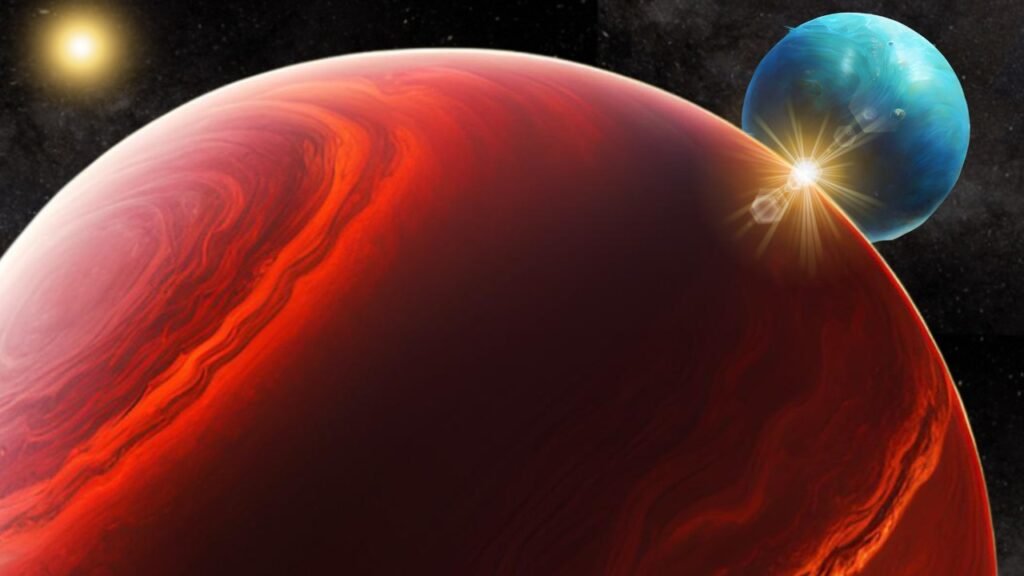

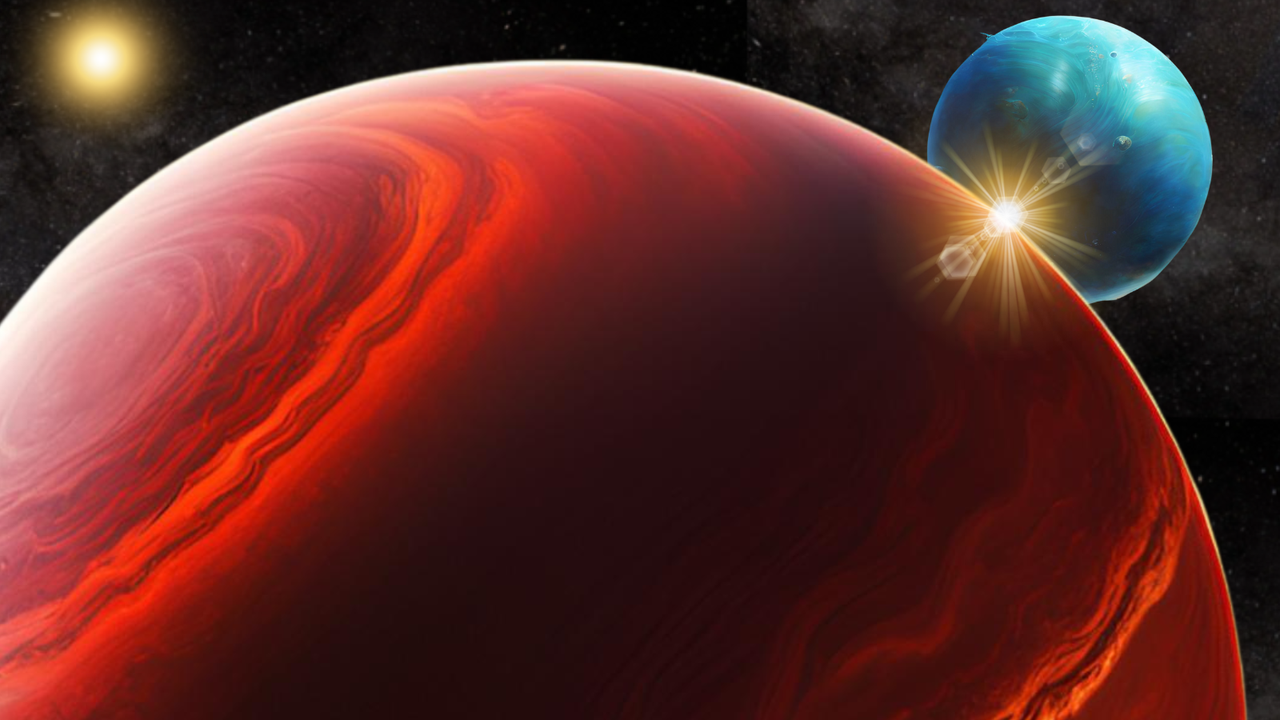
Unsteady Orbit Sparks New Hunt for Exomoons (Image Credits: Cdn.mos.cms.futurecdn.net)
Astronomers have identified unusual motion in a distant exoplanet that points to the presence of an extraordinarily large orbiting companion, potentially reshaping how scientists define a moon.
Unsteady Orbit Sparks New Hunt for Exomoons
Researchers observed the exoplanet exhibiting a distinct wobble during its transit across its star’s face. This deviation from a predictable path suggested gravitational influence from a massive unseen body. Transit timing variations, a key detection method, revealed timing shifts that aligned with the pull of a substantial satellite.
Such wobbling had long been theorized as a signature of exomoons, but confirmation remained elusive. The candidate exomoon’s inferred size dwarfed known moons in our solar system. Its mass appeared comparable to smaller planets, prompting questions about categorization.
Decoding the Gravitational Dance
The exoplanet’s irregular path stemmed from the gravitational tug of its potential moon. As the pair orbited their host star, the moon induced perturbations that altered transit durations and timings. Analysts modeled these effects using data from space telescopes focused on exoplanet surveys.
Key indicators included prolonged transits and asymmetric light curves. These features matched simulations of a moon with significant mass disrupting the planet’s trajectory. Unlike Earth’s Moon, which causes minor effects, this companion exerted a profound influence.
Why Size Matters in Redefining ‘Moon’
Traditional moons orbit planets without dominating the system dynamically. This candidate, however, rivaled its host in mass, blurring lines between moon and planet. Astronomers debated whether such objects warranted a new classification, akin to dwarf planets.
The discovery highlighted gaps in nomenclature for extrasolar systems. In our solar system, no moon approaches planetary scale; Ganymede, Jupiter’s largest, holds just a fraction of Earth’s mass. A redefinition could affect future catalogs of celestial bodies.
Challenges and Next Steps for Confirmation
Detecting exomoons remains technically demanding due to faint signals amid stellar noise. Current observations provided strong hints but lacked direct imaging. Upcoming missions with advanced spectrographs aimed to probe atmospheres and refine mass estimates.
Scientists outlined verification strategies, including repeated transit monitoring and radial velocity measurements. These approaches promised to distinguish true exomoons from other phenomena like additional planets.
- Monitor multiple transits for consistent timing shifts.
- Employ radial velocity to measure combined mass.
- Analyze starlight for signs of dual atmospheres.
- Simulate light curves against alternative models.
- Cross-check with archival data from prior surveys.
Key Takeaways:
- The exoplanet’s wobble indicates a moon-like body with unprecedented mass.
- Such a find could prompt updates to astronomical terminology.
- Advanced telescopes hold potential for definitive proof.
This breakthrough underscores the diversity of planetary systems beyond our own and invites broader rethinking of satellite definitions. As evidence mounts, it challenges long-held assumptions about moons. What implications do you see for future exoplanet studies? Share your thoughts in the comments.