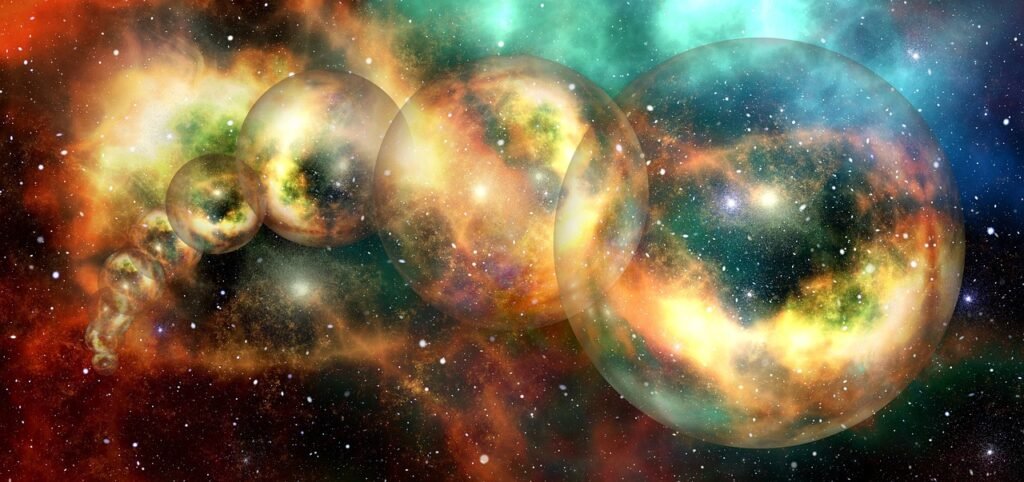

Superposition’s Grip on Primordial Possibilities (Image Credits: Pixabay)
Astronomers have peered deeper into space than ever before, revealing galaxies formed mere hundreds of millions of years after the Big Bang and ripples from the universe’s birth etched in the cosmic microwave background. Yet one puzzle persists: what preceded the explosive inflation that shaped our cosmos? Physicist Konstantin Zloshchastiev from the Durban University of Technology offers a provocative answer in a recent study. He argues that our reality crystallized from a quantum superposition of countless possible universes during the elusive pre-inflationary epoch.[1][2]
Galileo’s Moons to Webb’s Distant Galaxies
Humanity’s quest to understand the cosmos began with simple tools and bold observations. In 1610, Galileo Galilei trained his telescope on Jupiter and spotted orbiting moons, challenging the notion that Earth stood alone at the center. Centuries later, Edwin Hubble confirmed other galaxies exist beyond the Milky Way. Today, the James Webb Space Telescope captures light from stars igniting just 200 to 400 million years post-Big Bang, while LIGO detects gravitational waves from colliding black holes.[1]
These instruments also map the cosmic microwave background, a faint glow from the Big Bang itself. Such precision has fueled profound questions about the universe’s infancy. Instruments like these underscore how far science has advanced, yet they leave the pre-inflationary era shrouded in uncertainty. Zloshchastiev’s work builds on this legacy by linking quantum principles to cosmic origins.
- 1610: Galileo discovers Jupiter’s moons.
- 1920s: Hubble identifies distant galaxies.
- 2015 onward: LIGO observes gravitational waves.
- 2022-present: JWST images early universe structures.
- Ongoing: CMB analysis reveals Big Bang echoes.
The Shadowy Pre-Inflationary Epoch
Before inflation rapidly expanded the universe fractions of a second after the Big Bang, conditions defied everyday physics. Zloshchastiev posits that this period featured a “pre-inflationary multiverse” composed of indistinguishable particles locked in quantum superposition. All potential spacetimes overlapped in a probabilistic haze, much like Schrödinger’s cat existing in life and death until observed.[1][2]
“The time preceding these dark energy and inflation epochs, the pre-inflationary era, largely remains a mystery, both empirically and theoretically,” Zloshchastiev wrote. “However, one large and easily observable natural phenomenon exists, which is directly related to the pre-inflationary period. This is our Universe itself, with its diverse yet quite orderly and mathematically predictable structure.”[1] The universe’s very existence serves as indirect evidence of this quantum prelude. No telescope can directly probe this fleeting phase, but its orderly laws suggest a decisive transition occurred.
Superposition’s Grip on Primordial Possibilities
In quantum mechanics, superposition allows particles to occupy multiple states simultaneously until measured. Zloshchastiev extends this to cosmology: the pre-inflationary background resembled a Bose-Einstein condensate, where particles merged into a single quantum wave embodying a multiverse of spacetimes. This “proverbial Schrödinger’s cat box” held infinite outcomes in balance.[1]
Geometrical fluidity defined this realm, with spacetime emerging statistically from the ensemble. Matter as we know it had not yet formed. Instead, pure potential dominated. This setup resolved paradoxes in early universe models by treating reality as emergent from quantum statistics. The theory aligns quantum weirdness with gravitational expansion.
A Measurement Breaks the Quantum Spell
The turning point came with a measurement-like event that shattered the superposition. Zloshchastiev describes it as a Shannon information transfer – named for information theory pioneer Claude Shannon – leaking “which-possibility” data into an external record. This reduced the multiverse to one reality: ours.[2]
The process induced logarithmic nonlinearity, birthing a superfluid vacuum. This low-energy quantum field, far from empty, became the ground state for all particles and forces. It generated mass-energy for inflation and paved the way for dark energy’s current reign. The vacuum’s properties explain the smooth shift from explosive growth to accelerated expansion today. Read the full study in the journal Universe.[2]
Paths to Verification and Cosmic Insights
Testability elevates this hypothesis beyond speculation. Zloshchastiev predicts vacuum Cherenkov radiation – particles exceeding light speed in the quantum vacuum – could manifest in high-energy phenomena. Astronomers might detect it in blazars, quasars, or fast radio bursts, offering empirical clues.[1]
Such signatures would validate the superfluid vacuum model. The theory also unifies inflation, vacuum structure, and dark energy under quantum information principles. Ongoing observations from telescopes and detectors could soon provide data. History shows persistent inquiry yields breakthroughs, even from cosmic enigmas.
Key Takeaways
- Pre-inflationary multiverse existed as quantum superposition of spacetimes.
- Shannon-like information transfer collapsed it into our singular universe.
- Result: Superfluid vacuum enabling inflation and dark energy.
This framework challenges views of a singular Big Bang origin, portraying our universe as one outcome from quantum chaos. It invites deeper scrutiny of reality’s foundations. As tools sharpen, the pre-inflationary veil may lift further. What do you think of this quantum cosmic origin story? Share in the comments.