
Titan’s Surface Defies Its Age (Image Credits: Upload.wikimedia.org)
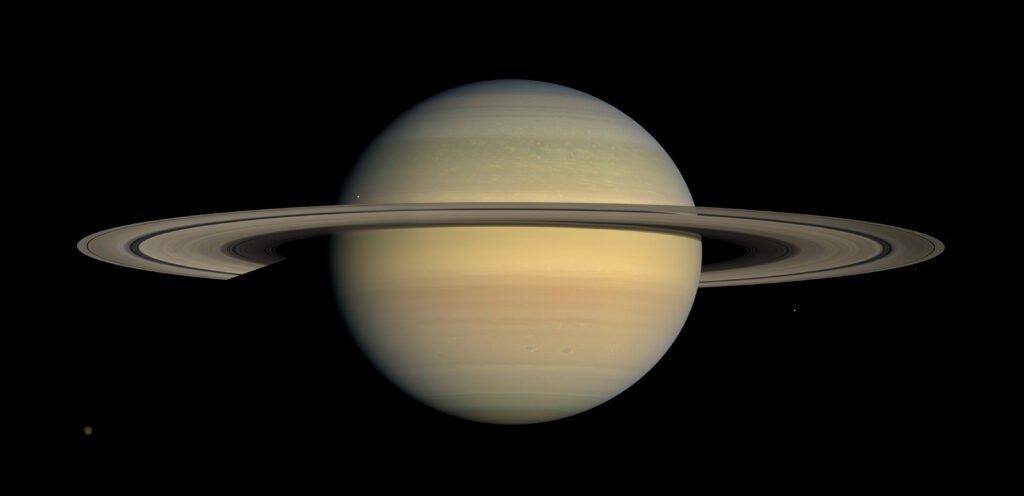
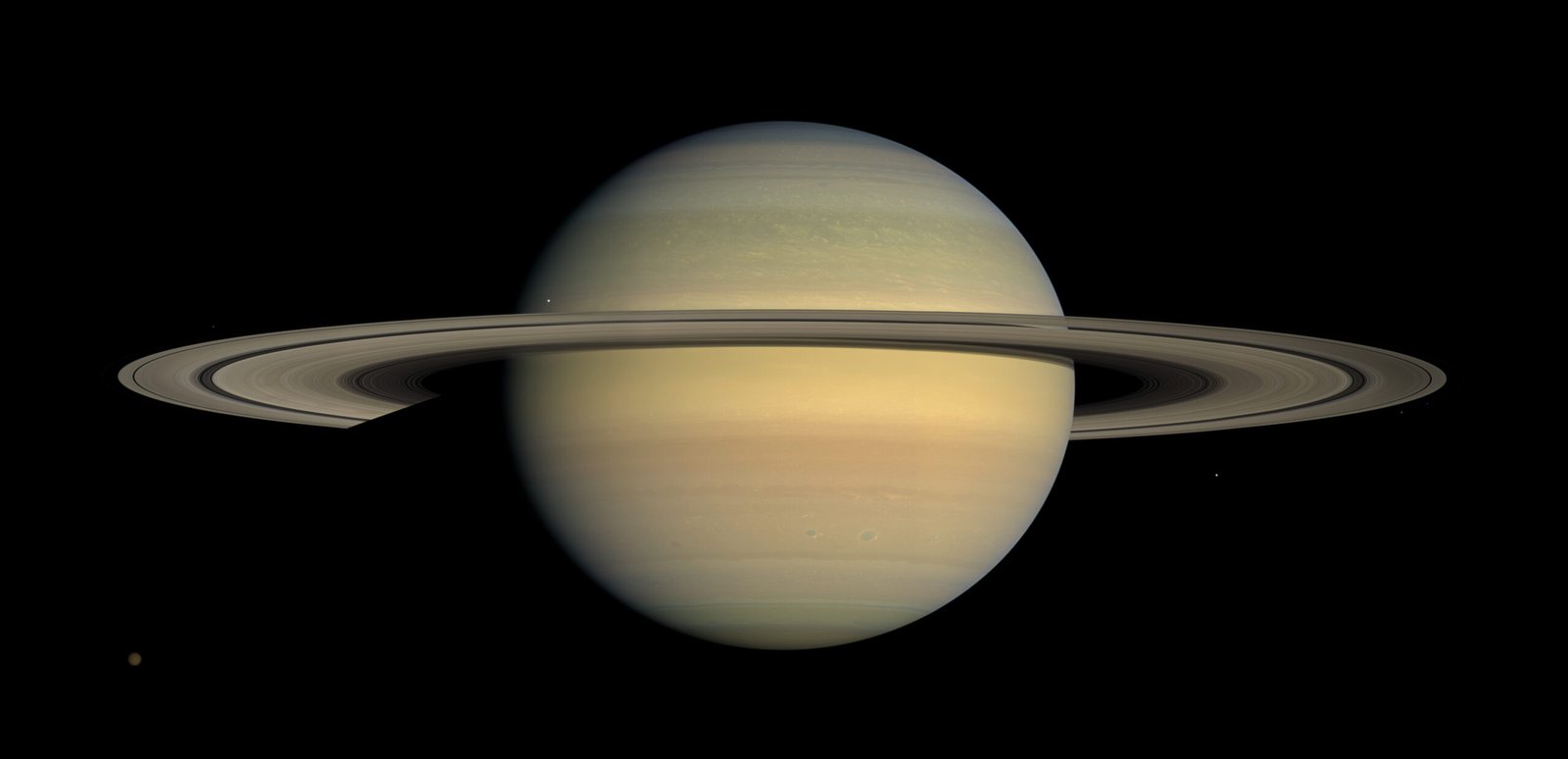
Astronomers have uncovered evidence suggesting Saturn’s largest moon, Titan, formed through a cataclysmic merger of two earlier moons hundreds of millions of years ago.[1][2]
Titan’s Surface Defies Its Age
Saturn’s Titan boasts a remarkably smooth exterior, with far fewer impact craters than expected for a moon of its supposed antiquity.[1]
This youthful appearance puzzled researchers for decades. Models had long assumed Titan survived intact from Saturn’s formation some 4.5 billion years ago. Yet its terrain, partially veiled by a thick nitrogen atmosphere, reveals limited scarring from cosmic bombardments. The scarcity of craters implies a major resurfacing event relatively recently in geological terms. Such a disturbance would have melted and reformed the icy surface, wiping away ancient marks.[3]
Neighboring Hyperion adds to the intrigue. This small, irregularly shaped moon tumbles chaotically and shares a resonant orbit with Titan. Its pristine condition further hints at a shared, recent origin story.
The Proto-Moon Merger Explained
Computer simulations now point to a specific culprit: a giant impact between a large proto-Titan and a smaller proto-Hyperion.[2]
About 400 to 500 million years ago, Titan’s orbit expanded outward due to tidal interactions with Saturn. This shift destabilized an additional mid-sized moon, dubbed proto-Hyperion, which orbited between Titan and the distant moon Iapetus. Proto-Hyperion veered onto a collision course with proto-Titan, a body possibly resembling Jupiter’s cratered moon Callisto. The smash-up merged the pair into the modern Titan. Fragments from the debris disk coalesced into today’s Hyperion, explaining its position near Titan’s path.[3]
“If the extra moon merged with Titan, it would likely produce fragments near Titan’s orbit. That is exactly where Hyperion would have formed,” explained Matija Ćuk of the SETI Institute.[3]
Simulations Seal the Deal
Detailed modeling revisited earlier ideas of an extra moon’s role in Saturn’s system. Previous theories suggested it might have been ejected or directly spawned the rings. Yet the latest runs, detailed in a forthcoming Planetary Science Journal paper, favor collision as the dominant outcome.[4]
Researchers from the SETI Institute, Southwest Research Institute, Caltech, and Observatoire de Paris integrated orbital dynamics and impact physics. The work conserved mass and momentum during the merger. Results matched observations: Titan’s eccentric orbit, now circularizing, stems from the event. Proto-Hyperion’s perturbations also accounted for Iapetus’s unusual orbital tilt.[2]
- Titan’s low crater count from resurfacing heat.
- Hyperion’s youth and resonant orbit with Titan.
- Iapetus’s orbital inclination from pre-collision nudges.
- Titan’s orbit eccentricity, decaying via tides.
- Setup for later inner moon disruptions leading to rings.
Ripples Through the Saturn System
The collision’s aftermath extended beyond Titan. Titan’s post-impact eccentricity destabilized inner moons like Rhea and the group near the rings. This chaos enabled their fragmentation and re-accretion, birthing Saturn’s bright rings perhaps 100 million years ago.[4]
Saturn’s rings themselves appear young, consistent with this timeline. The model ties together multiple enigmas in one coherent narrative.
Key Takeaways
- Titan likely merged from proto-Titan and proto-Hyperion ~400 million years ago.
- Collision erased craters and birthed Hyperion from debris.
- Event paved way for Saturn’s rings via inner moon instability.
This violent origin reframes Titan not as a sleepy survivor, but a dynamic product of cosmic upheaval. Future missions could test these ideas by probing Titan’s interior structure. What do you think of this cosmic crash theory? Tell us in the comments.