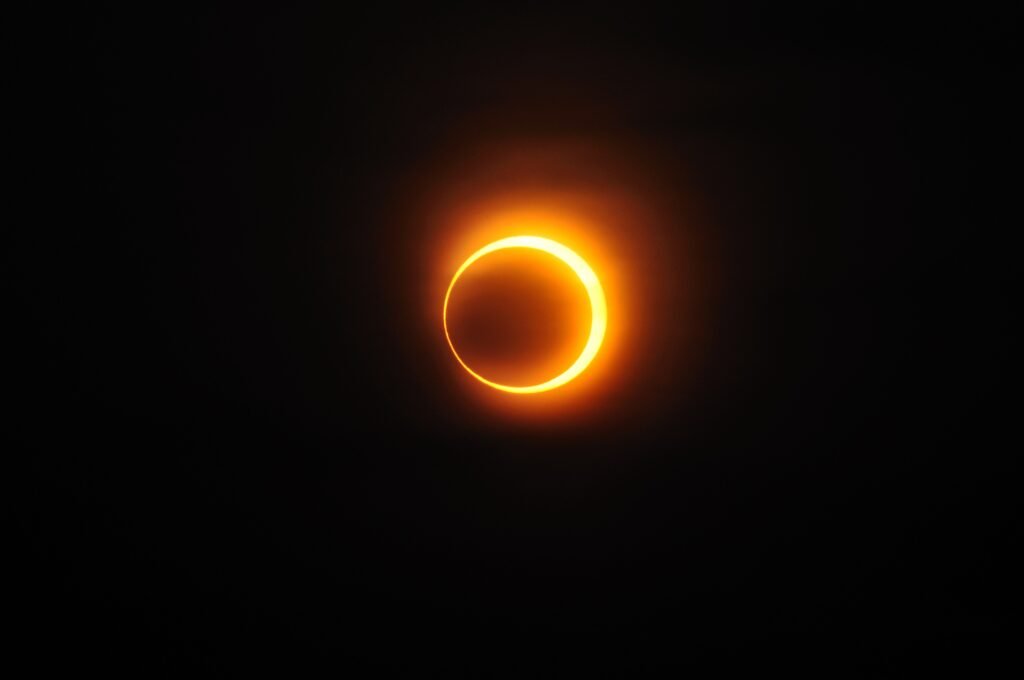


Few Witnesses to a Celestial Rarity (Image Credits: Upload.wikimedia.org)
Antarctica – A striking annular solar eclipse produced a vivid “ring of fire” effect across the continent’s icy expanse on Tuesday.[1][2]
Few Witnesses to a Celestial Rarity
Only a handful of researchers at remote stations experienced the full spectacle firsthand. The eclipse reached its peak annularity at Concordia Station, where the sun’s outer edge glowed brilliantly around the moon’s silhouette starting around 6:48 p.m. local time.[3] This event marked the first solar eclipse of 2026, with a magnitude of 0.963, meaning the moon covered nearly all but a thin ring of the sun’s disk.[2]
Antarctica’s isolation ensured minimal crowds, underscoring the eclipse’s exclusivity. Scientists there captured data on solar corona behavior and atmospheric effects unique to polar regions. The alignment also preceded Lunar New Year celebrations, adding cultural resonance for observers worldwide.[1]
The Path of the ‘Ring of Fire’
The annular path stayed confined to Antarctica, sweeping over research bases like Concordia and possibly Dumont d’Urville. Partial phases extended visibility to southern Africa, parts of South America, and surrounding oceans, though the full ring remained elusive for most.[4][5]
Maximum duration of the ring phase varied by location but peaked near one minute in optimal spots. Unlike total eclipses, annularity occurs when the moon appears smaller due to its elliptical orbit, failing to fully obscure the sun.[6]
Safe Viewing Practices and Alternatives
Direct observation demanded certified solar filters or indirect methods like pinhole projectors to prevent eye damage. Live streams from observatories provided global access, broadcasting the ring’s ethereal glow in real time.[7]
For those unable to travel south, apps and websites tracked the event’s progress with maps and simulations. Enthusiasts in partial visibility zones reported crescent-shaped shadows on the ground and unusual midday dimming.
- Use eclipse glasses meeting ISO 12312-2 standards.
- Employ safe projection techniques for groups.
- Monitor weather forecasts for clear skies.
- Follow updates from NASA or TimeandDate.com.
- Avoid unverified binoculars or cameras without filters.
Looking Ahead to More Eclipses
This eclipse kicked off a busy year, with a total lunar eclipse on March 3 and a total solar eclipse on August 12 visible from parts of Europe, Asia, and the Arctic.[8] The next annular event arrives February 6, 2027, crossing Chile and Argentina for up to 7 minutes 51 seconds of ring time.[9]
Astronomers anticipate heightened interest as paths shift toward populated areas later in the decade.
Key Takeaways
- A rare annular eclipse lit Antarctica’s skies with a “ring of fire” on February 17, 2026.
- Full visibility limited to polar research stations; partial views elsewhere.
- Safety gear essential; streams offered worldwide viewing options.
These fleeting alignments remind us of Earth’s place in the cosmic dance. What celestial event are you most excited for next? Tell us in the comments.