
A Star That Defied Expectations (Image Credits: Cdn.mos.cms.futurecdn.net)
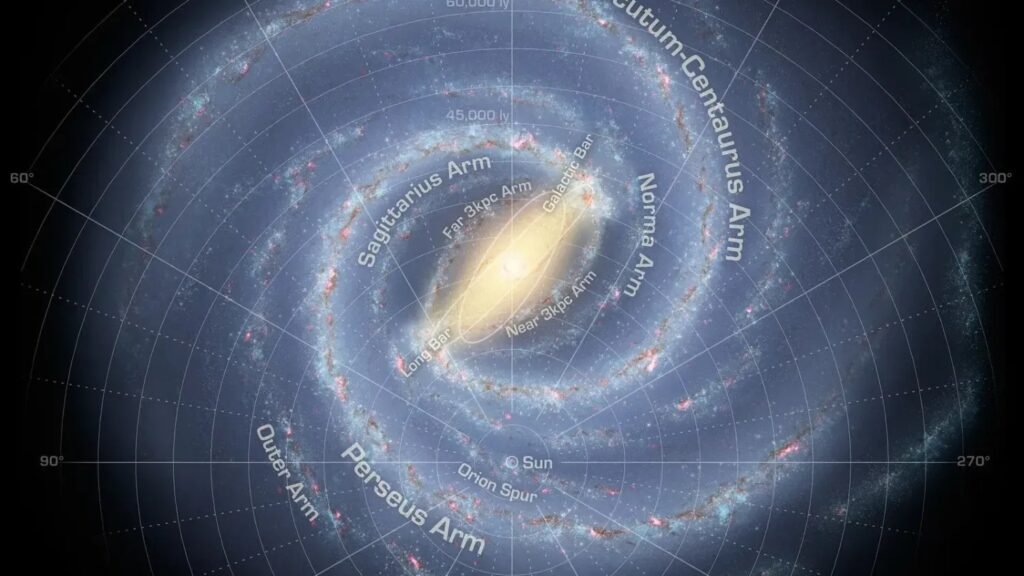
A distant star’s erratic light fluctuations revealed signs of a massive planetary smash-up roughly 11,000 light-years from Earth.[1]
A Star That Defied Expectations
The star, cataloged as Gaia20ehk and located near the constellation Puppis, displayed unusual behavior starting in 2016. Researchers noted three distinct dips in its visible brightness before the fluctuations intensified dramatically around 2021.[1] Anastasios Tzanidakis, a doctoral candidate in astronomy at the University of Washington, described the shift vividly: “The star’s light output was nice and flat, but starting in 2016 it had these three dips in brightness. And then, right around 2021, it went completely bonkers.”[1]
Such erratic patterns stood out because mature stars like this one rarely exhibit them. Tzanidakis emphasized the anomaly: “I can’t emphasize enough that stars like our sun don’t do that. So when we saw this one, we were like, ‘Hello, what’s going on here?'”[1] Multiple telescopes captured the changes in real time, providing a decade-long dataset that unfolded the story.
Debris Cloud Signals Catastrophic Impact
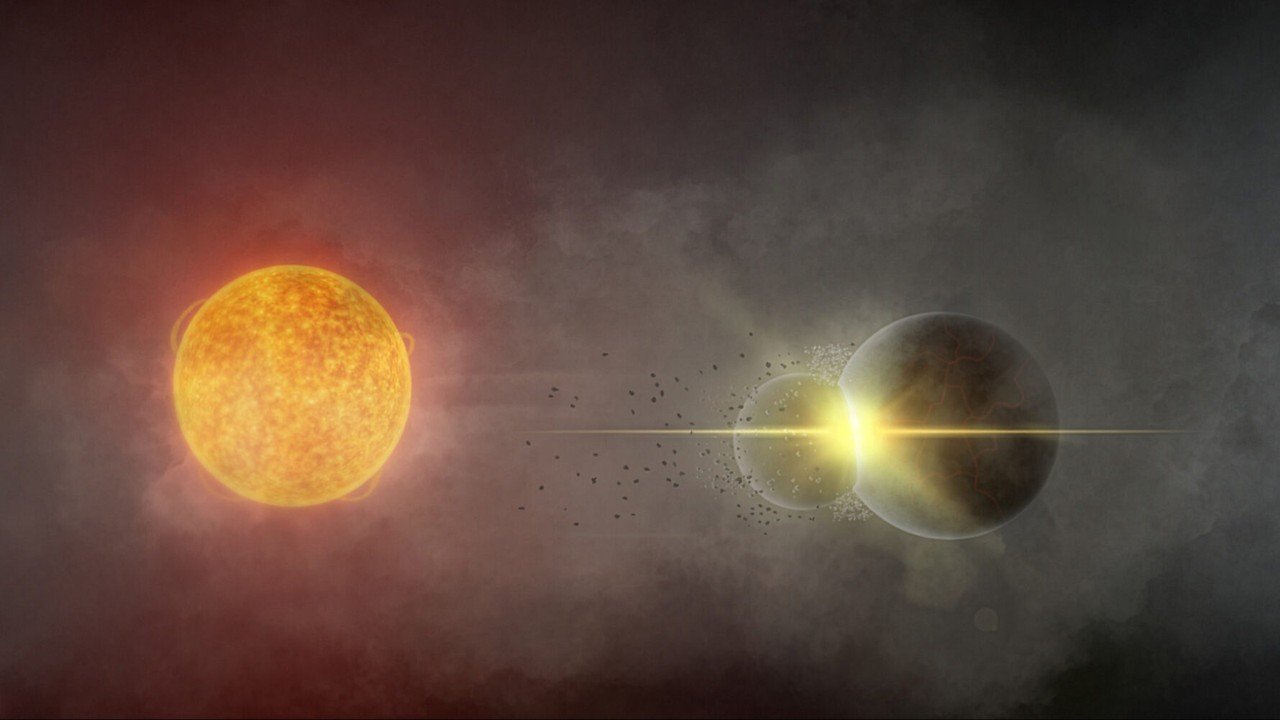
Analysis showed vast amounts of rocks and dust passing in front of the star, causing patchy dimming in visible light. At the same time, infrared emissions spiked sharply, pointing to extremely hot material newly ejected into space.[1] The debris orbited at about one astronomical unit from the star, the same average distance as Earth from the sun.
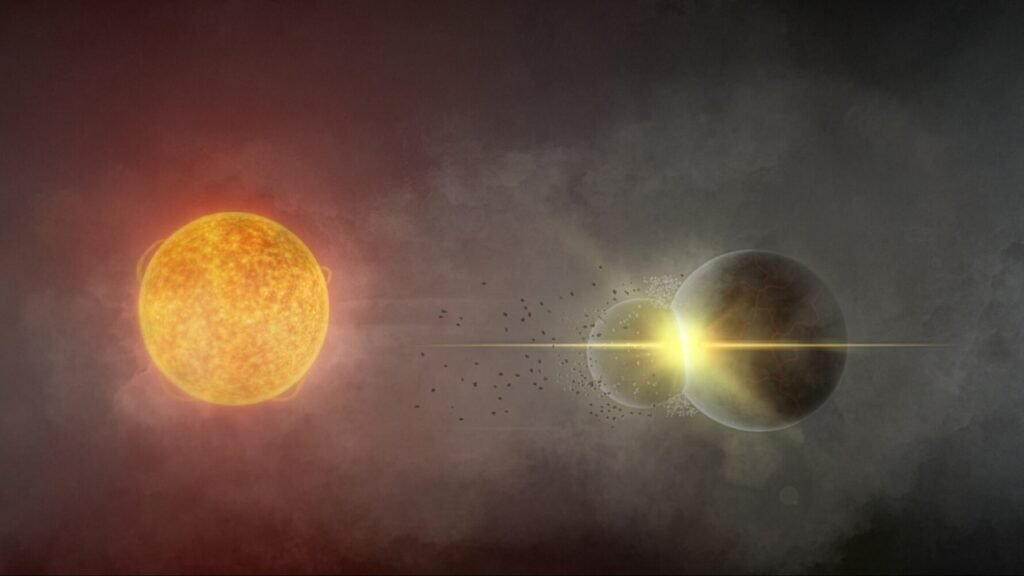
Scientists concluded that two planets had spiraled toward each other over time. Initial grazing impacts produced minor effects, but a final head-on collision unleashed the observed chaos. Tzanidakis explained: “That could be caused by the two planets spiraling closer and closer to each other… At first, they had a series of grazing impacts, which wouldn’t produce a lot of infrared energy. Then, they had their big catastrophic collision, and the infrared really ramped up.”[1]
- Visible light dips began in 2016 with three events.
- Infrared brightening peaked around 2021.
- Dust cloud suggests planetesimals or planet-scale bodies involved.[1]
- Collision likely produced molten debris now cooling in orbit.
Echoes of Earth’s Ancient Catastrophe
This event bore striking similarities to the giant impact hypothesis for the moon’s formation. About 4.5 billion years ago, a Mars-sized body struck early Earth, ejecting material that coalesced into the moon. The Gaia20ehk debris cloud offered a modern analog, potentially evolving into a new planetary system.
Senior author James Davenport, an assistant research professor at the University of Washington, highlighted the significance: “How rare is the event that created Earth and the moon? That question is fundamental to astrobiology.”[1] Observations like this could reveal how common such violence is during planet formation.
Future Hunts for Cosmic Crashes
The discovery appeared in The Astrophysical Journal Letters under the title “Gaia-GIC-1: An Evolving Catastrophic Planetesimal Collision Candidate.”[1] Davenport suggested that facilities like the Vera C. Rubin Observatory might detect around 100 similar events over the next decade.
Tzanidakis expressed optimism: “It’s incredible that various telescopes caught this impact in real time… If we can observe more moments like this elsewhere in the galaxy, it will teach us lots about the formation of our world.”[1]
Key Takeaways
- A planetary collision 11,000 light-years away produced a glowing dust cloud observable today.
- Infrared spikes and light dips confirmed the violent merger.
- This rare sighting informs theories on moon formation and planetary evolution.
Planetary collisions shape worlds across the universe, and Gaia20ehk provides a front-row seat to one such drama. What secrets might future observations unlock about our own solar system’s turbulent past? Share your thoughts in the comments.