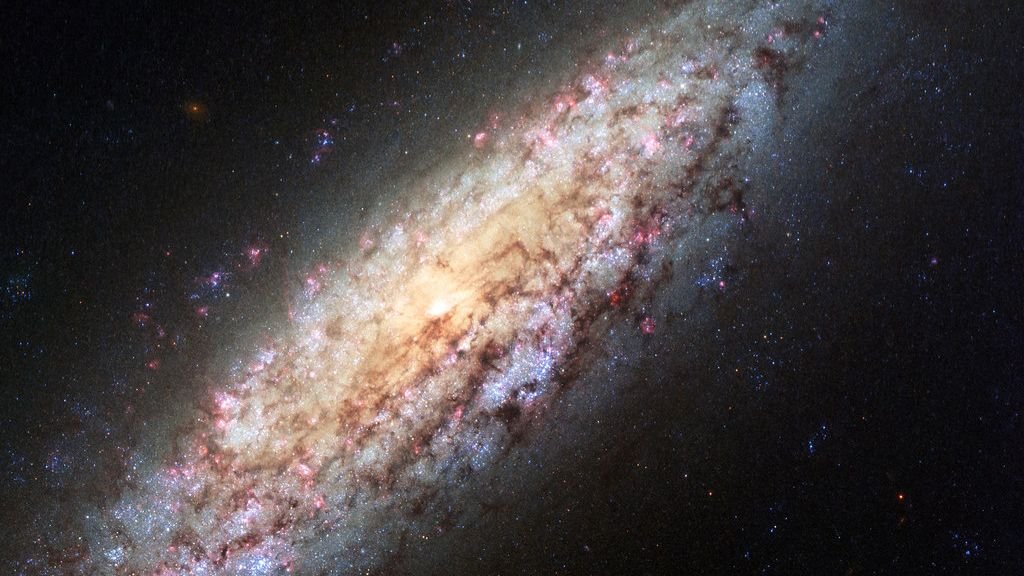

Space rarely feels urgent. It’s easy to think of galaxies as still, ancient, almost frozen things hanging in the dark. The truth, though, is far more dramatic – and honestly, a little unsettling once you understand what’s actually happening to our own galaxy right now.
A nearby dwarf galaxy is in the process of colliding with the Milky Way. Not metaphorically. Not in some distant theoretical future. It’s happening, and the effects are rippling through our galaxy in ways scientists are only beginning to fully map. Let’s dive in.
The Sagittarius Dwarf Galaxy: Our Galaxy’s Persistent Intruder
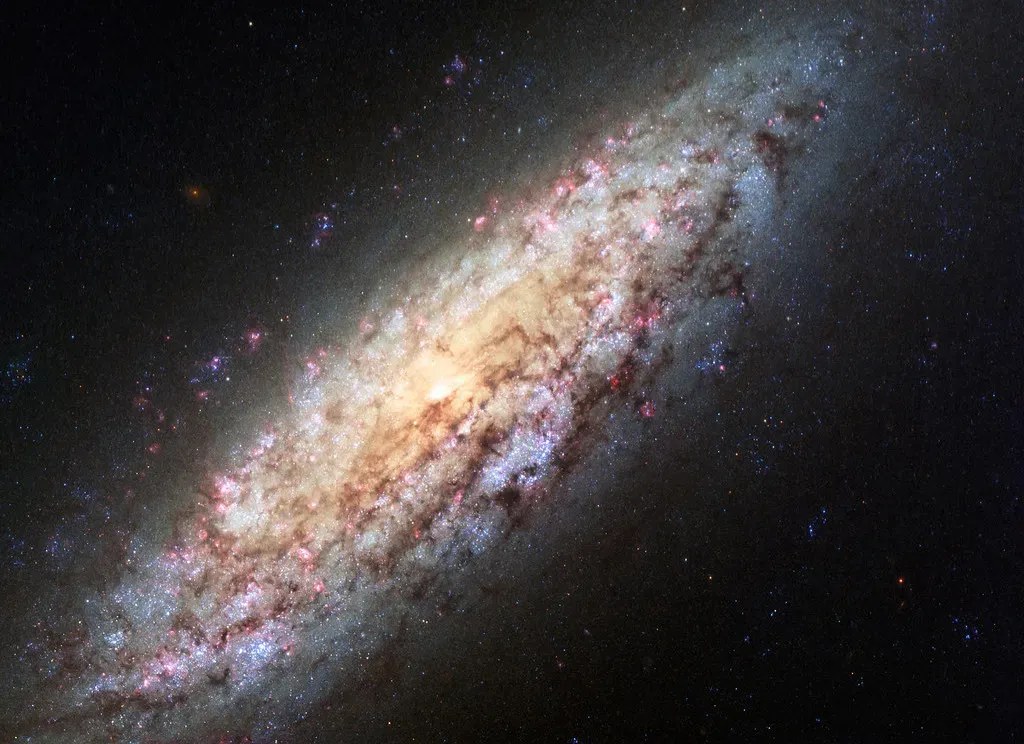
Here’s the thing most people don’t realize: the Milky Way has been hit before. The Sagittarius Dwarf Galaxy, a small satellite galaxy bound to ours by gravity, has passed through the Milky Way’s disk multiple times over billions of years. It’s like a cosmic repeat offender, looping around and plunging through again and again.
Each collision strips more stars and material from Sagittarius, slowly dismembering it. At this point, the dwarf galaxy is a shadow of what it once was. Researchers have traced long stellar streams, essentially rivers of stars pulled free from Sagittarius, that now arc across vast stretches of our sky.
What makes this particularly fascinating is that even a weakened intruder can leave a serious mark. The Sagittarius Dwarf Galaxy, despite being dramatically smaller than the Milky Way, carries enough mass to disturb structures across our entire galaxy. Size, it turns out, isn’t everything in galactic dynamics.
Think of It Like a Stone Dropped Into Still Water
Scientists describe the effect using a surprisingly relatable image. Imagine dropping a stone into a calm pond. You see ripples spread outward from the point of impact, moving in all directions. Now scale that up to hundreds of thousands of light years, and you have a rough picture of what Sagittarius has done to the Milky Way.
The Milky Way’s disk of stars and gas hasn’t just been nudged. It’s been set into a wave-like oscillation, a pattern that researchers have been detecting with increasing precision. Stars in our disk aren’t simply orbiting in neat flat paths. Many are bobbing up and down, displaced vertically from where they would otherwise sit, all because of repeated gravitational disturbances from the incoming dwarf galaxy.
The Galactic Anticenter: Where the Evidence Is Strongest
One region of the sky has become particularly important for researchers studying this phenomenon: the galactic anticenter. This is essentially the direction opposite to the center of the Milky Way, and it offers a cleaner, less cluttered view of the outer disk. Honestly, it’s a bit like trying to study traffic patterns by looking away from the busy city center.
Recent data, particularly from the European Space Agency’s Gaia satellite, has given astronomers an unprecedented look at how stars in this region are moving. The findings confirm significant vertical waves propagating through the disk, star populations displaced above and below the galactic plane in patterns consistent with an external gravitational kick. The fingerprints of Sagittarius are all over it.
What’s striking is the scale of the disturbance. The waves don’t affect just a local patch of the galaxy. They extend across enormous distances, suggesting that even a relatively small galactic intruder can send shockwaves through a structure as massive as the Milky Way. It rewrites our sense of how stable and undisturbed our galaxy actually is.
Gaia’s Role: Mapping the Invisible Damage
Without Gaia, much of this would still be speculation. The satellite, launched by the European Space Agency, has been meticulously cataloguing the positions, distances, and velocities of over a billion stars. That kind of data volume is almost incomprehensible, like trying to track every grain of sand on a very large beach, individually, in three dimensions.
Using Gaia’s measurements, researchers have been able to reconstruct the three-dimensional motion of stars throughout the Milky Way’s disk. The result is something like a time-lapse movie of galactic disruption, played back in slow motion. Patterns that would have been invisible to earlier instruments are now undeniable.
The satellite continues to refine its dataset with each new data release. Each update brings sharper resolution to the picture of our disturbed, wave-riddled disk. It’s hard to overstate how transformative this tool has been for the field.
Dark Matter’s Unexpected Supporting Role
Here’s where it gets even more interesting. The Milky Way isn’t just made of stars and gas. It’s embedded in a vast halo of dark matter, the mysterious invisible substance that makes up a huge portion of the universe’s total mass. This halo, it turns out, plays a significant role in how the galaxy responds to an impact.
When Sagittarius punches through, it doesn’t just interact with the visible disk. It also disturbs the dark matter halo surrounding the Milky Way. That halo then responds dynamically, amplifying or modifying the waves that propagate through the stellar disk. It’s a bit like hitting a drum that’s surrounded by a thick, invisible cushion that has its own resonant properties.
Researchers believe that studying the exact shape and behavior of these galactic waves could actually help them learn more about the dark matter halo itself. In a sense, the ripples left by Sagittarius are serving as a probe, giving scientists indirect evidence about something they cannot directly observe. That’s one of those elegant scientific tricks that I find genuinely exciting.
The Milky Way Is Not the Flat, Orderly Disk We Once Imagined
For a long time, popular depictions of the Milky Way showed it as a neat, flat spiral. Clean arms, orderly rotation, everything in its proper place. That image was always a simplification, but research into the Sagittarius collision has made it more outdated than ever.
Our galaxy’s disk is warped. It’s rippled. Stars that “should” sit neatly in the plane are displaced upward or downward by thousands of light years. The outer disk in particular shows strong signs of this warping, which researchers increasingly attribute to the gravitational tug of Sagittarius across repeated passages.
It’s a humbling realization, really. The galaxy we live in, the one we’ve spent centuries mapping and studying, turns out to be considerably messier and more dynamic than anyone imagined just a few decades ago. There’s something almost poetic about discovering that home is stranger than you thought.
What Happens Next for Sagittarius and the Milky Way
Sagittarius is not going to survive this relationship intact. Each passage through the Milky Way rips away more of its mass, leaving it smaller and more diffuse. Eventually, over timescales of billions of years, it will likely be fully absorbed into the Milky Way, its stars scattered into our disk and halo with no trace of their original home.
The waves and ripples currently propagating through the Milky Way will gradually dampen and fade as the galaxy settles back toward equilibrium. It’s slow, but gravity is patient. What we’re witnessing now is a snapshot of a process playing out across geological timescales that dwarf anything in human experience.
For now, every time you look up at the night sky, you’re looking at a galaxy in the middle of a slow-motion collision. The Milky Way is absorbing its neighbor, rippling from the impact, and reshaping itself in the process. What does it say about our understanding of the universe that something this dramatic could be happening to our own galaxy, and we’re only just now beginning to see the full picture?