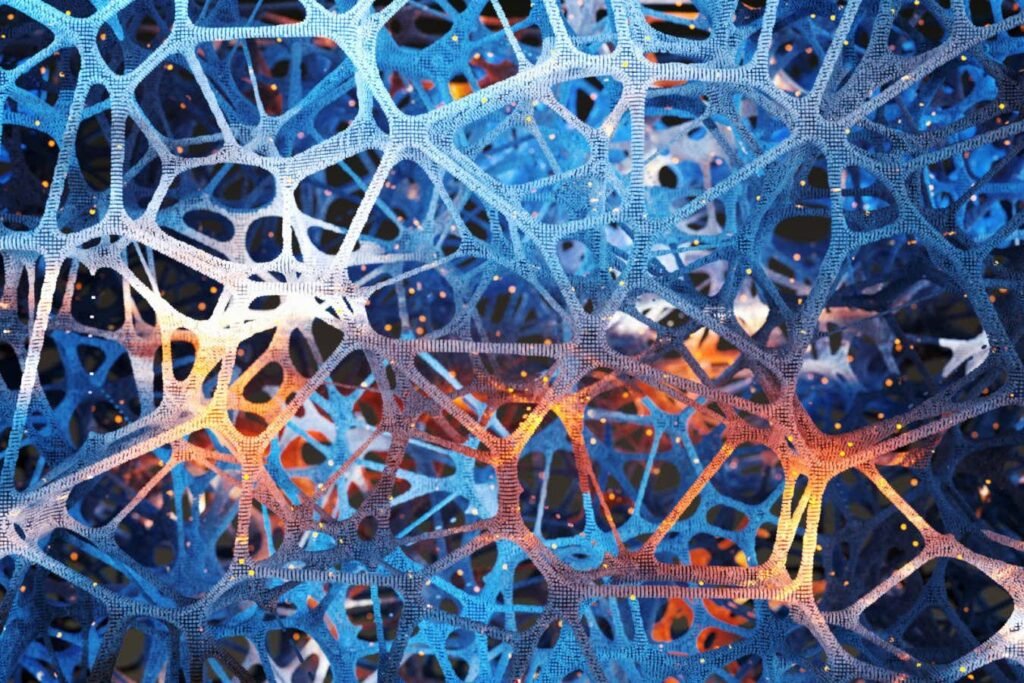


Neurons Master Games, Now Tackle Computing (Image Credits: Images.newscientist.com)
Melbourne, Australia – Cortical Labs announced plans for the world’s first biological data centers, where lab-grown human neurons perform computations on silicon chips.
Neurons Master Games, Now Tackle Computing
Lab-grown neurons first captured attention when they learned to play Pong in 2021, sensing the ball and controlling a paddle through electrical signals.[1][2]
These biological processors quickly advanced, mastering the more complex game Doom within a week. Cortical Labs built on this by developing the CL1, a commercial unit that integrates living neurons with hardware. The company unveiled its Melbourne prototype recently, marking a shift from experiments to scalable infrastructure. Each neuron cluster responds to stimuli much like a human brain, offering intuitive learning that traditional AI struggles to match. This foundation now supports broader applications in research and cloud services.
Inside the CL1: Biology Meets Silicon
The CL1 unit features neurons cultivated from human stem cells, grown directly on a multi-electrode array chip immersed in a nutrient solution.[3]
Electrical impulses stimulate the neurons, which process data and send responses interpreted by software via the Biological Intelligence Operating System, or biOS. These systems remain alive for up to six months, enabling extended experiments without constant reculturing. Cortical Labs designed the CL1 as plug-and-play, with USB ports for sensors and actuators, plus a touchscreen for monitoring.
- Real-time neural interaction through closed-loop stimulation.
- Self-contained life support and data processing.
- Ethical alternative to animal testing for neuroscience.
- Integration with Cortical Cloud for distributed computing.
Two Facilities Herald a New Era
Cortical Labs unveiled a prototype data center in Melbourne housing about 120 CL1 units, stacked to form a biological computing cluster.[2]
In Singapore, the startup partnered with DayOne Data Centers and the National University of Singapore for a smaller site starting with 20 units, with expansion to 1,000 planned after approvals.[4][2]
These facilities prioritize cloud access, allowing developers to deploy code remotely without lab setups. The Melbourne site serves as proof-of-concept, while Singapore focuses on validation and growth. Together, they aim to democratize biocomputing for AI research and beyond.
Energy Efficiency Challenges AI’s Power Hunger
Each CL1 draws just 30 watts, a fraction of the thousands consumed by high-end AI GPUs.[5][2]
This low draw reduces cooling demands and nutrient needs, positioning biological systems as a sustainable alternative amid data center energy strains.
| Computing System | Power Usage (Watts) |
|---|---|
| CL1 Biological Unit | 30 |
| Typical AI GPU | 600+ |
Experts note potential for massive savings at scale, though maintenance like nutrient supply adds complexity.
Early Days, Big Promises – and Hurdles
The technology remains experimental, with neurons requiring retraining after each culture’s lifespan ends.[2]
“We’re still in the early days of this development,” said Tjeerd olde Scheper of Oxford Brookes University. Reinhold Scherer of the University of Essex added that programming neurons differs fundamentally from standard computers, as training data is lost upon culture expiration.
Scaling to replace large language models poses significant challenges, according to Steve Furber of the University of Manchester. Cortical Labs views these centers as initial steps toward broader adoption.
Key Takeaways
- Cortical Labs’ CL1 merges human neurons with chips for efficient, adaptive computing.
- Melbourne hosts 120 units; Singapore starts with 20, eyeing 1,000.
- 30W per unit slashes energy use versus traditional AI hardware.
Biological data centers promise a paradigm shift, blending life’s efficiency with silicon’s speed, though maturity will determine their impact. What potential do you see for neuron-powered tech? Share your thoughts in the comments.