
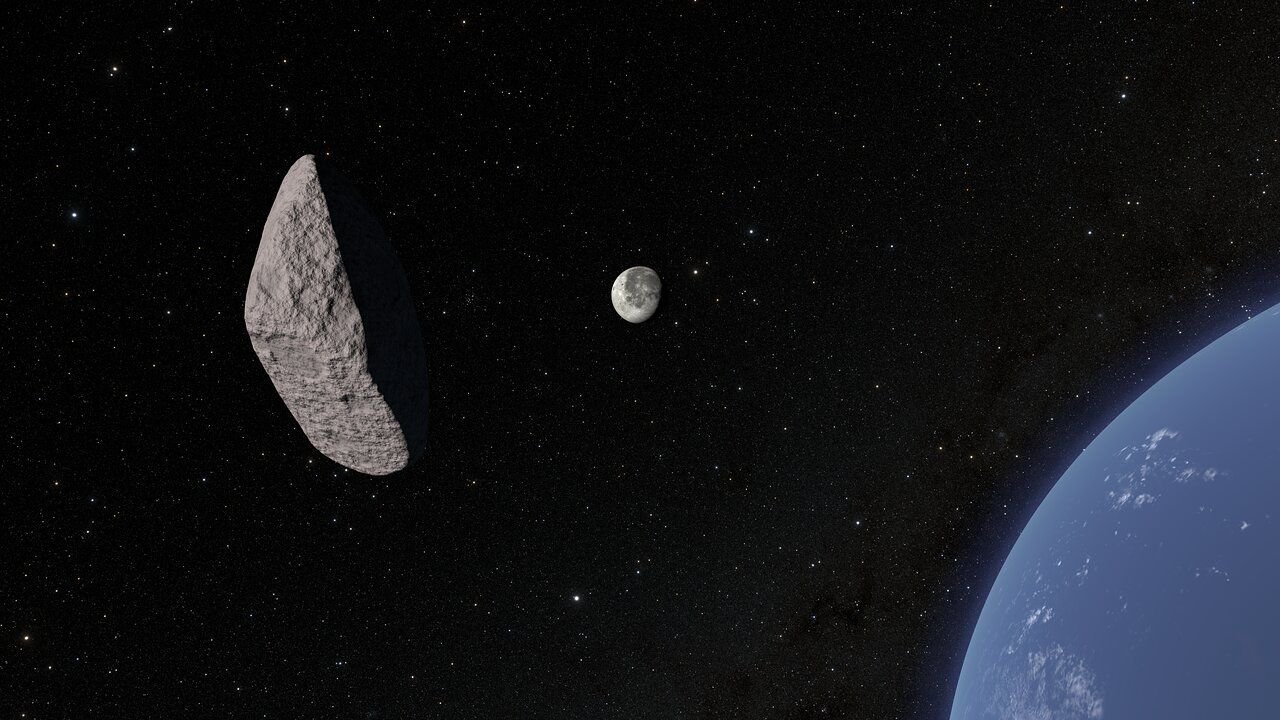
From Earth Alert to Lunar Uncertainty (Image Credits: Cdn.mos.cms.futurecdn.net)
Astronomers breathed a collective sigh of relief as new observations confirmed that a potentially hazardous asteroid will safely pass by Earth’s moon next decade.[1][2]
From Earth Alert to Lunar Uncertainty
Discovered on December 27, 2024, by the ATLAS survey in Chile, asteroid 2024 YR4 quickly drew attention for its close approaches to Earth.[3] Early trajectory calculations in early 2025 flagged a peak 3.1 percent chance of striking our planet on December 22, 2032, marking it as the highest-risk object of its size in two decades.[3] Global observatories ramped up efforts, and by April 2025, additional data eliminated the Earth impact risk entirely.[1]
Attention then shifted to the moon. Risk assessments pegged a 4.3 percent probability of lunar impact on the same date, enough to warrant close monitoring.[2] Scientists modeled a potential crater spanning 500 to 2,000 meters if the strike occurred, releasing energy equivalent to 5.2 megatons of TNT.[3] The scenario captivated researchers, who anticipated a visible flash from Earth.
James Webb Telescope Delivers Precision
NASA’s James Webb Space Telescope stepped in with critical observations. Data gathered on February 18 and 26, 2026, captured the faint asteroid, among the dimmest targets ever tracked by the observatory.[1] These infrared images refined the orbit without altering its path, narrowing uncertainties in the 2032 position.[4]
The results proved decisive. NASA’s Center for Near-Earth Object Studies at the Jet Propulsion Laboratory now projects a miss distance of 13,200 miles, or 21,200 kilometers, from the lunar surface – well beyond collision range.[2] ESA astronomers echoed the findings, estimating over 20,000 kilometers clearance.[3] This update extended the observation arc to 428 days, solidifying predictions through the century.
Characteristics of the Would-Be Intruder
Measuring about 60 meters across, roughly the height of a 15-story building, 2024 YR4 qualifies as a “city-killer” in asteroid terms.[3][2] Its stony composition, likely S-type, features a rocky surface confirmed by JWST’s thermal imaging.[3]
- Elongated and flattened shape, with equatorial diameter three times the polar one.
- Retrograde spin every 19.5 minutes, driving orbital changes via the Yarkovsky effect.
- Apollo-group near-Earth asteroid, with perihelion inside Earth’s orbit.
- Close Earth approaches: 828,000 km in 2024, next in 2028 at 8 million km.
Such traits make it a prime subject for study, originating likely from the main asteroid belt.[3]
Lessons in Vigilance and Technology
This episode highlighted the value of international collaboration. Telescopes worldwide, from the Very Large Telescope to Gemini South, contributed data alongside JWST’s prowess.[3] Planetary defense systems like NASA’s CNEOS and ESA’s NEOCC demonstrated rapid response, turning initial alarms into precise forecasts.
Future watches include the 2032 flyby at 278,000 km from Earth, offering chances for more data before potential 2047 risks.[3] The non-event underscores proactive monitoring’s role in safeguarding celestial neighbors.
Key Takeaways
- JWST observations slashed lunar impact odds from 4.3 percent to zero for December 22, 2032.
- Asteroid 2024 YR4, 60 meters wide, will pass the moon at over 21,000 km.
- Success story for global asteroid tracking and advanced telescopes.
With the moon secure, attention returns to the cosmos’s broader threats. What close calls have you followed? Share in the comments.