
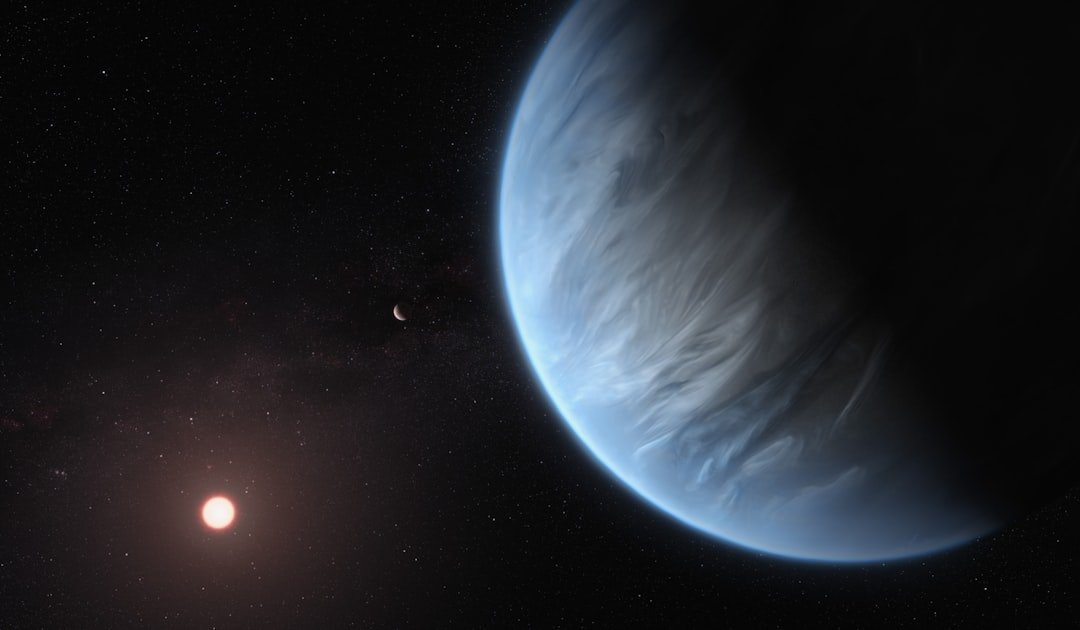
RAVEN Transforms Exoplanet Detection (Image Credits: Unsplash)
Warwick, UK – Researchers at the University of Warwick harnessed a cutting-edge artificial intelligence pipeline to validate 118 exoplanets lurking in NASA’s Transiting Exoplanet Survey Satellite (TESS) observations. The effort targeted data from more than 2.2 million stars collected during the mission’s initial four years. These findings sharpen astronomers’ understanding of close-orbiting worlds and highlight rare configurations that challenge existing models of planetary formation.[1]
RAVEN Transforms Exoplanet Detection
Astronomers faced longstanding hurdles in sifting genuine planetary transits from misleading signals, such as those produced by eclipsing binary stars. The RAVEN pipeline, developed primarily by Dr. Andreas Hadjigeorghiou, integrated detection, machine learning classification, and statistical validation into a seamless process. Trained on hundreds of thousands of simulated transits and false positives, RAVEN excelled at spotting subtle patterns humans might overlook.
Dr. Hadjigeorghiou explained the tool’s design: “RAVEN is designed to handle the whole process in one go, from detecting the signal, to vetting it with machine learning and statistically validating it. This gives the pipeline an additional edge over contemporary tools that only focus on specific parts of the workflow.” The framework achieved high accuracy, with area under the curve scores exceeding 97 percent across various false positive scenarios. Warwick researchers released interactive catalogs and cloud-based tools alongside the results, enabling global collaboration.[3]
Rare Worlds Emerge from the Data
Among the validated planets, several stood out for their extreme proximity to host stars. Ultra-short-period planets, which complete orbits in under 24 hours, featured prominently, as did previously undetected multi-planet systems where multiple worlds huddled close together. These configurations offered fresh glimpses into dynamic environments shaped by intense stellar radiation.
The pipeline also identified planets in the so-called Neptunian desert, a sparse zone near stars depleted of Neptune-sized worlds. Dr. Marina Lafarga Magro, lead author of the study and a postdoctoral researcher at Warwick, noted: “Using our newly developed RAVEN pipeline, we were able to validate 118 new planets, and over 2,000 high-quality planet candidates, nearly 1,000 of them entirely new.”[1] In total, RAVEN processed candidates with orbital periods under 16 days and transit depths above 300 parts per million, yielding over 2,000 reliable prospects.
Refined Demographics of Close-In Planets
The analysis delivered precise occurrence rates for planets around Sun-like FGK stars. Roughly 9 to 10 percent of such stars host at least one close-orbiting world, aligning with earlier Kepler findings but with uncertainties reduced by up to a factor of ten. This cleaner dataset allowed mapping of planet sizes and periods with unprecedented clarity.
| Planet Category | Occurrence Rate (Sun-like Stars) |
|---|---|
| Any close-in planet | 9–10% |
| Neptunian desert planets | 0.08% |
Dr. Kaiming Cui, who led the population study, highlighted the breakthrough: “For the first time, we can put a precise number on just how empty this ‘desert’ is.” Theories suggest high-energy radiation strips atmospheres from Neptune-like planets in this region, or migration processes prevent their formation there. RAVEN’s results tested these ideas directly.[1]
Tools and Horizons for Astronomy
Senior author Dr. David Armstrong emphasized RAVEN’s broader utility: “RAVEN allows us to analyse enormous datasets consistently and objectively. Because the pipeline is well-tested and carefully validated, this is not just a list of potential planets — it is also reliable enough to use as a sample to map the prevalence of distinct types of planets around Sun-like stars.” The team published findings in three Monthly Notices of the Royal Astronomical Society papers, supported by UK Research and Innovation funding.
Interactive resources now empower researchers to prioritize follow-up observations with ground-based telescopes or upcoming missions like the European Space Agency’s PLATO. These tools promise to accelerate discoveries in planetary demographics and system architectures.
Key Takeaways
- 118 exoplanets newly validated, plus over 2,000 candidates from TESS data.
- First precise measure of the Neptunian desert at 0.08 percent occurrence.
- RAVEN pipeline publicly available for ongoing exoplanet hunts.
This work underscores artificial intelligence’s role in unlocking cosmic secrets from archival data. As TESS continues scanning the skies, RAVEN equips astronomers to chart the galaxy’s planetary landscape with greater precision. What implications do these close-in worlds hold for our understanding of planetary evolution? Share your thoughts in the comments.