

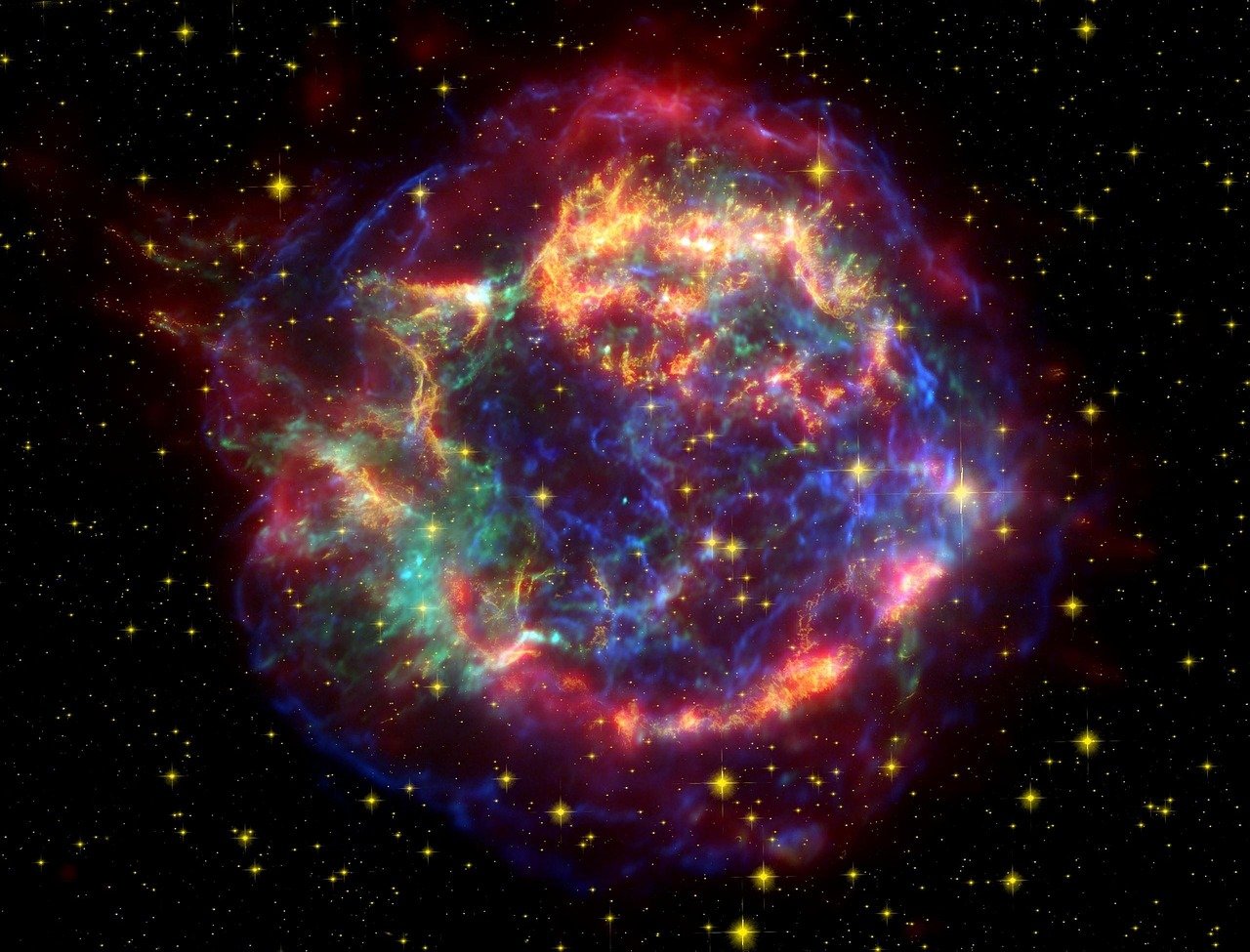
Historic Detection with the Very Large Array (Image Credits: Pixabay)
Charlottesville, VA – Astronomers captured unprecedented radio emissions from a Type Ibn supernova, revealing how a massive star violently shed material in the years leading to its destruction.[1][2]
Historic Detection with the Very Large Array
Researchers monitored faint radio waves from supernova SN 2023fyq for about 18 months after its explosion. The National Science Foundation’s Very Large Array in New Mexico detected these signals between 58 and 525 days post-blast. This marked the first radio observation of a Type Ibn event.[3]
Lead author Raphael Baer-Way, a doctoral student at the University of Virginia, described the data as a time machine. “We were able to use radio observations to ‘view’ the final decade of the star’s life before the explosion,” he stated.[2] The emissions arose when the supernova’s shockwave collided with surrounding gas, producing a detectable echo invisible to optical telescopes.
Unraveling the Type Ibn Mystery
Type Ibn supernovae arise when stripped-envelope stars explode into helium-rich circumstellar material they ejected beforehand. SN 2023fyq exemplified this rare class, where the progenitor star lost its outer layers dramatically. Radio data pinpointed intense mass shedding, especially in the final five years.[4]
Unlike common supernovae, these events feature strong interactions between ejecta and pre-existing gas shells. The helium abundance distinguished SN 2023fyq, confirming the star’s composition. Such observations filled gaps left by light-based studies, which often miss pre-explosion details.
Signs Point to Binary Interaction
The scale of mass loss challenged models of isolated stars. Researchers inferred that a companion star in a binary system drove the process through gravitational tides. This interaction distorted the primary star’s envelope, triggering rapid ejection of helium-rich gas.[1]
Baer-Way noted, “To lose the kind of mass we saw in just the last few years… it almost certainly requires two stars gravitationally bound to each other.”[3] The radio “mirror” reflected this late-stage turmoil, reconstructing the star’s evolution timeline.
Key Findings from the Observations
The study highlighted several breakthroughs in understanding massive star deaths:
- Radio waves traced gas expulsion over the last decade, peaking in the final five years.
- First confirmation of pre-explosion mass loss in a Type Ibn supernova via radio.[2]
- Evidence favored binary companions over single-star scenarios.
- Need for prompt radio follow-up, as signals fade quickly.
- Potential to survey diverse supernovae for hidden mass-loss patterns.
Co-author Maryam Modjaz, a University of Virginia professor, emphasized the urgency: “Raphael’s paper has opened a new window to the universe for studying these rare, but crucial supernovae.”[4]
Pathways to Future Discoveries
Findings appeared in The Astrophysical Journal Letters under the title “The First Radio View of a Type Ibn Supernova in SN 2023fyq.”[1] Multi-wavelength campaigns could now probe more events, clarifying binary roles in stellar fates. Radio tools promise insights into distant explosions, reshaping views on massive star diversity.
Key Takeaways
- Radio offers a “time machine” for pre-supernova mass loss undetected optically.
- Binary interactions likely fueled the star’s final outburst.
- Early radio monitoring will unlock more stellar death secrets.
This discovery underscores how companions shape explosive ends, urging expanded surveys. What do you think about these radio revelations? Tell us in the comments.