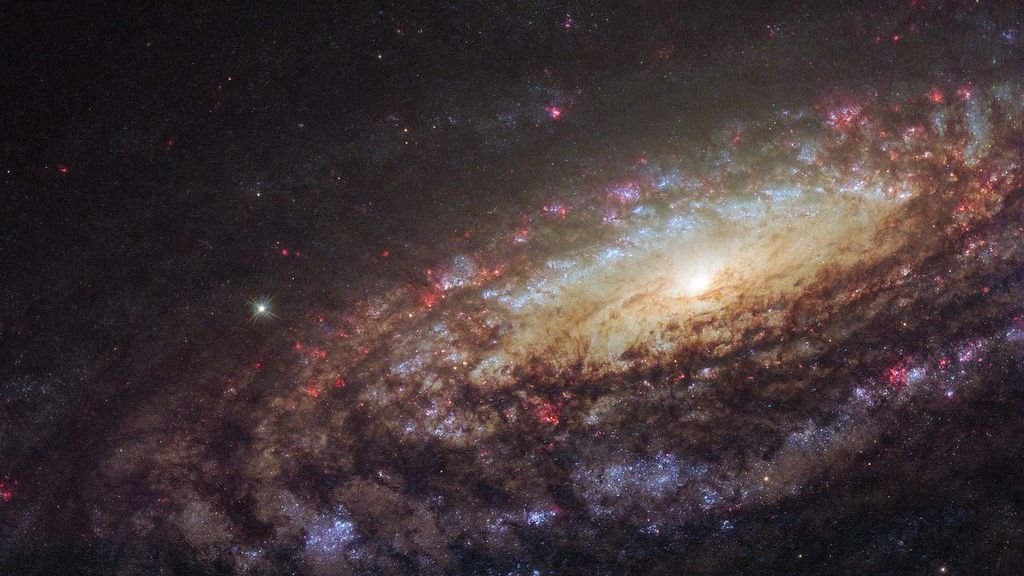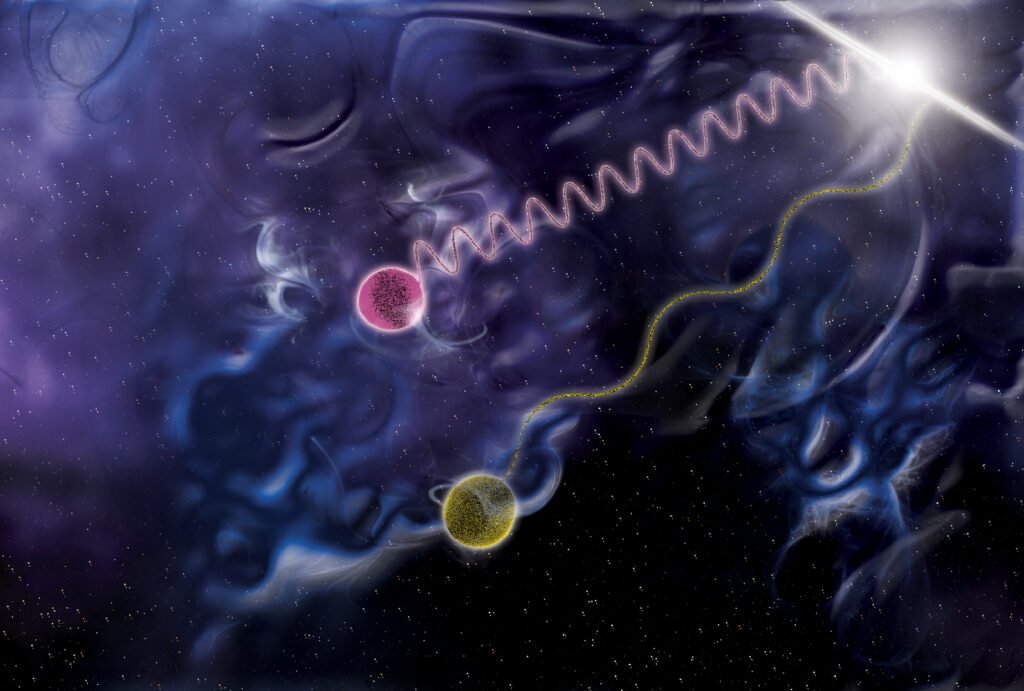


The Quest to Merge Quantum Mechanics and Gravity (Image Credits: Upload.wikimedia.org)
Scientists have begun leveraging tools from quantum information theory to probe the enigmatic link between gravity and quantum mechanics, potentially upending long-held views on the fabric of reality.
The Quest to Merge Quantum Mechanics and Gravity
Physicists have long grappled with reconciling quantum mechanics, which governs the microscopic world, and general relativity, the theory describing gravity on cosmic scales. Recent efforts focus on whether gravity itself emerges from quantum processes. A new approach draws from quantum information principles to test this idea directly.
Researchers examined how gravitational interactions might generate quantum entanglement between particles. This phenomenon, known as gravitationally induced entanglement, could reveal if the gravitational field requires quantization. Experiments aim to detect entanglement in massive bodies influenced solely by gravity, offering clues about the field’s quantum nature.
Such investigations build on foundational quantum experiments. The Mach-Zehnder interferometer, for instance, demonstrates wave-particle duality, while the Stern-Gerlach experiment highlights spin quantization. These tools underscore the weirdness of quantum reality, now applied to gravity.
Entanglement as a Window into Quantized Gravity
Gravitationally induced entanglement stands out as a promising testbed. In this setup, two particles interact through gravity, and scientists check for correlated quantum states that classical gravity alone could not produce. If detected, it would suggest gravity operates on quantum rules.
The concept relies on Bell inequalities, which distinguish quantum correlations from classical ones. Violations of these inequalities in gravitational contexts would signal non-classical behavior. Quantum circuits provide a framework to model these interactions, simulating outcomes before real-world tests.
Early theoretical models predict measurable effects in controlled lab settings, such as with superconducting masses or Bose-Einstein condensates. Success here could confirm that gravity entangles particles, pushing theories toward a unified quantum gravity framework.
Unveiling Non-Classical Spacetime Through Causal Structures
Beyond entanglement, quantum information methods scrutinize spacetime’s causal order. In classical physics, events follow a strict timeline, but quantum effects might allow indefinite causal structures where sequences blur.
Studies explore how gravity influences these quantum causal relations. By analyzing process matrices – mathematical descriptions of quantum operations – researchers infer if spacetime deviates from classical expectations. Indirect evidence from such analyses points to non-classical spacetime geometry.
This line of inquiry connects to broader quantum gravity puzzles, like black hole information paradoxes. Resolving causal ambiguities could illuminate how information persists in extreme gravitational fields.
Key Building Blocks from Quantum Information Theory
To appreciate these advances, understanding core quantum concepts proves essential. Entanglement links particles so that measuring one instantly affects the other, defying classical intuition. Bell tests confirm this non-locality experimentally.
Quantum circuits offer a visual language for computations, now adapted to gravitational scenarios. They help predict how quantum states evolve under weak gravitational influences.
- Mach-Zehnder interferometer: Illustrates interference patterns key to quantum superposition.
- Stern-Gerlach experiment: Reveals discrete quantum outcomes in magnetic fields.
- Bell inequalities: Quantify limits on classical correlations, often violated quantumly.
- Entanglement: The “spooky action” enabling gravitational probes.
- Quantum circuits: Diagrams for modeling complex interactions.
These elements form the toolkit driving current research, as detailed in a recent arXiv preprint introducing the approach.
Implications for Physics and Beyond
These quantum information forays into gravity promise to reshape our understanding of the universe. If spacetime proves non-classical, it could validate theories like loop quantum gravity or string theory, where geometry emerges from quantum bits.
Practical tests remain challenging, requiring ultra-precise measurements to isolate gravitational effects from noise. Yet, progress accelerates, with labs worldwide gearing up for entanglement detection experiments.
Key Takeaways
- Gravitationally induced entanglement tests if gravity must be quantized.
- Causal structure analysis hints at spacetime’s quantum weirdness.
- Quantum basics like Bell inequalities and circuits underpin the methods.
As these discoveries unfold, they invite a reevaluation of reality’s foundations. What implications do you see for future technologies or our cosmic worldview? Share your thoughts in the comments.