
There’s a moment, the first time you really grasp quantum entanglement, when your brain almost rebels. It feels like the universe has been trolling us this whole time, hiding a rulebook that doesn’t care about common sense, distance, or even time in the way we’re used to. When I first read about two particles influencing each other instantly from across the galaxy, I genuinely thought I’d misunderstood the article.
But here we are in 2026, with experiments that keep confirming the same unsettling truth: nature plays by rules that feel more like science fiction than everyday life. Entanglement doesn’t just stretch our imagination, it breaks it and hands us a new one. From ultra-secure communication to the foundations of reality itself, this phenomenon is forcing us to ask uncomfortable questions: What does it even mean for something to be “real” or “separate” anymore?
The Weird Core Idea: What Entanglement Actually Is
Imagine rolling two dice on opposite sides of the planet and somehow always getting perfectly linked results, even though no message could possibly travel between them fast enough. That’s the flavor of quantum entanglement, except instead of dice, we’re talking about particles like photons, electrons, or atoms. When particles become entangled, their properties are no longer independent; measuring one instantly tells you something about the other, no matter how far apart they are.
It’s not that one sends a signal to the other at super-speed, at least not in any way we understand. It’s more like they share a single, connected state that only reveals its “choice” when you look. Until then, the system sits in a strange limbo where possibilities coexist instead of one definite outcome. That picture alone is enough to make your everyday sense of reality feel like a nice, comforting illusion.
Einstein’s “Spooky Action” And Why He Was Bothered
Albert Einstein famously hated this whole thing so much that he mocked it as spooky action at a distance. He believed nature had to be governed by deeper, hidden variables that kept everything sensible and local, meaning nothing could affect something else faster than light. In his view, entanglement just meant there was information we weren’t seeing yet, not that the universe was fundamentally weird.
For decades, that seemed like a reasonable stance: either quantum theory was incomplete, or there was some more “normal” explanation waiting to be found. But as experiments improved, the world slowly cornered Einstein’s hope. It turned out that if you accept the data we’ve measured, you’re stuck with a universe that either gives up local realism or accepts something even stranger. Spoiler: local realism lost.
Bell’s Theorem: The Math That Killed Local Realism
In the 1960s, physicist John Bell did something quietly revolutionary: he turned a philosophical argument into a testable inequality. Bell’s theorem basically said, if the world obeys local realism – where things have definite properties and no influence travels faster than light – then certain statistical limits must never be crossed in experiments with entangled particles. If quantum mechanics is right, those limits get smashed.
Over the years, researchers ran these tests again and again with photons, atoms, and more elaborate setups, and the same pattern kept showing up: nature violates Bell’s inequality. In plain language, this means you can’t keep both locality and realism in the classical sense. The vast majority of data says the universe either allows some sort of nonlocal correlation or your idea of “things having properties before you measure them” is just wrong at a fundamental level.
Modern “Loophole-Free” Experiments That Sealed The Deal
For a long time, skeptics pointed to potential loopholes in Bell-test experiments: maybe the detectors weren’t efficient enough, or the experimenters accidentally biased the settings, or there were hidden connections we weren’t accounting for. But in the mid-2010s and after, several independent teams performed so-called loophole-free Bell tests. They used fast, random setting choices, high-efficiency detectors, and separated particles so far apart that no light-speed signal could cheat the result.
The outcome was brutally consistent: quantum entanglement was real, and classical local realism was not. These experiments stretched over kilometers, and some even used cosmic sources to pick random settings, as if to say, “Fine, let the universe itself choose.” Even then, the violations persisted. At this point, denying entanglement is like denying that the sun rises: you can, but you’re arguing with a mountain of carefully tested evidence.
Faster Than Light? Why Entanglement Doesn’t Let You Break Physics
Here’s where things get tricky: if two entangled particles seem to coordinate instantly, doesn’t that mean information travels faster than light? Strangely, no – at least not in any way that helps you send a usable message. When you measure one particle, you get a random outcome, and your partner measuring the other particle also gets a random outcome. The magic only appears when you later compare notes and see the correlations.
Because each individual measurement is random, you can’t control what result you send to the other side, so you can’t encode a message. The speed-of-light limit survives, even if the underlying correlations feel nonlocal and bizarre. It’s like having a pair of perfectly synchronized dice that always add up to seven, but you only discover that after texting each other your results later. The pattern is undeniable, but the universe stubbornly refuses to let you turn that pattern into a galactic telephone.
Entanglement As A Real-World Resource, Not Just A Parlor Trick

For a long time, entanglement sounded like something that belonged in philosophy debates and late-night dorm conversations. Then researchers realized it’s actually a kind of fuel for new technologies. In quantum information science, entanglement is treated as a resource you can create, store, swap, and even distill, almost like energy or bandwidth. The more entanglement you have, the more powerful certain quantum protocols become.
This shift from “weird phenomenon” to “usable ingredient” completely changed the field. Quantum cryptography, quantum teleportation, and many quantum computing algorithms rely directly on entangled states. Labs now build devices specifically designed to generate and manipulate entangled photons and atoms with increasing reliability. What used to be a philosophical headache is now something engineers actively try to mass-produce.
Quantum Teleportation: Moving States, Not Starship Crews
Quantum teleportation sounds like something straight out of a sci‑fi script, but the reality is both less dramatic and more profound. You’re not teleporting physical objects or people; you’re teleporting the quantum state of a particle from one location to another using entanglement and classical communication. The original state is destroyed at the sender’s side and recreated at the receiver’s side, preserving the no-cloning rule of quantum mechanics.
Researchers have demonstrated quantum teleportation over fiber networks and even between the ground and satellites, pushing it over hundreds and then thousands of kilometers. It’s a key building block for future quantum networks, where entanglement lets distant nodes share information in ways classical networks can’t match. You won’t be beaming onto a starship anytime soon, but your data might someday take a quantum shortcut that would make any sci‑fi writer proud.
Quantum Communication And The Birth Of The Quantum Internet
Entanglement is at the heart of ultra-secure quantum communication, where eavesdropping isn’t just hard, it’s fundamentally detectable. In quantum key distribution, any attempt to intercept the entangled particles changes their state and shows up as an error rate spike. This gives communicating parties a built-in warning system that classical encryption could only dream of. Several countries have already demonstrated long-distance quantum-secured links using satellites and fiber networks.
The long-term vision is a quantum internet: a global network where entangled states are distributed between distant nodes, enabling secure communication and remote access to quantum processors. To get there, researchers are building quantum repeaters, quantum memories, and better sources of entangled photons. It’s a messy, incremental process, but step by step, what started as a “spooky” curiosity is turning into infrastructure. The cables and satellites of tomorrow may quietly run on the strangest feature of modern physics.
Entanglement, Black Holes, And The Fabric Of Spacetime
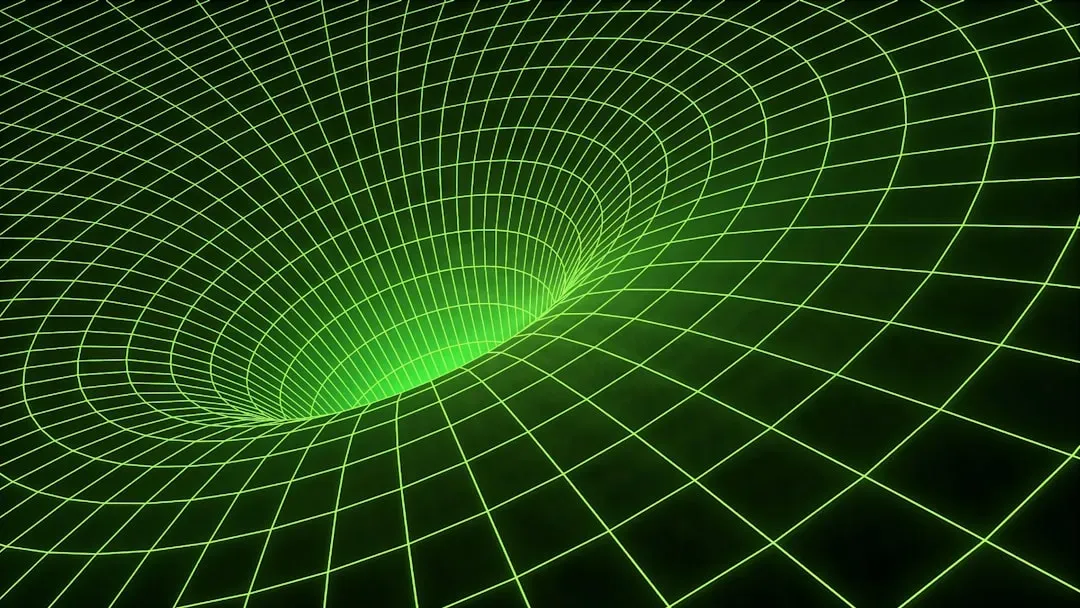
As wild as it sounds, some of the most ambitious ideas in theoretical physics now treat entanglement as a kind of glue that might literally hold spacetime together. In certain models of quantum gravity, the geometry of space emerges from patterns of entanglement between underlying quantum degrees of freedom. This leads to the provocative thought that where there is less entanglement, there may literally be “less space.”
Black hole research has pushed this even further, linking entanglement to puzzles like the information paradox and the nature of event horizons. Some proposals suggest deep connections between entangled pairs and hypothetical tiny wormhole-like structures, not in a sci‑fi travel sense, but as a mathematical reflection of how information is organized. None of this is settled, and it’s still a fiercely active research area, but the fact that entanglement keeps showing up at the foundations of spacetime is hard to ignore.
What Entanglement Says About Reality Itself

Entanglement forces an uncomfortable question: if two distant things behave like one unified system, what does “separate” really mean? Some interpretations of quantum mechanics suggest that properties don’t exist in a definite way until they’re measured, while others say everything evolves smoothly but we only experience one branch of many possibilities. Either way, our intuitive idea of a world made of independent, local objects starts to look more like a helpful story than a literal description.
Personally, the more I read, the less convinced I am that reality lines up with how our brains like to picture it. Our senses evolved to keep us alive on a planet with rocks, trees, and predators, not to understand entangled photon pairs or the deep structure of spacetime. Quantum entanglement is a reminder that nature doesn’t owe us simplicity or comfort; it only owes us consistency. And the universe, in all its strange coherence, seems to be saying: this is how it works – were you expecting something less bizarre?