
Imagine changing something in your living room and, at the exact same instant, something across the galaxy reacts as if the two were secretly in on the same joke. That is the kind of bizarre behavior you step into when you explore quantum entanglement. It is one of those ideas that sounds like science fiction at first, but the more you learn about it, the more you realize it is quietly reshaping how you think about reality, information, and even the limits of technology.
You are not just learning an abstract theory when you dive into entanglement; you are walking into a place where your everyday intuition no longer works. Up becomes sideways, cause and effect get fuzzy, and the universe starts to look less like a collection of separate objects and more like a deeply connected web. If you have ever enjoyed being a little mind-blown, entanglement is going to feel like your favorite new rabbit hole.
What Quantum Entanglement Actually Is

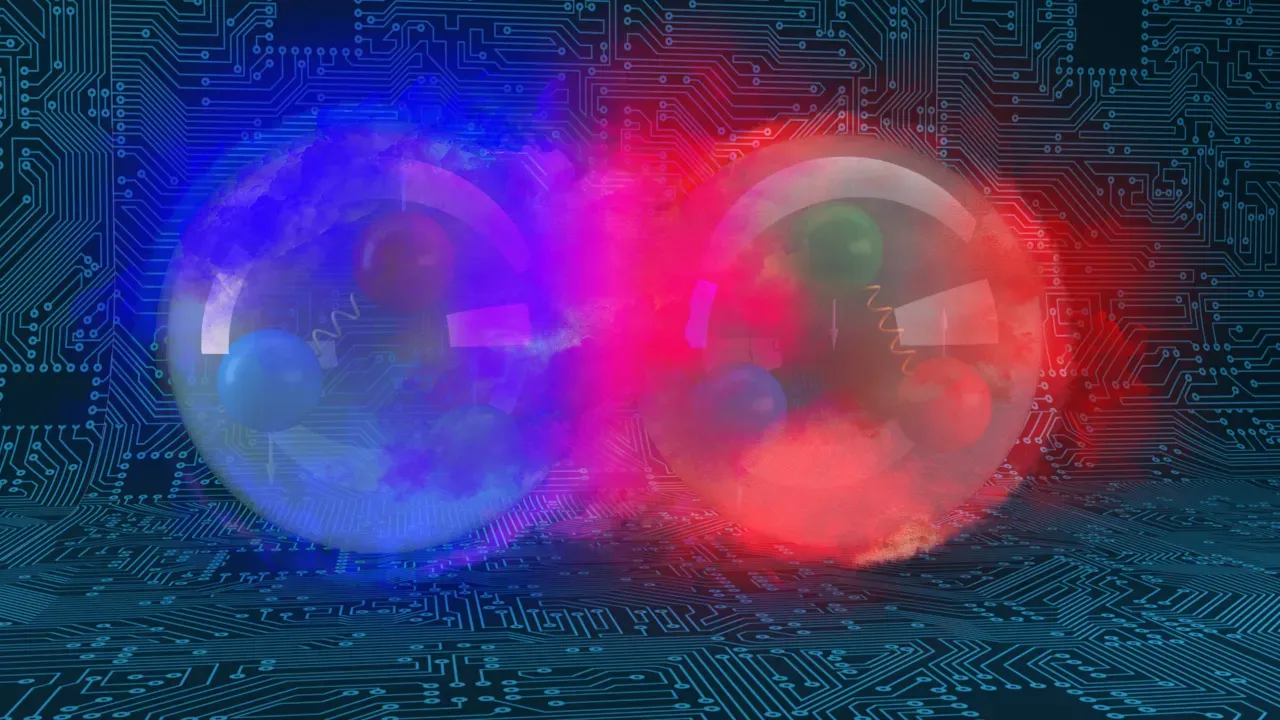
When you hear that two particles are entangled, what you are really hearing is that they share a single, unified quantum state, even when they are far apart. Instead of each particle having its own independent set of properties, they behave like pieces of one system, as if they are locked into a shared script. You can picture it like a pair of perfectly synchronized dice: whenever you roll one, the other somehow knows exactly what to show, no matter how far away it is.
The strange part is that before you measure them, the possible outcomes do not exist as fixed values in the usual sense. Instead, they exist in a spread of possibilities described by quantum theory. As soon as you measure one particle, you force a definite result, and the other particle’s state becomes fixed instantly to match the rules of their shared connection. You are not sending a signal faster than light; you are revealing something that was already encoded in the joint state but had no definite, classical description until you looked.
Why Distance Does Not Break the Connection

One of the most shocking things you discover about entanglement is that distance does not seem to matter at all. You can separate entangled particles by meters, kilometers, or even imagine them at opposite sides of the universe, and the correlations between their measurements still follow the same strange quantum rules. In your everyday world, if two objects influence each other, they usually need to push, pull, or send some kind of signal. Entanglement does not work like that; it acts more like a shared story that plays out consistently wherever the characters are.
When you measure one particle and immediately know something about its partner, it is tempting to think of a hidden message shooting through space faster than light. However, the rules of quantum mechanics carefully prevent you from using this effect to send actual information instantaneously. What you get instead is a pattern of outcomes that only reveals its full structure when you compare notes afterward, using ordinary, slower-than-light communication. The connection is real, but it lives in the correlations between results, not in a usable faster-than-light signal.
How You Can Visualize Entangled States

Because you cannot literally see quantum states with your eyes, it helps to lean on metaphors that bring them down to earth. You might imagine entangled particles as two coins that are somehow linked so that whenever you flip them, the results are always related in a specific way. The catch is that before you flip them, they are not secretly sitting as heads or tails; they are in a fuzzy mix of possibilities that only settles when you look. The entanglement is like a rulebook that says how their outcomes must match, even though each individual flip seems random to you.
Another way to picture it is as a shared playlist that exists in the cloud instead of on any single device. Each particle is like a device that can access the same playlist, but the songs only start playing once you hit play on one of them. The important thing is not where the devices are located but that they are tied into the same underlying list of songs. In a similar way, entangled particles are not carrying separate, fixed instructions; they are part of a single, spread-out quantum description that you only partially uncover with each measurement.
What Bell’s Theorem Means for Your Intuition
When you first hear about entanglement, you might try to rescue your intuition by assuming that each particle carries hidden instructions from the start, telling it how to behave in every possible situation. Bell’s theorem is the mathematical result that shows you this comforting picture cannot fully explain what experiments actually observe. When physicists test entangled particles in clever ways, they find correlations that go beyond what any set of pre-written, local instructions could ever produce. Your familiar, classical ideas about separate objects with fixed properties simply do not stretch far enough.
What this means for you, at a deeper level, is that the world appears less like a stage filled with independent actors and more like a single play where the script is written in a language of probabilities and connections. The outcomes you see are still definite when measured, but the underlying reality does not behave as if things are just sitting there with fixed values, waiting to be read. Instead, the universe forces you to accept that measurement, context, and relationships are not optional details; they are built into the fabric of what is real. Your intuition has to expand to include nonlocal correlations that defy everyday logic, yet still respect the speed-of-light limit on usable signals.
How Entanglement Powers Quantum Computing
When you step into the world of quantum computing, entanglement stops being a philosophical curiosity and turns into a working resource. A regular computer processes bits that are either zero or one, but a quantum computer works with qubits that can occupy combinations of zero and one at the same time. When those qubits are entangled, you are no longer just dealing with separate pieces of information; you are dealing with a web of possibilities that your algorithm can explore in a highly coordinated way. This interconnectedness lets certain quantum algorithms cut through complex problems that would bog down a classical machine.
You can think of entangled qubits as a team of problem-solvers who always keep track of each other’s choices in a way ordinary teammates never could. Instead of trying solutions one by one, an entangled system can evaluate many potential pathways at once, then interfere with itself to amplify the useful answers and cancel out the dead ends. That does not mean quantum computers magically solve everything instantly, but it does mean that for some tasks, like factoring large numbers or simulating molecules, they can offer a huge speed boost. Entanglement is the invisible glue that makes that collective quantum behavior possible.
How Quantum Communication Uses Entangled Pairs
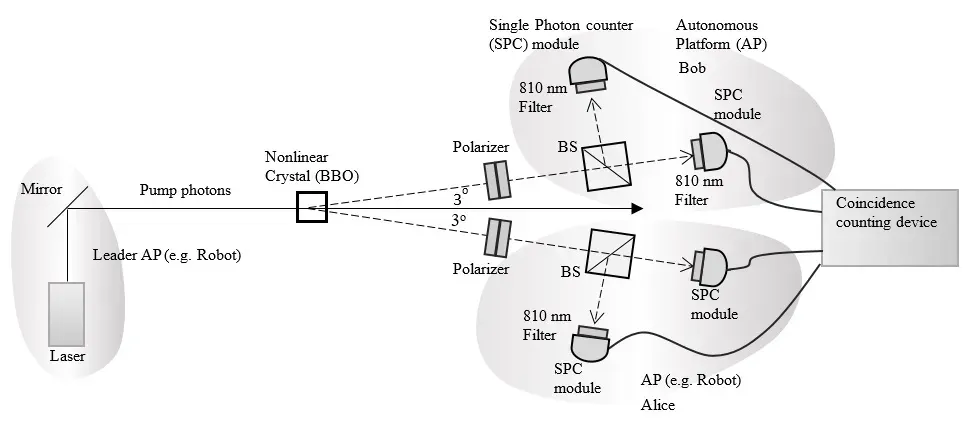
In quantum communication, you use entanglement less as a way to shout across the universe and more as a way to guarantee security and integrity. When you share entangled particles between two locations, the measurement outcomes they produce are linked in a way that cannot be fully copied or intercepted without leaving a trace. If someone tries to eavesdrop by measuring or tampering with the particles, the pattern of correlations changes, and you can spot the intrusion. You are not beating the speed of light; you are harnessing the fragility of quantum states to protect your information.
Quantum key distribution is one of the clearest examples of how this plays out in practice. You and a partner each measure parts of entangled pairs using agreed-upon settings, then compare some of your data over a classical channel to check for tampering. If everything looks clean, the remaining measurement results can be turned into a shared secret key for encryption. The magic is that the security comes from the laws of physics rather than from the difficulty of solving a mathematical puzzle. You are essentially making use of the fact that entanglement cannot be copied perfectly without breaking itself.
What Entanglement Says About Reality Itself

Once you get past the technical details, entanglement pushes you to ask uncomfortable questions about what is actually real. If two particles separated by huge distances do not have independent properties until you measure them, then your old picture of a universe made of tiny, self-contained building blocks starts to wobble. Instead, you are nudged toward a view where relationships and correlations are just as fundamental as the objects involved. Reality looks less like a set of isolated dots and more like a pattern woven into a fabric, where pulling a thread in one place subtly shapes the design somewhere else.
This does not mean you have to throw out everything you know about everyday physics. At the scales you live in, classical ideas work beautifully and keep your world predictable. But when you peer into the quantum layer underneath, you see that the rules are far stranger and more intertwined than your common sense suggests. You are faced with the possibility that space and separation are not as absolute as they feel, and that the universe might be deeply holistic in ways your language struggles to capture. Entanglement becomes a clue that your ordinary picture of the world is only an approximation of something richer.
How Experiments Across the World Keep Stress-Testing Entanglement
To trust any of this, you want more than wild ideas; you want experiments that keep trying to break the theory and fail. Over the years, researchers have pushed entanglement tests over longer distances, with tighter controls, and with fewer loopholes for classical explanations to hide in. They have sent entangled photons across cities, up to satellites, and through fibers, repeatedly checking whether the correlations match quantum predictions. Time and again, the results have lined up with the strange, nonlocal patterns that quantum mechanics demands, rather than the safer, classical alternatives.
These experiments are not just confirmations; they are stepping stones to real-world technology. When you prove that entanglement holds under messy, realistic conditions, you gain confidence that quantum networks, secure channels, and distributed quantum computing might actually work outside a pristine lab. You are watching the field move from thought experiments on chalkboards to hardware that might one day underpin parts of your digital life. Each new test is both a stress test of the foundations of physics and a rehearsal for future systems that will rely on these fragile, connected states.
When you pull back and look at the big picture, quantum entanglement turns out to be more than a strange footnote in physics. It challenges how you think about distance, separateness, and information, while also giving you concrete tools for computing and communication. You find yourself in a universe where two tiny particles can behave like a single system, even when they are worlds apart, and where that weirdness can be turned into practical power rather than just philosophical confusion. In the end, you are left with a simple but unsettling realization: the deep structure of reality might be far more connected than your everyday senses ever let on.