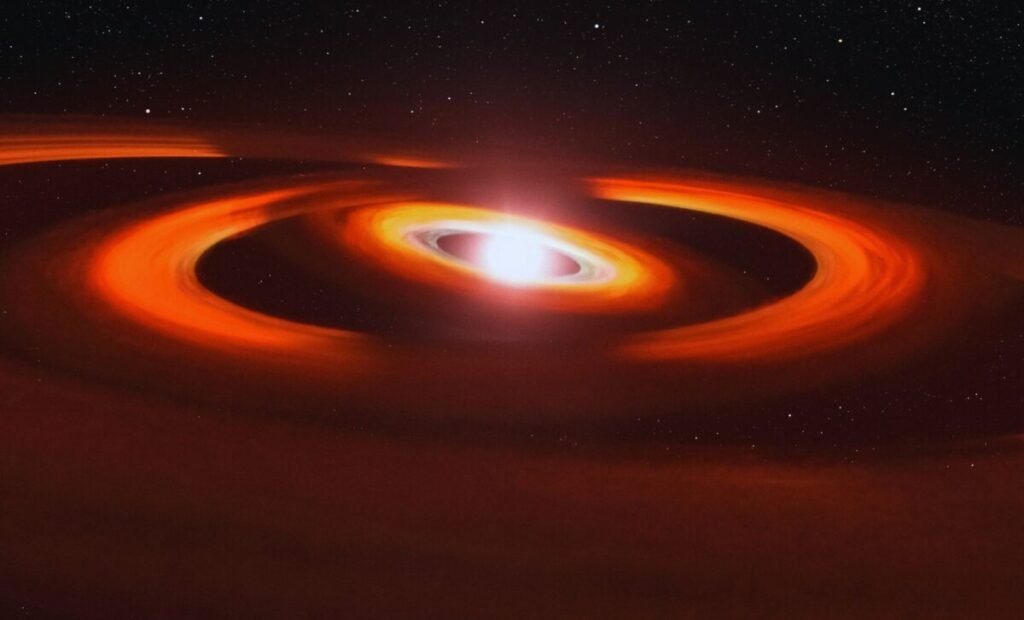

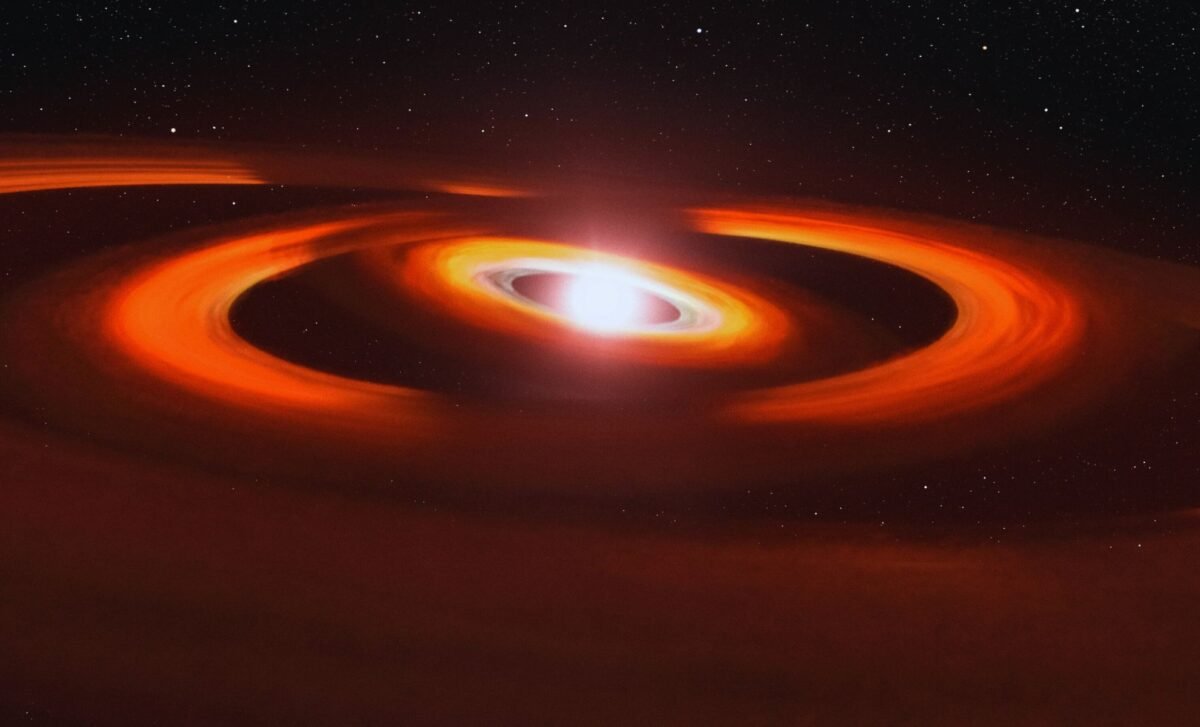
Signal Emerges from Cosmic Chaos (Image Credits: Dailygalaxy.com)
Galactic Center – Astronomers detected a promising radio signal from a potential ultra-fast pulsar positioned tantalizingly close to Sagittarius A*, the supermassive black hole at our galaxy’s core.[1][2]
Signal Emerges from Cosmic Chaos
The finding surfaced during the Breakthrough Listen Galactic Center Survey, one of the deepest radio searches ever aimed at the Milky Way’s turbulent heart. Researchers processed vast datasets from the Green Bank Telescope, dedicating 11 hours to the innermost 1.4 arcminutes around Sagittarius A*. This effort yielded terabytes of data, analyzed on high-performance computing clusters.[1]
Lead author Karen I. Perez, a recent Columbia University PhD graduate, spearheaded the study published in The Astrophysical Journal. The survey spotted just one intriguing candidate amid expectations of more pulsars, sparking questions about the region’s stellar population. The signal pulses every 8.19 milliseconds, marking it as a millisecond pulsar contender.[2]
Follow-up observations continue, with all data released publicly to invite global scrutiny and verification.[3]
Pulsars: Nature’s Precision Timekeepers
Pulsars consist of rapidly rotating neutron stars, the ultra-dense remnants of exploded massive stars. Their strong magnetic fields accelerate charged particles, producing beams of radio waves that sweep across space like a lighthouse. When these beams cross Earth’s line of sight, observers detect regular pulses.
Millisecond pulsars stand out for their stability, rivaling atomic clocks on Earth. Without disturbances, their pulses arrive with extraordinary predictability. External forces, however, introduce measurable deviations, turning these objects into sensitive probes of their environments.[4]
Probing Einstein in Extreme Gravity
Sagittarius A* packs about four million solar masses into a tiny volume, creating profound gravitational effects. A confirmed pulsar nearby would serve as an ideal laboratory for general relativity, Einstein’s theory describing gravity as space-time curvature.
Gravitational pull from the black hole would alter pulse timings, while signals passing close to it could bend or delay due to warped space-time. Slavko Bogdanov, a research scientist at Columbia’s Astrophysics Laboratory, explained: “Any external influence on a pulsar, such as the gravitational pull of a massive object, would introduce anomalies in this steady arrival of pulses, which can be measured and modeled. In addition, when the pulses travel near a very massive object, they may be deflected and experience time delays due to the warping of space-time, as predicted by Einstein’s General Theory of Relativity.”[1][2]
- Pulse arrival anomalies from orbital perturbations.
- Shapiro-like delays as signals graze the black hole’s influence.
- Deflections revealing space-time geometry near extreme mass.
Such measurements promise precision tests unmatched elsewhere, potentially confirming or challenging relativity in uncharted regimes.[3]
Obstacles in the Galactic Core
The central Milky Way brims with gas, dust, and stars, scattering radio waves and obscuring signals. Despite high sensitivity—detecting roughly 10% of expected millisecond pulsars and 50% of slower ones—only this lone candidate appeared. This scarcity puzzles astronomers, hinting at unique destruction or hiding mechanisms for neutron stars there.
Confirmation demands rigorous checks against interference or exotic sources. Perez noted: “We’re looking forward to what follow-up observations might reveal about this pulsar candidate. If confirmed, it could help us better understand both our own galaxy and General Relativity as a whole.”[1]
Collaboration accelerates progress, as international teams scrutinize the open data.
Key Takeaways
- A 8.19-millisecond pulsar candidate lies near Sagittarius A*, offering a rare GR testbed.
- Breakthrough Listen survey provides the deepest probe yet of the galactic core.
- Confirmation could redefine our grasp of gravity around supermassive black holes.
This discovery underscores the galactic center’s potential to reshape physics. What implications do you see if the pulsar proves real? Share your thoughts in the comments.