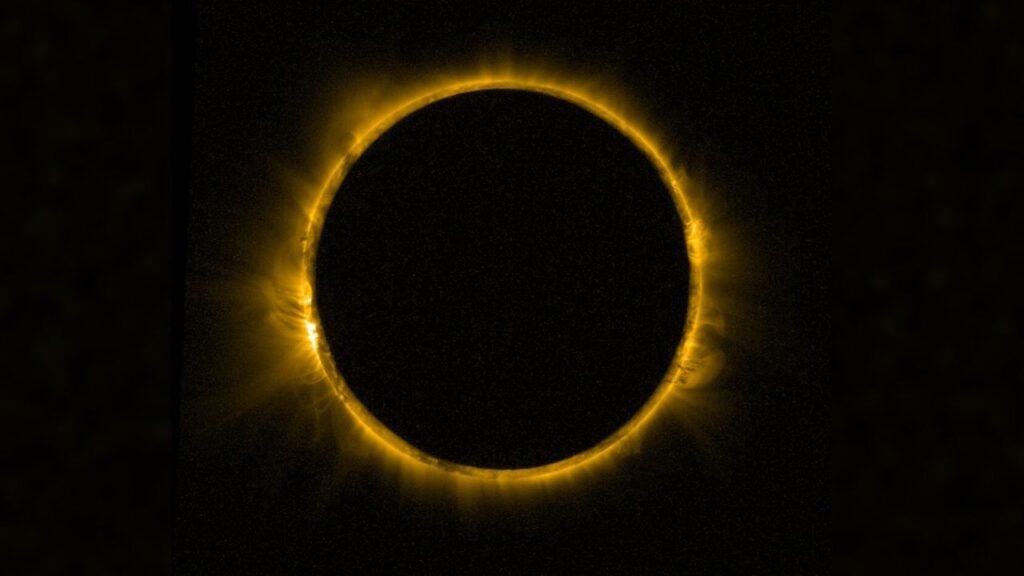

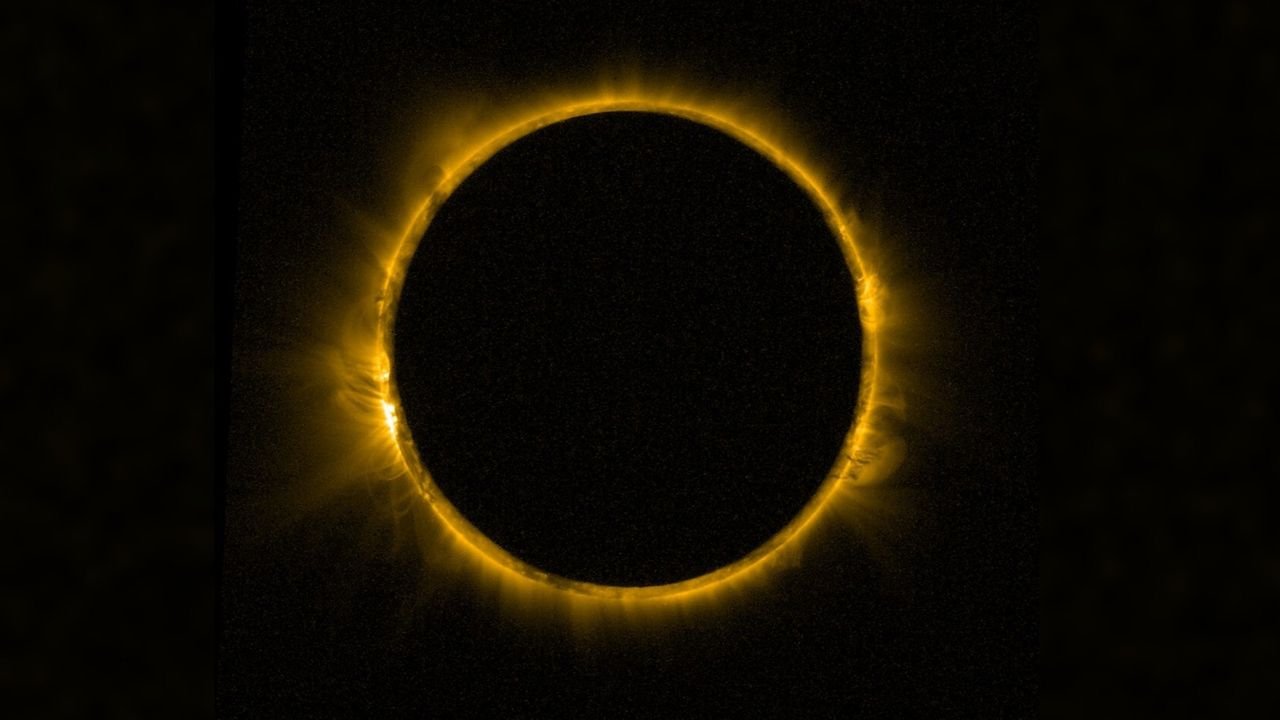
Rare Spectacle Lights Up Remote Skies (Image Credits: Cdn.mos.cms.futurecdn.net)
Earth orbit witnessed a mesmerizing annular solar eclipse on February 17, 2026, as ESA’s Proba-2 satellite documented the event multiple times from its unique perch.[1][2]
Rare Spectacle Lights Up Remote Skies
Fewer than a handful of scientists at Antarctic research stations savored the full “ring of fire” effect, where the moon’s silhouette framed a blazing solar halo.[3] This first eclipse of 2026 unfolded with a magnitude of 0.963, peaking at 12:12 UTC over coordinates deep in the frozen continent.[4]
Annularity lasted up to two minutes and five seconds at sites like Concordia Station, though harsh weather often obscured ground views. Partial phases reached observers in southern Africa, the tips of Argentina and Chile, and scattered Pacific islands. The event’s gamma value of -0.9743 positioned the path squarely over Antarctica’s vast ice sheets. Maximum duration hit 140 seconds within a narrow 616-kilometer band. Such alignments occur when the moon rides farther from Earth, appearing smaller against the sun’s disk.[3]
Satellite’s Orbit Unlocks Multiple Angles
Proba-2’s sun-synchronous orbit propelled it through the eclipse zone four times, granting perspectives unavailable to surface dwellers.[5] The spacecraft logged small partial eclipses in its first and fourth passes, an annular phase exceeding 93 percent obscuration in the second, and a near-total blackout during the third.
This repeated exposure highlighted the satellite’s agility in tracking solar phenomena. Ground teams at the Royal Observatory of Belgium processed the influx of data swiftly. The mission’s design ensured unobstructed solar stares, even as Earth rotated below. Such orbits prove invaluable for phenomena tied to specific geometries. Proba-2 thus amplified a fleeting event into a dataset rich with repetition.[2]
Precision Instruments Freeze the Fire
The SWAP extreme ultraviolet imager, tuned to 17.4 nanometers, snapped the iconic ring at 11:31 UTC during the second pass.[1] Operating in high-cadence mode, it fired off images roughly every 20 seconds, compiling sequences that traced the moon’s transit precisely.
Complementing SWAP, the LYRA radiometer detected signal dips across its channels, confirming the moon’s interruptions. Backup units ensured data integrity amid maneuvers. Calibrated outputs now reside in public archives, credited to ESA and the Royal Observatory of Belgium. These tools pierced the corona’s glow, revealing dynamics beyond visible light. The haul underscores Proba-2’s role in sustained solar vigilance since its 2009 launch.
| Passage | Obscuration Level | Type |
|---|---|---|
| First | Low | Partial |
| Second | >93% | Annular |
| Third | Near-total | Deep partial |
| Fourth | Low | Partial |
Boosting Solar Science from Above
Observations like these calibrate models of solar eclipses and coronal behavior. Proba-2’s EUV views complement ground telescopes hampered by atmosphere and weather. The eclipse belonged to Saros series 121, the 61st of 71 events. Future passes in this cycle promise more data points.
Antarctica’s isolation amplified the satellite’s value, extending the show to global audiences. Instruments captured not just visuals but irradiance shifts, aiding forecasts for space weather. Missions such as this pave the way for deeper corona probes.
- Annularity confined to Antarctica, partials across southern continents.
- Proba-2’s four passes yielded diverse data sets.
- SWAP and LYRA combined for multi-wavelength insights.
- Magnitude 0.963 marked a near-maximal annular display.
Key Takeaways
- First 2026 eclipse peaked at 12:12 UTC with 2+ minutes of annularity.
- Proba-2 imaged the ring of fire at 11:31 UTC in EUV light.
- Orbit enabled four unique observations, over 93% obscuration max.
Proba-2’s eclipse odyssey reminds us how space-based eyes expand our cosmic reach, turning isolated phenomena into shared wonders. What celestial event captivates you most? Share in the comments.