
The Puzzle of Cosmic Imbalance (Image Credits: Unsplash)
The universe teems with stars, galaxies, and planets, all built from ordinary matter. Yet physicists long puzzled over why matter triumphed over antimatter, which should have annihilated everything in the Big Bang’s aftermath.[1] A recent theory proposes that tiny primordial black holes formed in the early cosmos selectively consumed antimatter, tipping the balance in matter’s favor.
The Puzzle of Cosmic Imbalance
Standard Big Bang cosmology predicted equal amounts of matter and antimatter. When particles meet their antiparticles, they annihilate into energy, leaving a void. Observations reveal no such void; instead, a slight excess of matter endured, forming the structures we see today.[1]
This asymmetry, quantified at about one extra matter particle per billion matter-antimatter pairs, defies simple explanation. Decades of experiments at facilities like CERN confirmed no obvious violation sufficient to account for it. Theorists invoked Sakharov conditions: baryon number violation, C and CP symmetry breaking, and departure from thermal equilibrium.
Torsion: Gravity’s Hidden Spin
General relativity describes gravity through spacetime curvature alone. Einstein-Cartan theory extends this by including torsion, an antisymmetric twist sourced by the intrinsic spin of fermions like quarks and electrons.[1] At everyday densities, torsion remains negligible, matching tested predictions.
Nikodem Poplawski, a physicist at the University of New Haven, showed torsion renders the Dirac equation nonlinear. This cubic self-interaction alters energy eigenvalues for spinors. Fermions and antifermions acquire distinct dispersion relations; their effective masses diverge with density, peaking near the Cartan density of roughly 10^45 kg/m³ prevalent in the infant universe.[1]
Antimatter emerges heavier and slower than matter counterparts. This violates charge conjugation (C) and charge-parity (CP) symmetries naturally, without extra particles.
Capture Asymmetry and Black Hole Feeding
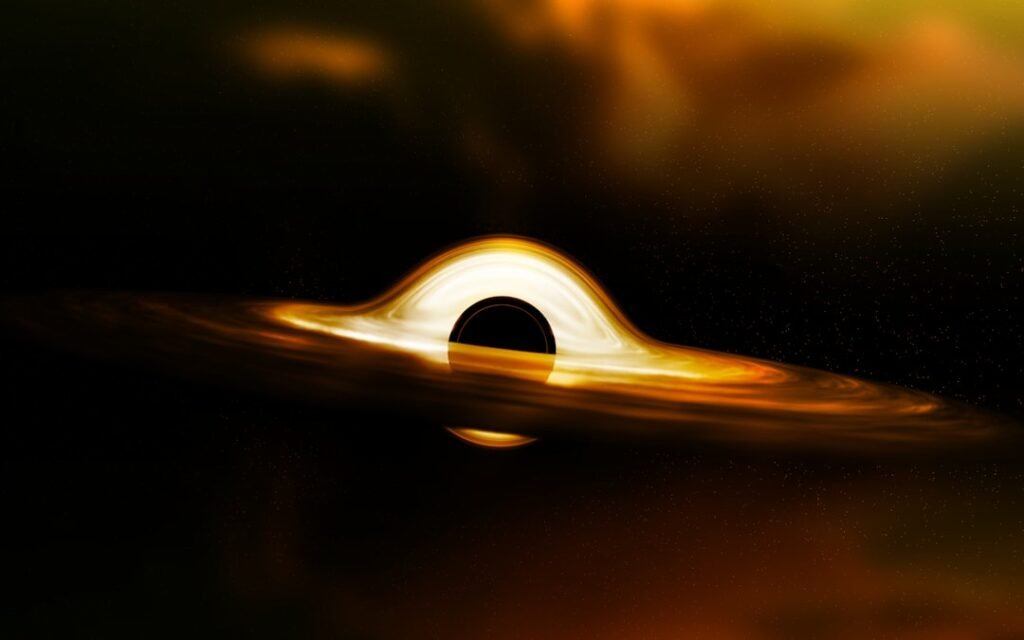
Primordial black holes arose from density fluctuations in the hot, dense early universe, mere instants after the Big Bang. These minuscule singularities dotted the cosmos, their event horizons hungry for nearby particles.[1]
Slower antimatter particles faced higher gravitational capture cross-sections. Black holes accreted antimatter preferentially, sequestering it beyond escape. Matter, zipping faster, evaded many such traps. Over time, this black-hole capture asymmetry depleted antimatter, leaving matter to dominate.
- Torsion-induced mass gap: Antimatter heavier by terms proportional to spin density.
- Velocity disparity: Slower speeds boost infall probability.
- One-way infall: Event horizons ensure permanent removal.
- Sakharov fulfillment: C/CP violation via torsion, disequilibrium from collapse dynamics.
Linking Black Holes to Baryogenesis
Poplawski’s framework conserved baryon number overall while achieving effective asymmetry through differential capture. No singularities plague black holes; torsion prompts bounces, potentially birthing new universes inside.[1] This recursive cosmology amplifies the effect across generations.
Predictions include subtle mass differences testable at extreme densities, perhaps in neutron star cores or future colliders. Gravitational wave detectors like LIGO might reveal primordial black hole signatures in merger rates. Cosmic microwave background anomalies or primordial nucleosynthesis tweaks could offer indirect confirmation.
| Aspect | Matter | Antimatter |
|---|---|---|
| Effective Mass | Lower | Higher |
| Speed (pair production) | Faster | Slower |
| Capture by PBHs | Lower probability | Higher probability |
Challenges and Observational Horizons
Critics note torsion’s elusiveness at lab scales demands high-precision probes. Primordial black hole abundance remains uncertain, constrained by microlensing and Hawking radiation limits. Yet the theory elegantly sidesteps new physics, relying on spin – a fundamental trait.
Future missions like the Nancy Grace Roman Space Telescope could hunt microlensing events from surviving primordial black holes. Gravitational wave observatories may detect their mergers, validating the scenario.
Key Takeaways
- Torsion from particle spin creates matter-antimatter mass split in dense early universe.
- Slower antimatter fed primordial black holes more readily.
- Explains asymmetry without violating baryon conservation.
This provocative idea reframes black holes not as destroyers, but as cosmic arbiters of fate. If confirmed, it unveils torsion’s role in our existence. What do you think about this theory? Tell us in the comments.