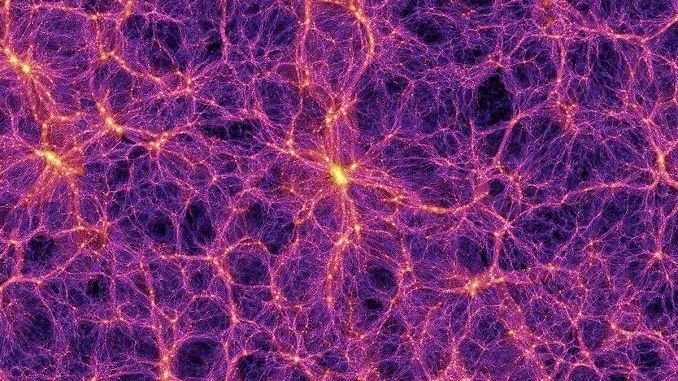

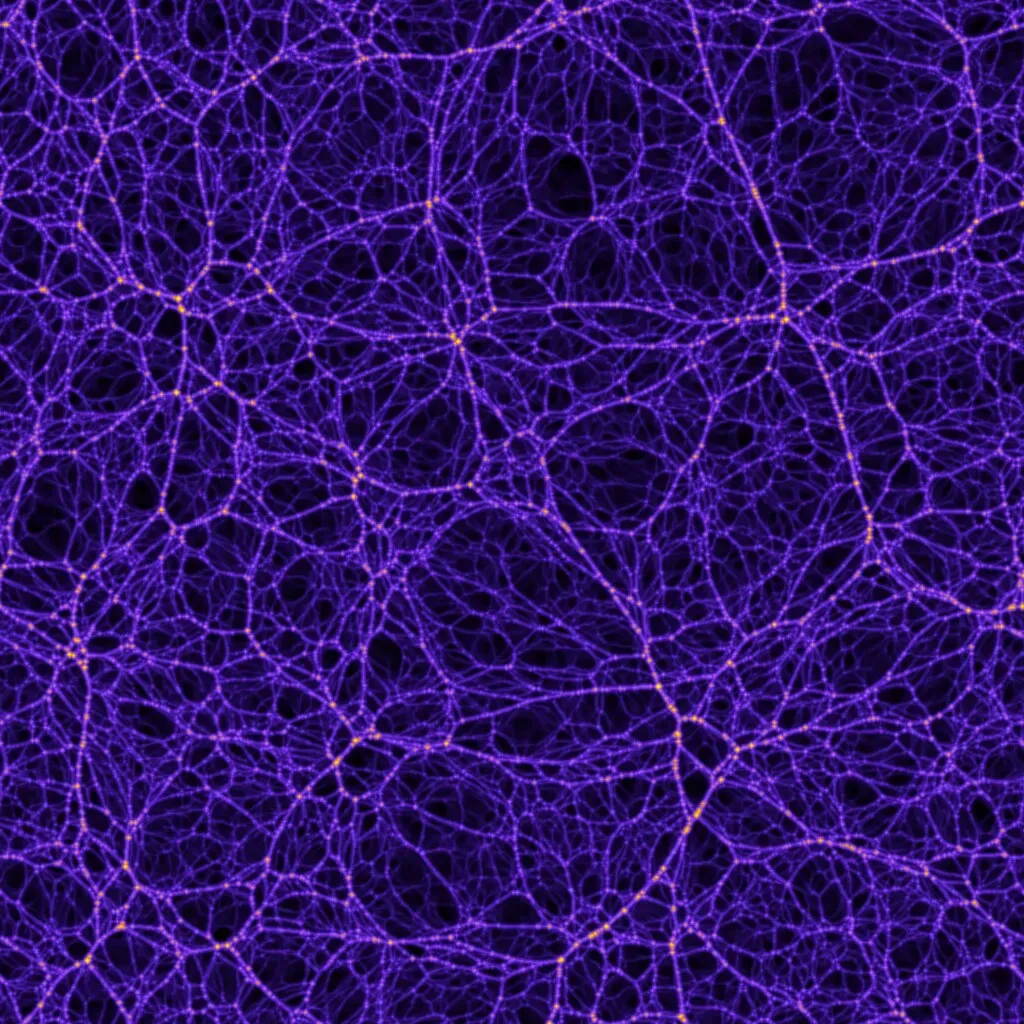
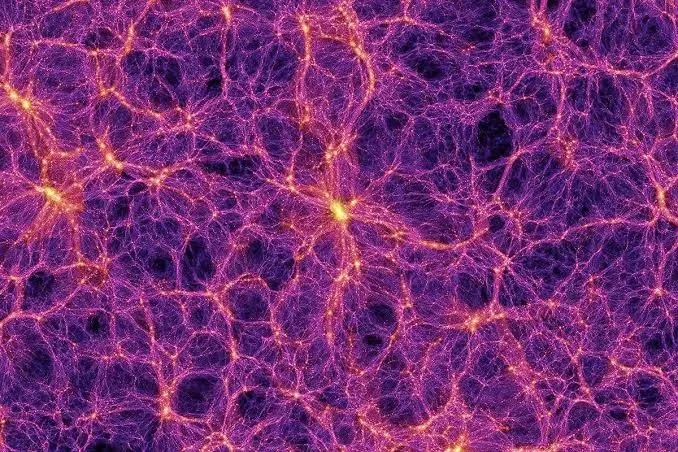
There’s something quietly unsettling about placing a photograph of a human neuron next to a simulated image of the large-scale cosmic web. The two look almost identical: delicate, branching filaments connecting dense clusters, with vast open spaces in between. One fits inside your skull. The other stretches across billions of light-years. The resemblance is hard to dismiss, and for a growing number of researchers, it’s far more than a visual coincidence.
What started as a striking observation in cosmology and neuroscience has evolved into a serious theoretical question. Could the universe, at its most fundamental level, operate the way a brain does? The ideas being put forward aren’t purely philosophical. Some of them come with testable mathematics, published peer-reviewed papers, and the names of well-regarded physicists attached. What follows is an honest look at where the science currently stands.
The Cosmic Web and the Connectome: A Resemblance That Goes Deeper Than Looks
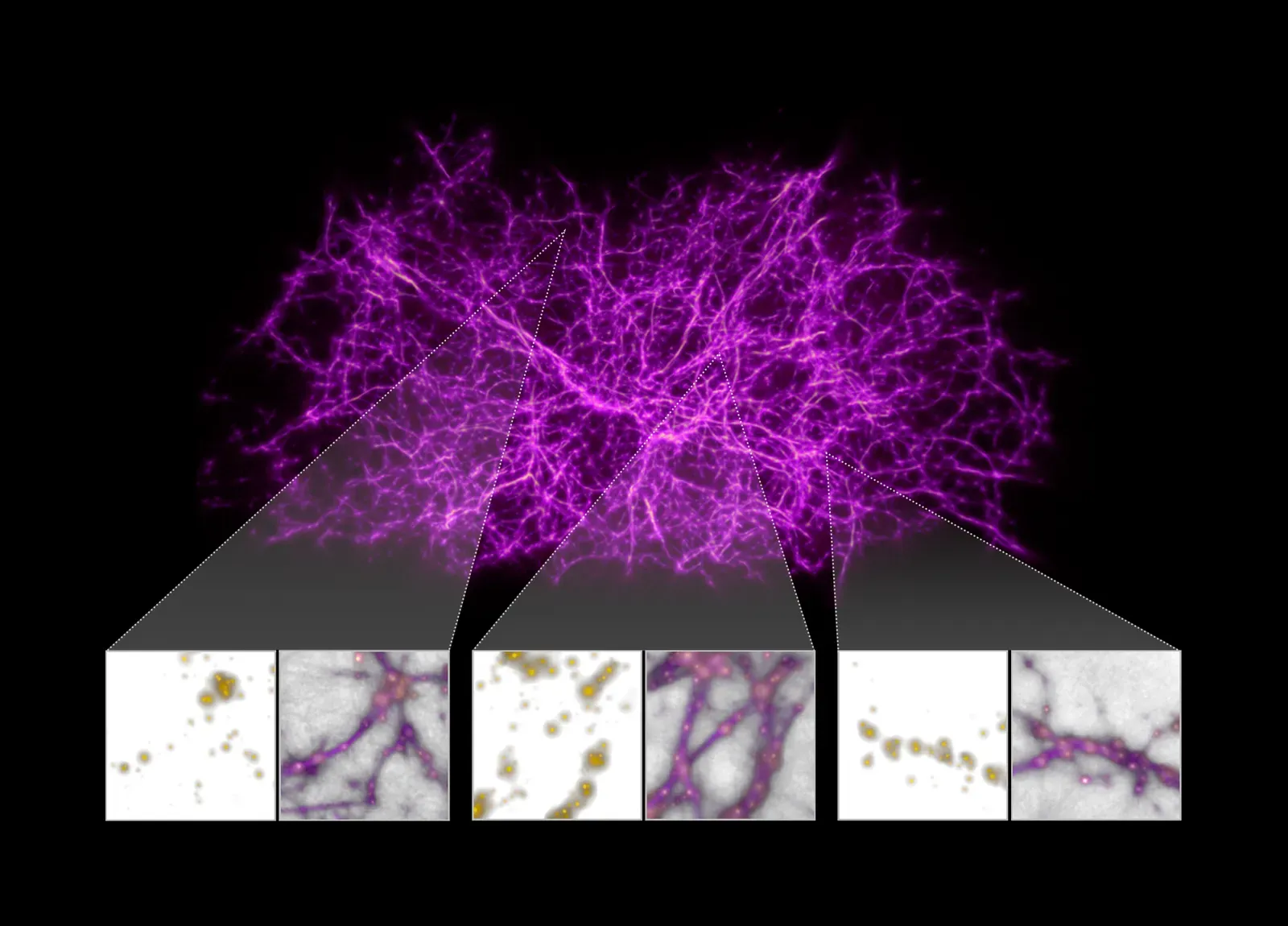
The estimated 200 billion detectable galaxies aren’t distributed randomly, but are lumped together by gravity into clusters that form even larger clusters, which are connected to one another by “galactic filaments,” long thin threads of galaxies. This vast architecture is what scientists call the cosmic web. When you zoom far enough out, the structure of the entire observable universe begins to take on a shape that looks startlingly familiar.
The “cosmic web” formed by these clusters and filaments looks strikingly similar to the “connectome,” a term that refers to the complete wiring diagram of the brain, which is formed by neurons and their synaptic connections. Neurons in the brain also form clusters, which are grouped into larger clusters, and are connected by filaments called axons, which transmit electrical signals across the cognitive system. The parallel isn’t merely visual. It turns out to be quantifiable.
The Numbers Behind the Comparison: What Scientists Actually Measured
In a paper published in the journal Frontiers of Physics, a duo of researchers from Italy investigated the similarities between the network of neurons in the human brain and the cosmic network of galaxies. Their approach was methodical, not metaphorical. Despite the substantial difference in scale between the two networks, more than 27 orders of magnitude, their quantitative analysis suggests that diverse physical processes can build structures characterized by similar levels of complexity and self-organization.
The human brain functions thanks to its wide neuronal network deemed to contain approximately 69 billion neurons, while the observable universe is composed of a cosmic web of at least 100 billion galaxies. Within both systems, only about 30 percent of their masses are composed of galaxies and neurons. Within both systems, galaxies and neurons arrange themselves in long filaments or nodes between filaments. Finally, within both systems, roughly 70 percent of the distribution of mass or energy is composed of components playing an apparently passive role: water in the brain and dark energy in the observable universe. The symmetry in those proportions is hard to ignore.
Vitaly Vanchurin’s Bold Claim: The Universe Is Literally a Neural Network
In 2020, theoretical physicist Vitaly Vanchurin published a landmark paper titled “The World as a Neural Network” in the journal Entropy. Where others had described the structural organization of the universe to be brain-like, Vanchurin argues that the world is literally a neural network, with an interconnected network of “nodes” existing at the microscopic scale that is equivalent to the network of neurons inside our skulls. This isn’t a loose analogy. It’s a formal physical proposal.
Vanchurin’s work attempts to bridge one of the biggest gaps in physics: the divide between the quantum mechanics that governs the super-small, and the general relativity that describes the super-large. The physicist thinks that if you view the universe as working essentially as a neural network, its behavior under certain conditions can be explained by both the quirky equations of quantum mechanics and the laws of classical physics like the theory of general relativity. That alone would make the theory worth paying attention to.
Quantum Mechanics as an Emergent Property of a Learning Cosmos
One of the most exciting parts of this theory is how it suggests quantum mechanics, with all its probabilistic fuzziness and strange behaviors, might emerge. Vanchurin argues that when the “trainable” variables of this universal neural network are near a state of equilibrium, their dynamics can be described by what are called Madelung equations. For non-physicists, the significance here is enormous. This implies that quantum mechanics might not be a fundamental theory itself, but rather an emergent behavior of this vast, learning neural network.
When the network is further away from equilibrium, perhaps in a more active learning phase, the theory suggests its behavior then aligns more with Hamilton-Jacobi equations, which describe classical mechanics. This provides a potential pathway to see how both classical and quantum physics could arise from the same underlying neural network structure. In other words, you wouldn’t need two separate frameworks for the very large and the very small. They’d both be faces of the same coin.
Sabine Hossenfelder and the Question of a Thinking Universe
Sabine Hossenfelder, a theoretical physicist known for her critical approach, has entertained the idea of a thinking universe. In “Maybe the Universe Thinks,” she explores the concept without fully endorsing it but acknowledges that certain phenomena could be interpreted in this light. Coming from a physicist widely known for her skepticism of speculative ideas, that’s a meaningful concession. The resemblance between the cosmic web and the connectome is not superficial, with rigorous study by a physicist and a neuroscientist analyzing features common to both and, based on shared mathematical properties, concluding that the two structures are “remarkably similar.”
If true, then the universe could be a suitable substrate for cosmic-scale computation, or “thinking,” that Hossenfelder envisions. Hossenfelder has noted that the idea that the universe is intelligent is compatible with all we know so far, though she makes sure to state that the theory is not currently testable, making it pure philosophy rather than science. That disclaimer matters. Intellectual honesty requires holding the exciting idea at arm’s length until the evidence catches up with the imagination.
Information Capacity, Fractals, and the Memory of the Cosmos
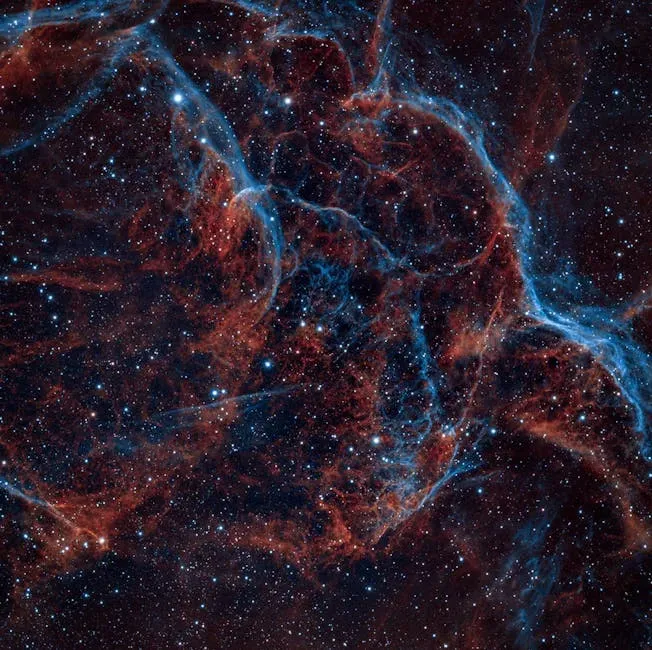
A recent study suggests that the memory of the human brain is around 2.5 petabytes. Another study by Vazza suggests that the memory capacity required to store the complexity of the universe is around 4.3 petabytes. Those figures are remarkably close for two systems separated by such an incomprehensible difference in scale. Fractals are patterns that repeat at different scales, and both the brain and the universe display fractal characteristics. Neuronal dendrites branch in fractal patterns, optimizing connectivity, while the distribution of galaxies and dark matter follows fractal-like patterns, with structures repeating over various scales from small galaxy groups to massive superclusters.
Perhaps most intriguingly, both systems display self-similarity and fractal-like patterns. Zoom in on a portion of the cosmic web, and you’ll find structures that resemble the whole. The same is true for the brain, where neural networks show similar patterns at different scales. The cosmic web, based on a sample of thousands of nodes, had on average around 3.8 to 4.1 connections per node. The human cortex had an average of 4.6 to 5.4 connections per node. In addition, both systems showed a tendency to cluster connections around central nodes. The convergence across so many independent metrics is what separates this from simple pattern-matching.
Ancient Roots, Modern Skepticism, and What Comes Next
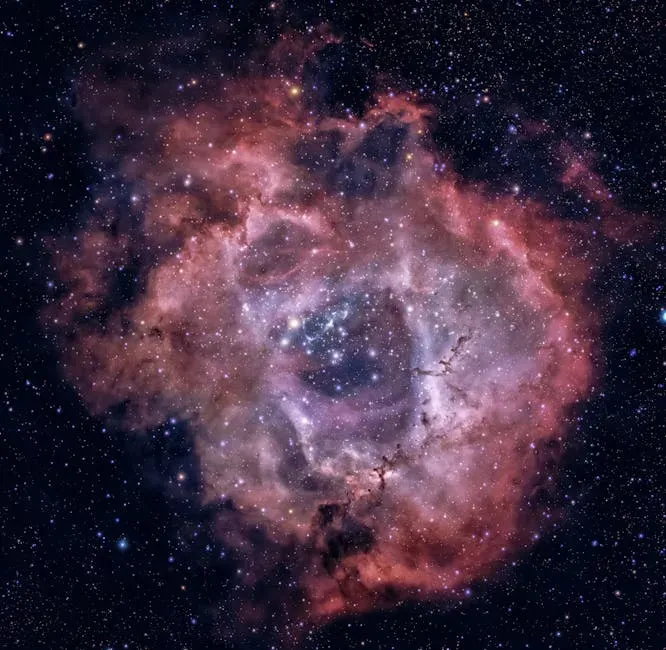
The idea that the universe is something like an organism or a brain isn’t a new one. This concept goes back at least to 500 B.C. when it was first dreamed up by Anaxagoras. The pre-Socratic Greek philosopher proposed that an intelligent cosmic force, or “Nous,” guides the development of the universe toward a more organized and purposeful state of existence. What’s new is that modern physics is giving these ancient intuitions a rigorous mathematical framework to inhabit.
Many scientists remain skeptical, emphasizing the lack of empirical evidence for cosmic consciousness. Structural similarities may arise from fundamental physical laws governing complex systems rather than from any deeper identity between mind and cosmos. With respect to Vanchurin’s proposal, it could be considered as a proposal for the theory of everything, and as such it should be easy to prove it wrong. All that is needed is to find a physical phenomenon which cannot be described by neural networks. Nobody has managed that yet, which keeps the conversation very much alive.
Conclusion
The idea that the universe might function like a giant brain sits somewhere between frontier physics and philosophy, and that’s precisely what makes it worth taking seriously. The structural similarities between the cosmic web and the neural connectome have now been measured, not just admired. The mathematical frameworks proposed by researchers like Vanchurin attempt to derive established physics from a neural network foundation, which is a genuinely ambitious and testable ambition.
None of this means the universe is conscious in any familiar sense. The honest position is that we don’t know, and the evidence so far permits curiosity more than it demands conclusions. The idea that the universe is a brain, a neural network, or a self-organizing complex adaptive system analogous to an organism invites us to reexamine our understanding of the cosmos. If the universe truly is a living, evolving entity, then the emergence of life and consciousness on Earth would not be an accidental phenomenon, but instead a natural and expected manifestation of a cosmic evolutionary process that continually generates higher levels of organization, knowledge, and awareness.
That’s worth sitting with. You might be less a visitor in this universe than a natural expression of it.