
If someone told you that everything you see, touch, and feel might be a kind of cosmic projection, it would sound like a late-night sci‑fi plot, not serious physics. Yet over the last few decades, some of the most respected theoretical physicists have been taking this idea seriously: our three‑dimensional universe may, in some deep sense, be a hologram. That doesn’t mean we’re living inside a glitchy simulation or that the coffee cup on your desk isn’t “real,” but it does suggest reality might be built in a way that’s far stranger than our everyday experience.
When I first read about the holographic universe, I did what most people do: I laughed, got confused, then couldn’t stop thinking about it. The more you look into it, the more it feels like staring at one of those optical illusions that refuses to snap into place. This theory doesn’t just tweak a few details of physics; it challenges what we think space, information, and even existence actually are. Let’s walk through it slowly and carefully, and see how something that sounds so wild has become a serious candidate for describing our universe.
The Strange Birth of the Holographic Principle
The holographic idea didn’t start as a philosophical thought experiment; it grew out of a genuine crisis in physics involving black holes. In the nineteen seventies, researchers realized that when matter falls into a black hole, it seems like the information describing that matter disappears forever, which clashes with a basic rule of quantum mechanics: information is never truly lost. This so‑called information paradox rattled the foundations of modern physics and forced people to rethink what a black hole really is.
Digging deeper, physicists noticed something weird: the amount of information you can hide inside a black hole doesn’t scale with its volume (how much space is inside) but with the area of its surface. Roughly speaking, the bits of information behave as though they’re stored on the two‑dimensional boundary, not crammed into the three‑dimensional interior. That’s where the “hologram” idea first emerges: just like a flat hologram plate can encode a 3D image, maybe the universe itself stores its information on a kind of cosmic surface, and what we experience as 3D reality is a projection of that deeper description.
What Physicists Actually Mean by a “Hologram”

In everyday life, a hologram is a flat image that somehow looks three‑dimensional when you move around it, like the shimmering logos on credit cards or those old holographic stickers. The physics version borrows this imagery, but it’s more radical. The claim isn’t that we’re living in a fake world, but that the fundamental description of reality might require fewer dimensions than we see. In other words, our 3D space (and even time) could emerge from a deeper, lower‑dimensional layer of information.
Imagine a familiar example: a video game world. The characters move in a three‑dimensional environment, but the underlying data lives on a flat storage medium or server. The game world isn’t an illusion for the characters; it has consistent rules, objects, and interactions. But if you’re “behind the scenes,” you know the real description is coded in a different way. That’s roughly the flavor of the holographic principle: our cosmos might be the “game world,” and the fundamental encoding could live on a kind of boundary we don’t directly see.
How Black Holes Turned into Cosmic Hard Drives
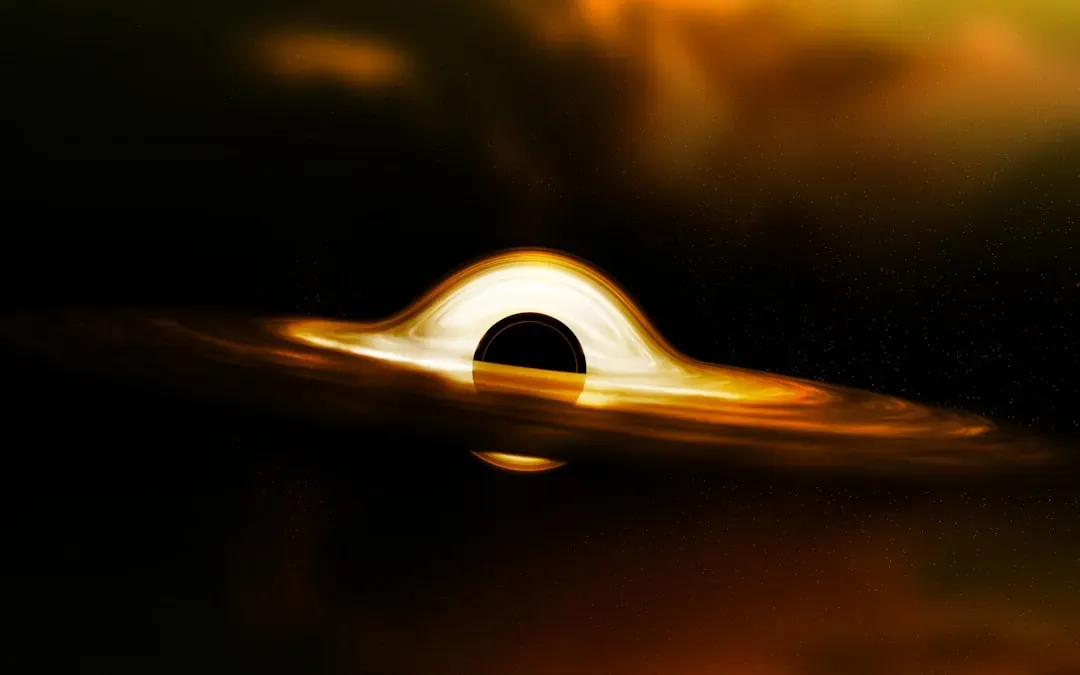
Black holes used to be portrayed as simple, featureless monsters that swallow everything and tell us nothing. But the holographic view recasts them as extraordinarily dense information vaults. The fact that a black hole’s entropy – a measure of its information content – depends on its surface area suggests that nature stores information on surfaces, like a kind of cosmic hard drive. This is shocking because it breaks from our usual intuition that more space inside something should mean more room for information.
To put it more concretely, imagine shrinking an entire library into a thin skin wrapped around a sphere, without losing a single page of content. That’s the kind of compression black hole physics seems to demand. This discovery wasn’t a quirky side note; it forced theorists to accept that something essential about space, information, and gravity is deeply holographic. Instead of being optional, the holographic principle started to look like a survival kit for any future theory that hopes to unify quantum mechanics with gravity.
AdS/CFT: The Most Famous Holographic “Lab”
The holographic principle stopped being a vague idea and turned into a precise mathematical tool with the discovery of a framework often called AdS/CFT correspondence. At its heart, it describes an exact duality between a gravity‑filled universe in a certain kind of curved space and a quantum field theory without gravity living on that universe’s boundary. It’s like having two different languages, each capable of describing the same physical reality, but in completely different ways.
What makes this so powerful is that tricky problems in one picture can become easier in the other. For example, a complicated gravitational process in the “bulk” space might map to a more manageable problem in the boundary theory. This correspondence has become a workhorse in theoretical physics, used to explore black holes, quantum matter, and even properties of strongly interacting particles. Even though our real universe doesn’t perfectly match the specific geometry used in AdS/CFT, the success of this duality makes the holographic idea feel less like speculation and more like a tool we already know how to use.
Could Our Actual Universe Be Holographic? Tests and Hints
Turning the holographic principle into a statement about our real, expanding universe is where things get tricky. Most concrete holographic models work best in a universe with a negative cosmological constant, which is not what our observations show. We live in a cosmos whose expansion is accelerating, which looks more like the opposite case. Still, theorists have been trying to generalize holography to more realistic settings, exploring versions that might apply to a universe like ours.
On the experimental side, a few groups have tried to search for subtle “holographic noise” in the fabric of space itself, using very sensitive interferometers to look for tiny jitter that might betray an underlying information limit. So far, nothing conclusive has shown up, and some early hints have not held up under scrutiny. At the same time, holographic ideas keep popping up in surprising places, like attempts to understand dark energy, quantum cosmology, and the deep structure of spacetime. Right now, the balance is this: holography is strongly supported in certain theoretical settings, but whether our universe specifically is a hologram remains an open question.
What a Holographic Universe Would Mean for Reality

If holography really is how our universe works, then some of our most basic instincts about what’s fundamental may need an upgrade. Space might not be a smooth, continuous stage stretching out forever, but more like a large‑scale illusion emerging from underlying information, a bit like how temperature emerges from atoms jiggling around. In this view, what we call “here” and “there” would be secondary concepts, not the raw ingredients of reality. That’s a jarring thought if you’ve built your whole sense of existence on the solidity of space.
This also nudges us toward thinking of the universe not as a collection of objects but as a vast web of relationships and information. A cup, a star, or your own body becomes a particular organization of information in that web, rather than an independent chunk of stuff. For many people, this doesn’t feel cold or dehumanizing; it feels strangely intimate. If everything is patterns in one shared informational fabric, then separation is less absolute than it looks. In a quiet way, holography suggests a universe that is more deeply connected than our senses let on.
How This Differs from “Simulation Theory” and Other Wild Ideas

It’s easy to mix up the holographic principle with the idea that we’re living inside a computer simulation, but they’re not the same claim. Simulation theory says some advanced civilization has built a digital copy of a universe, and we’re the simulated inhabitants. The holographic principle, by contrast, is about how the laws of physics themselves might be organized, regardless of whether anyone is “running” the universe. It’s a statement about equivalence between different mathematical descriptions, not about a cosmic programmer.
There’s also a risk of drifting into mystical or metaphysical territory and losing the physics thread entirely. While the holographic universe can feel spiritually or philosophically suggestive, the core of it is hard, technical work: equations, entropy bounds, dualities, and consistency conditions. It doesn’t prove that thoughts create reality, or that you can manifest outcomes by believing in them. What it does say is that nature may be economical in how it stores information and that our best description of the world might live in fewer dimensions than we experience. That alone is already more than strange enough.
Where the Hologram Hunt Goes from Here
Right now, the holographic principle sits in a fascinating spot: it’s not a fringe idea, but it’s not a finished theory of everything either. Physicists are pushing to extend holographic dualities to more realistic universes, to connect them with quantum information theory, and to understand how spacetime itself might emerge from entanglement, the subtle quantum correlations between particles. In that picture, geometry – distances, shapes, even the flow of time – could be a kind of large‑scale shadow cast by patterns of entanglement living on a boundary.
For non‑physicists, the value of the holographic universe idea isn’t in memorizing jargon, but in letting it stretch your sense of what “real” can mean. It reminds us that our intuitions are shaped by survival on a midsized planet, not by exposure to the deep architecture of reality. Maybe the universe really is a kind of hologram; maybe the final description will be something even stranger that makes today’s theories look quaint. Either way, the journey of trying to understand it changes how we see ourselves: not as spectators in a simple, solid world, but as part of a vast, intricate pattern whose true nature we’re only just beginning to glimpse.