
Look up at the night sky, and it’s tempting to think we’re seeing the universe as it really is. Stars, galaxies, glowing nebulae – it all feels vast and complete. But the shocking truth is that everything we can see, touch, and measure directly is just a tiny sliver of what’s actually out there. The universe is mostly built from invisible stuff that doesn’t shine, doesn’t glow, and barely interacts with anything at all.
Physicists call this invisible majority dark matter and dark energy, and together they make up almost the entire cosmic budget. What’s wild is that we didn’t really start to grasp this until the last century, and even now in 2026, we still don’t fully know what they are. We only know they must exist because of the strange, stubborn ways the universe behaves. It’s like walking into a room, feeling a strong wind, and realizing there must be open windows somewhere – even if you can’t see them yet.
The Cosmic Pie: How Much of the Universe We Actually Understand
One of the most unsettling facts in modern science is that ordinary matter – everything made of atoms – is just a tiny fraction of the universe. All the planets, stars, gas clouds, dust, and even your own body add up to only about one twentieth of the total cosmic content. The rest is split between dark matter and dark energy, which don’t emit or reflect light in any way we can directly detect.
When cosmologists break it down, they find that roughly about two thirds of the universe is dark energy and about one quarter is dark matter, leaving only a small remainder for normal matter. That means nearly nineteen out of twenty “parts” of the universe are invisible and mysterious. It’s a bit like discovering that your bank account history shows huge flows of money you never knew existed, shaping everything you thought you understood. Suddenly, the familiar universe looks more like the tip of a vast, hidden iceberg.
Why We Believe in Dark Matter: Galaxies That Spin Too Fast
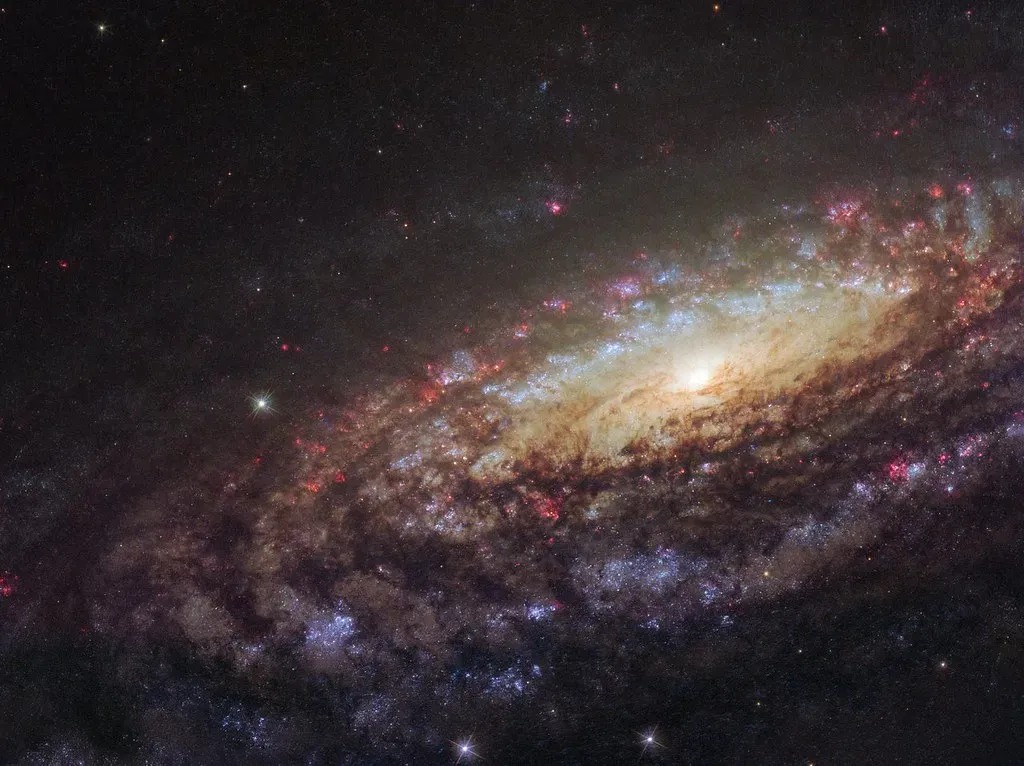
Dark matter might sound like science fiction, but it came out of a very practical problem: galaxies don’t behave the way they should if only visible matter is there. When astronomers measured how fast stars orbit around the centers of galaxies, they found something surprising. Instead of slowing down in the outer regions, as you’d expect if most of the mass were near the center, many stars in the outskirts were moving just as fast as those closer in.
According to gravity as we understand it, these fast-moving outer stars should be flung out of their galaxies like kids flying off a too-fast merry-go-round. But they’re not. They stay bound. The simplest explanation is that there’s extra invisible mass spread throughout and around galaxies, creating a stronger gravitational pull. That unseen mass is what we call dark matter. We don’t see it, but its gravitational fingerprints are written into the motion of stars and gas everywhere we look.
Gravitational Lensing: Seeing Dark Matter’s Shadow on Space-Time
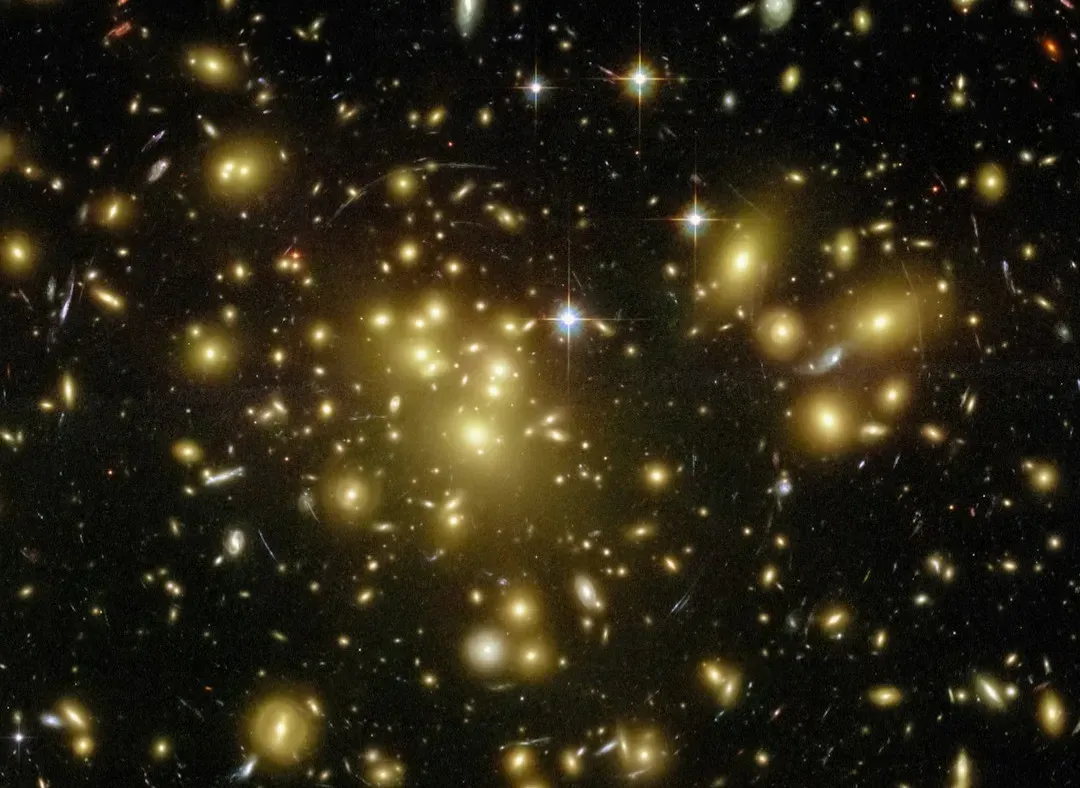
Another line of evidence for dark matter comes from something both beautiful and eerie: gravitational lensing. Massive objects like galaxy clusters bend the path of light from even more distant galaxies behind them, much like a glass lens bends light passing through it. When astronomers carefully map these distortions, they can reconstruct how mass is distributed in and around those clusters.
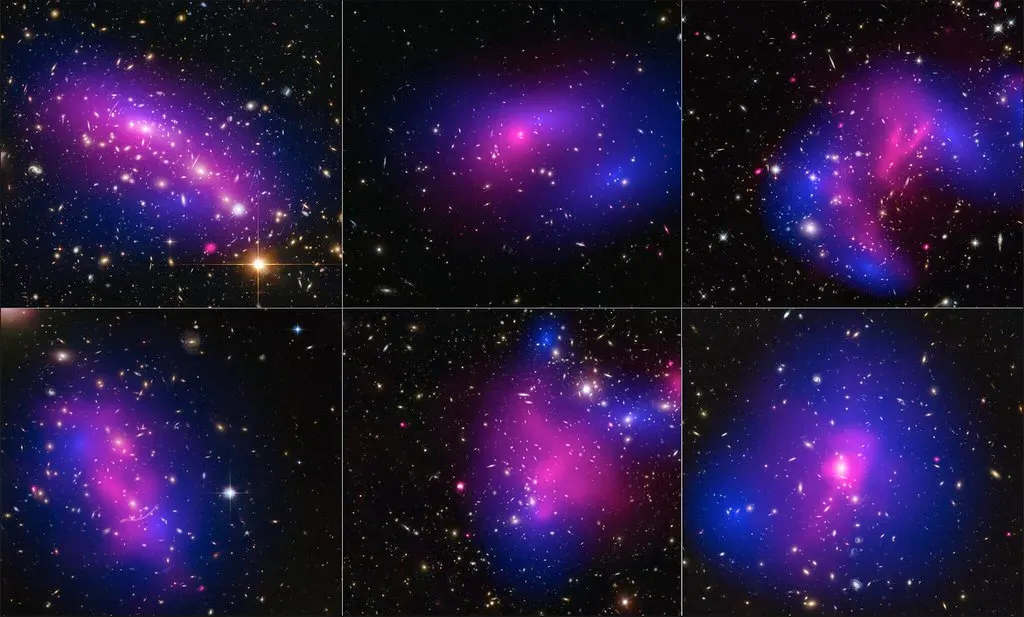
What they find over and over again is that there is way more mass than the visible galaxies and gas can account for. The lensing pattern reveals huge halos of invisible matter surrounding galaxy clusters, like ghostly cocoons of gravity shaping the path of light itself. In some famous systems, such as colliding clusters, the hot visible gas and the main centers of mass are even pulled apart, strongly suggesting that this unseen material behaves differently than ordinary matter. Dark matter shows up not by shining, but by warping the stage of space-time.
Dark Energy: The Mysterious Force Making Space Expand Faster
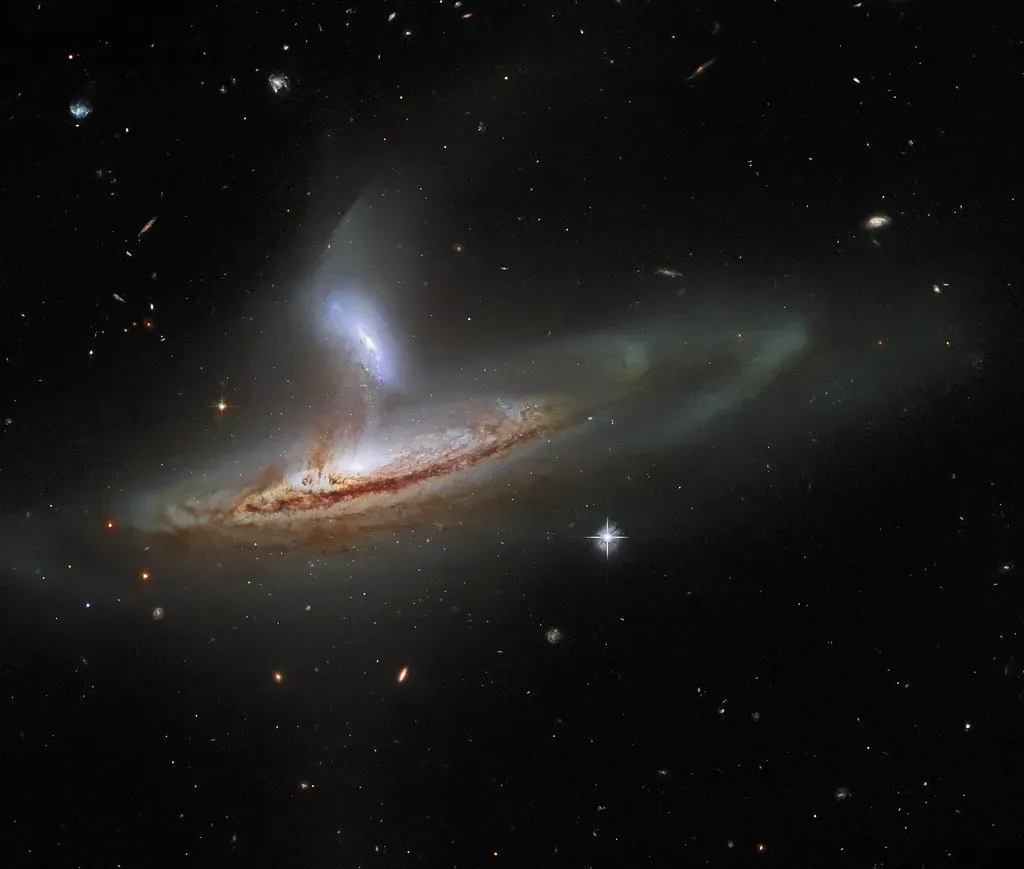
If dark matter explains how galaxies hold together, dark energy explains something even more mind-bending: why the universe’s expansion is speeding up. For a long time, scientists assumed that after the Big Bang, the expansion of space would gradually slow down under the pull of gravity. But in the late twentieth century, observations of distant exploding stars – used as “standard candles” – showed that these supernovae were dimmer than expected, meaning they were farther away than models predicted.
The only way to make sense of this was to accept that the expansion of the universe is accelerating, as if some kind of repulsive effect is pushing galaxies apart ever faster. That push is what we call dark energy. It’s not something we can bottle or point at directly, but its effect on the large-scale structure and history of the universe is unmistakable. Instead of a universe slowly coasting to a halt, we live in one that’s racing outward with increasing speed.
Einstein’s Cosmological Constant and the Vacuum That Isn’t Empty
Curiously, the idea behind dark energy has roots in Einstein’s work from more than a century ago. When he first developed general relativity, he added a term called the cosmological constant to keep the universe static, because at the time people thought the cosmos was unchanging. Later, when it became clear the universe is expanding, he abandoned that term and reportedly regretted using it at all.
Today, the cosmological constant is back in the game as a simple way to describe dark energy: a kind of constant energy density filling space itself. Quantum physics actually predicts that empty space should not be truly empty, but seething with fields and fluctuations. The problem is that theoretical estimates of this “vacuum energy” are wildly larger than what we see in the real universe, by an absurd margin. So while the cosmological constant fits the data very well, we’re left with a deep puzzle about why its value is so small and so finely tuned.
What Dark Matter Might Be: Candidates and Wild Ideas
Unlike dark energy, dark matter is usually imagined as some kind of actual particle or particles. Some of the leading candidates over the years have been things like WIMPs (weakly interacting massive particles) and axions, hypothetical particles that barely interact with ordinary matter and radiation. These would drift through us all the time like an invisible wind, rarely leaving a trace, yet providing the missing mass needed to hold galaxies together.
Scientists have been building incredibly sensitive detectors deep underground, under mountains, and in mines, trying to catch a rare collision between a dark matter particle and an atomic nucleus. So far, no unambiguous detection has been confirmed, which has forced theories to adapt and broaden. Other ideas range from superheavy particles formed in the early universe, to ultralight fields that behave like waves on galactic scales. There’s even a minority view suggesting we might need to tweak gravity itself instead of adding new matter, but most data still favor some form of real, unseen stuff.
How We Hunt the Invisible: Experiments and Telescopes
Studying things we can’t see sounds impossible, but physics is full of clever workarounds. For dark matter, researchers use three main strategies: direct detection, indirect detection, and production in particle colliders. Direct detection experiments try to observe rare impacts of dark matter particles on special detector materials. Indirect searches look for unusual patterns in cosmic rays, gamma rays, or neutrinos that might come from dark matter particles colliding and annihilating each other in space.
Meanwhile, particle colliders like the Large Hadron Collider attempt to create dark matter in high-energy collisions, then infer its presence when energy and momentum go missing from the debris. For dark energy, the approach is more cosmological: large sky surveys map how galaxies cluster together and how the expansion rate of the universe changes with time. New projects in the 2020s, from space telescopes to massive ground-based surveys, are essentially massive detective operations aimed at measuring how the cosmic web grows and stretches under the influence of this unknown force.
How Dark Stuff Shapes Cosmic History and Our Future
Dark matter and dark energy are not just background details; they choreograph the entire history of the universe. In the early universe, dark matter’s gravity helped seed the formation of galaxies by pulling ordinary matter into dense regions, like invisible scaffolding. Without it, structures might have taken much longer to form, or the cosmos might look completely different from the web of galaxies and clusters we see today.
Dark energy, on the other hand, took center stage later, when the universe had expanded and thinned out enough for this repulsive effect to dominate gravity on very large scales. Its continued push has huge implications for the far future. If dark energy stays constant, space will keep expanding faster, and distant galaxies will slip beyond our cosmic horizon, disappearing from view. The night sky millions or billions of years from now could look emptier and lonelier, with only our local group of galaxies remaining visible.
The Philosophical Shock: Living in a Mostly Invisible Universe
There’s something deeply unsettling about realizing that almost everything in the universe is fundamentally hidden from our senses. It challenges the quiet assumption many of us carry that what we see is what exists, or at least the most important part of what exists. Instead, our familiar world of atoms turns out to be a kind of surface story laid over a much stranger, deeper reality.
At the same time, this realization is oddly liberating and inspiring. It shows that human curiosity and careful measurement can reveal truths that are not at all obvious from everyday experience. We started with simple telescopes and basic physics, and somehow ended up discovering that space itself is filled with invisible matter and energy shaping our fate. It’s humbling, but it also feels like standing in the doorway of a much larger, weirder universe than we ever imagined. What else might we be missing?
Conclusion: A Universe We Hardly Know
Dark matter and dark energy flip our intuitive picture of reality on its head, turning the glowing parts of the cosmos into a minority player. We know they exist because of the way galaxies rotate, light bends, structures grow, and space itself accelerates outward, yet we still do not know their true nature. Every new measurement seems to sharpen the outline of these mysteries while leaving the core questions just out of reach.
In a sense, we are like early explorers who have mapped the coastlines but have barely stepped inland, aware that the interior is vast and mostly unknown. The next decades of experiments and observations will not just fill in details; they may redefine what we even mean by matter, energy, and space. When you look up at the night sky now, it’s worth remembering that most of what shapes that view is invisible and unexplained. Does it change how you feel, knowing that almost everything in the universe is something we still can’t see?