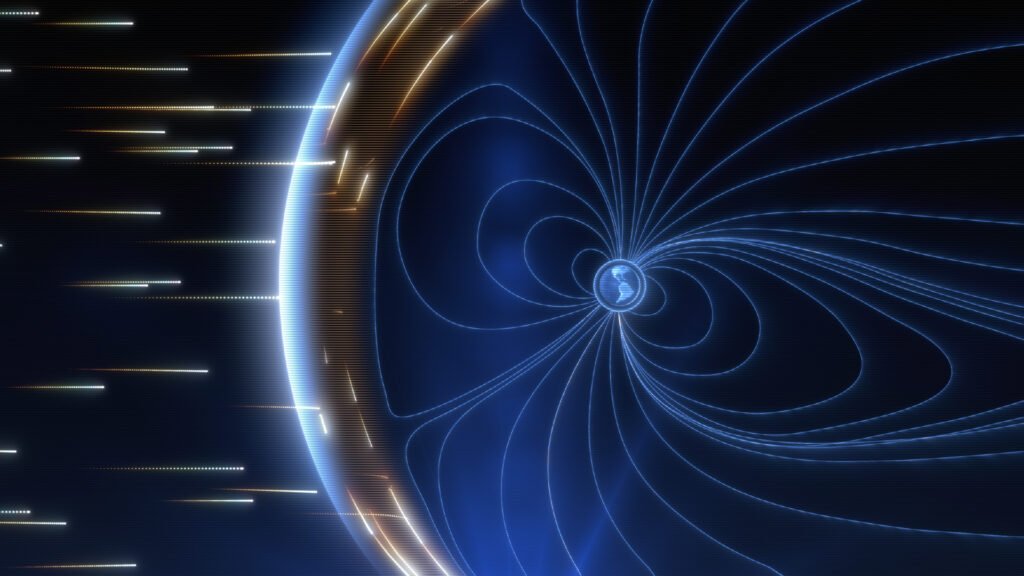

Right now, somewhere about three thousand kilometers beneath your feet, a vast ocean of molten iron is churning and swirling in patterns so complex that even the most powerful supercomputers struggle to model them. You probably never think about it. Why would you? Yet this invisible, restless engine is the reason life exists on Earth at all. Without it, the sky above you would offer no real protection from the brutal storms of radiation that pour endlessly from the sun and beyond.
The story of Earth’s magnetic field is one of the most fascinating tales in all of science. It’s a story of deep-Earth mechanics, vanishing poles, ancient human survival, animal superpowers, and a growing cosmic dent that satellite data is only now revealing to us in detail. So let’s dive in.
The Invisible Engine: How Earth Generates Its Magnetic Field
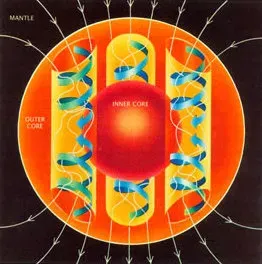
Earth’s magnetic field is largely generated by a global ocean of molten, swirling liquid iron that makes up the outer core, around 3,000 kilometers beneath our feet. Think of it as a self-sustaining electrical generator buried inside the planet. Acting like a spinning conductor in a bicycle dynamo, it creates electrical currents, which in turn generate a continuously changing electromagnetic field. It sounds almost impossibly simple for something so enormously powerful.
Hot material in Earth’s outer liquid iron core expands, becoming less dense than its surroundings, and rises. Cooling and becoming denser, it sinks back down. But Earth’s rotation prevents this from happening in a straightforward way. Consequently, liquid circulates around the core, and friction between its different layers charges them up – and it is these moving charges that generate Earth’s magnetic field. The resulting magnetic field extends far into space, forming a protective barrier known as the magnetosphere. Honestly, when you picture it that way – the spinning, the friction, the heat – it feels less like geology and more like magic.
Your Planet’s Shield: What the Magnetic Field Actually Protects You From
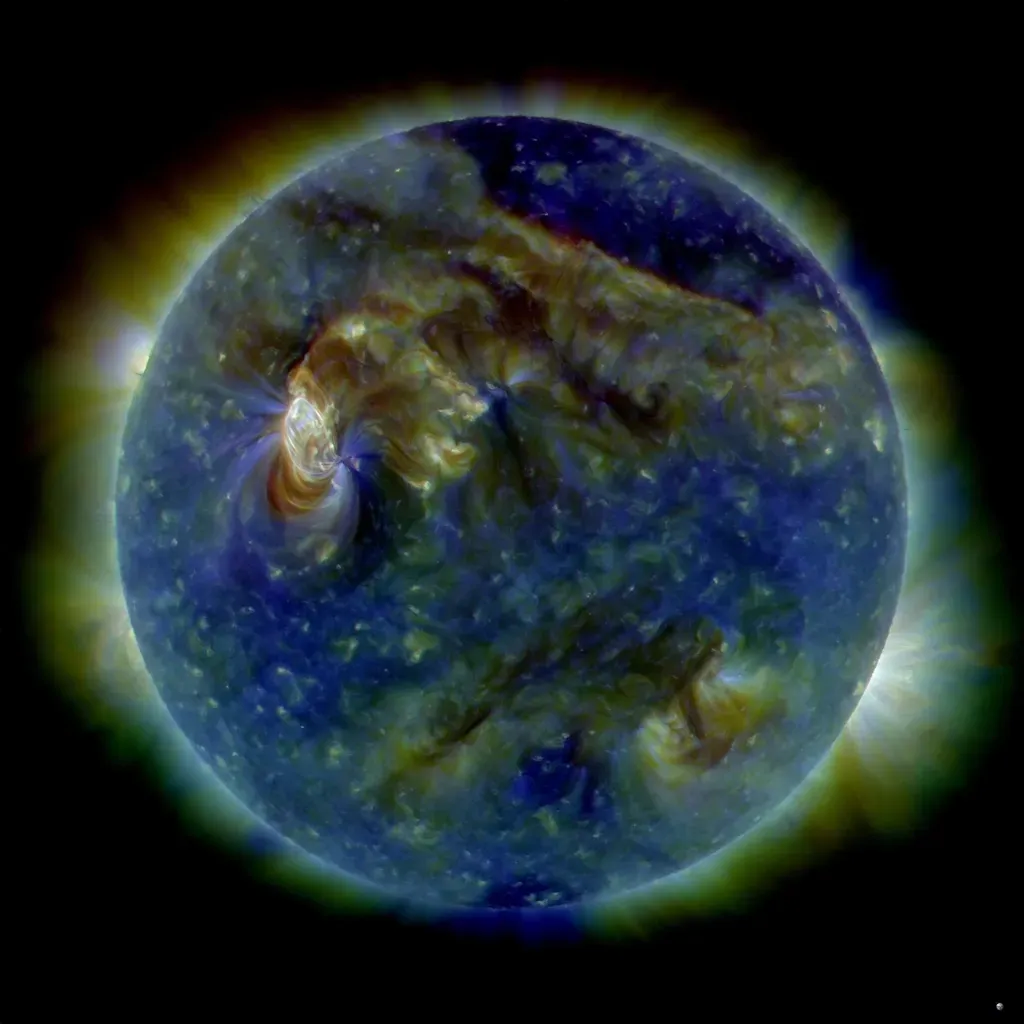
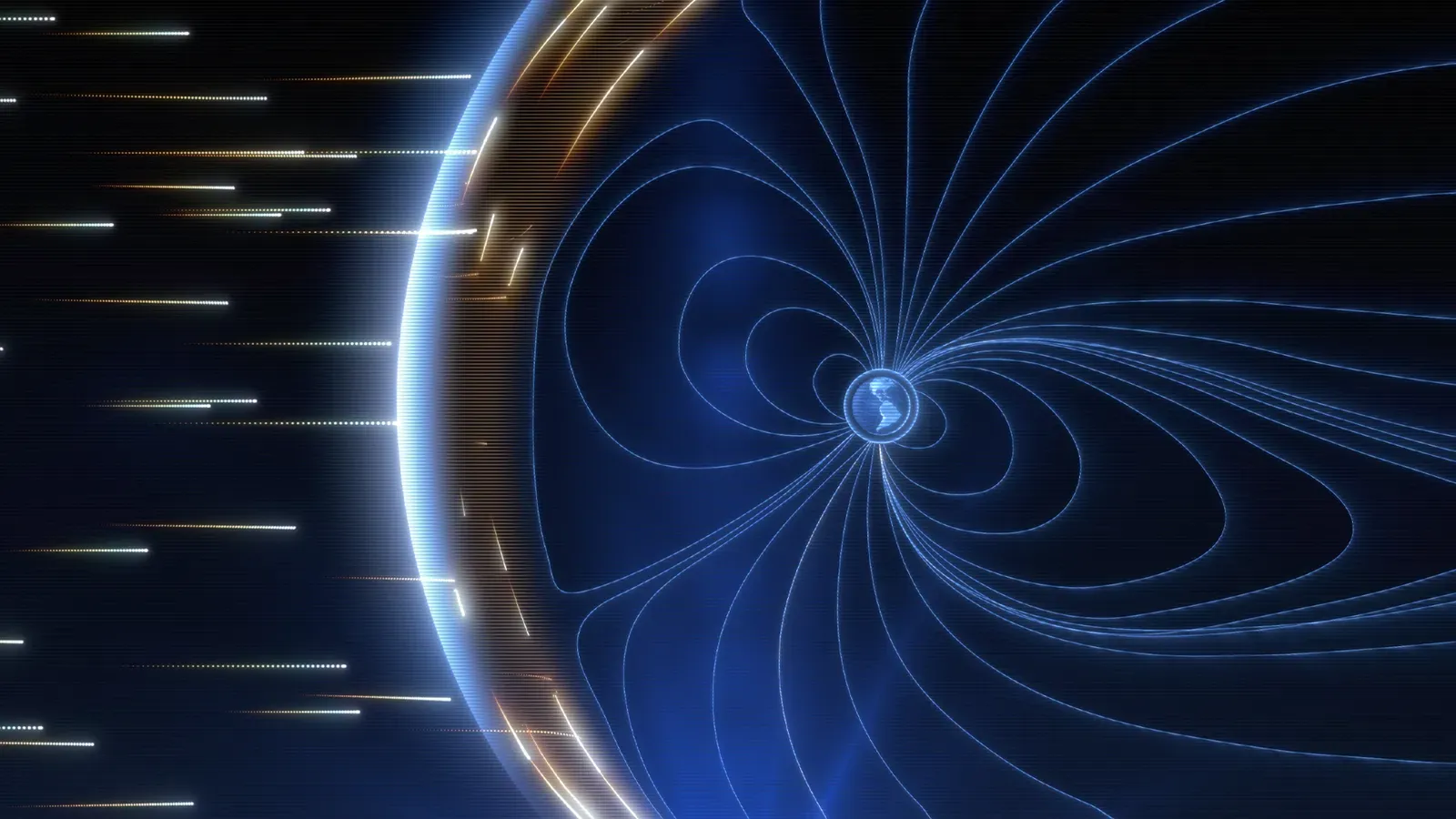
The Sun expels a constant outflow of particles and magnetic fields known as the solar wind, along with vast clouds of hot plasma and radiation called coronal mass ejections. This solar material streams across space and strikes Earth’s magnetosphere, which acts like a protective shield around the planet. Without that shield, you’d be living on a world gradually stripped of its atmosphere, bombarded by radiation that would make long-term survival essentially impossible.
The absence of Earth’s magnetic field would have profound consequences. Without protection, deadly radiation from the Sun could increase the mutation rate of living cells, leading to cancers in animals. The planet’s magnetic field extends far into space and creates a protective bubble around Earth, shielding the planet’s surface from the hurricane of particles of the Sun’s solar wind and higher energy cosmic ray particles from deep space. Normally, these are safely funnelled down at the poles, creating the auroras. So the next time you see a photograph of the Northern Lights, know that you’re also looking at evidence of your planet actively deflecting danger.
A Field in Constant Motion: The Wandering Poles
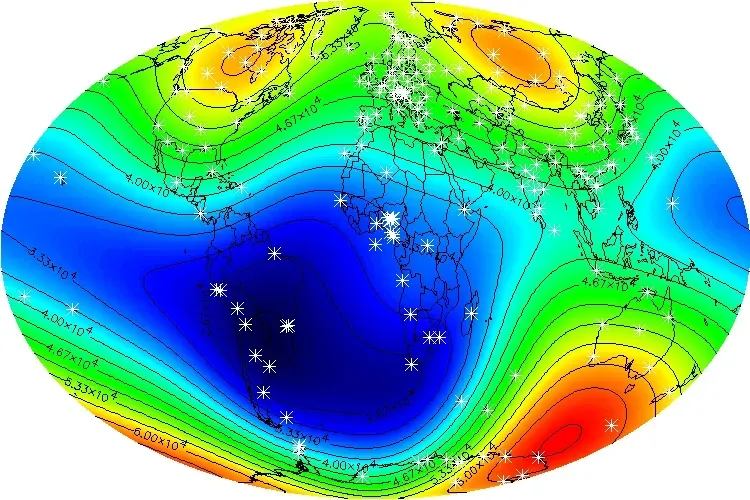
Since the forces that generate our magnetic field are constantly changing, the field itself is also in continual flux, its strength waxing and waning over time. This causes the location of Earth’s magnetic north and south poles to gradually change. The position of Earth’s magnetic north pole was first precisely located in 1831, and since then it has gradually drifted north-northwest by more than 600 miles, with its forward speed increasing from about 10 miles per year to about 34 miles per year. That acceleration is something scientists are watching very carefully.
Models of Earth’s magnetic field based on satellite observations have shown that the present wandering is the result of a battle between blobs of unusually intense magnetic fields deep inside the planet. It’s a strange thought, isn’t it – that magnetic “blobs” deep in the Earth are essentially arm-wrestling to control which way your compass points. For industries reliant on magnetic fields, such as aviation, shipping and navigation, this movement is no small matter. GPS systems, planes and military equipment track the magnetic field and rely on accurate models of magnetic north to function properly. When the magnetic field shifts, the models must be updated to reflect the changes.
When the Field Flips: Pole Reversals and What They Mean for You
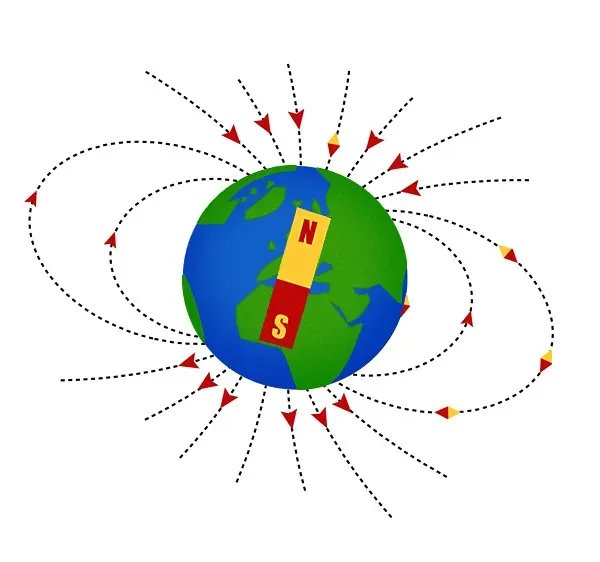
There have been at least 183 reversals over the last 83 million years, averaging roughly once every 450,000 years. The latest, the Brunhes-Matuyama reversal, occurred 780,000 years ago. Here’s the thing – we are statistically overdue for another one. Field reversals happen fast from a geologic standpoint, though slow from a human perspective. A reversal usually takes a few thousand years. During this time, the magnetosphere’s orientation may shift and expose more of the Earth to cosmic radiation.
During a pole reversal, the magnetic field weakens, but it doesn’t completely disappear. The magnetosphere, together with Earth’s atmosphere, continues protecting Earth from cosmic rays and charged solar particles, though there may be a small amount of particulate radiation that makes it down to Earth’s surface. The magnetic field becomes jumbled, and multiple magnetic poles can emerge in unexpected places. Plant and animal fossils from the period of the last major pole reversal don’t show any big changes. Deep ocean sediment samples indicate glacial activity was stable. Geologic and fossil records from previous reversals show nothing remarkable, such as doomsday events or major extinctions. So while a reversal sounds terrifying, the planet has been through it before and life carried on.
The Animal Kingdom’s Secret Sixth Sense: Reading the Magnetic Field

Evidence has accumulated that animals do indeed perceive magnetic fields. It is now clear that diverse animals, ranging from invertebrates such as molluscs and insects to vertebrates such as sea turtles and birds, exploit information in Earth’s field to guide their movements over distances both large and small. I think this is one of the most quietly astonishing facts in all of biology. You navigate with your eyes, your GPS, your sense of smell. These creatures navigate with the planet’s own invisible geometry.
Research has provided the first empirical evidence that loggerhead sea turtles can learn and remember the unique magnetic signatures of different geographic regions, offering new insights into how turtles and other migratory animals navigate vast distances to reach specific foraging and breeding grounds. Migrating animals like butterflies, salmon, sea turtles, and many birds have a form of signpost sense – they read the direction and inclination of the magnetic field and create mental maps of local anomalies to chart their paths in three dimensions over great distances. Salmon doing long-distance navigation by reading the planet’s magnetic field like a map is, let’s be real, more sophisticated than most of us give them credit for.
The Growing Weak Spot: The South Atlantic Anomaly
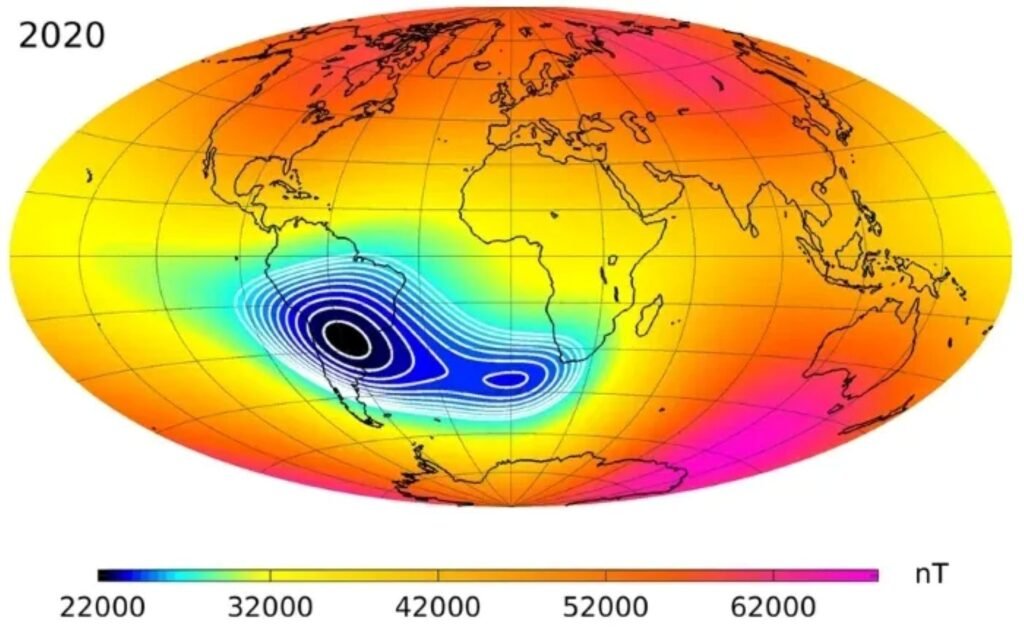
Using 11 years of magnetic field measurements from the European Space Agency’s Swarm satellite constellation, scientists have discovered that the weak region in Earth’s magnetic field over the South Atlantic – known as the South Atlantic Anomaly – has expanded by an area nearly half the size of continental Europe since 2014. The speed of the area’s weakening has increased since 2020, with different parts of the anomaly changing at different rates. That’s not a distant, theoretical concern. It’s happening right now, and it’s being tracked in real time.
Today, the South Atlantic Anomaly is of particular interest for space safety, as satellites passing over the region are faced with higher doses of incoming radiation. This can lead to malfunctions or damage to critical hardware, and even blackouts. The anomaly creates no visible impacts on daily life on the surface, and its weakening magnetic intensity is still within the bounds of what scientists consider normal variation. Still, Earth’s magnetic field has never been static, and it changes on timescales ranging from years to millions of years. The planet is always reshaping its own armor, whether we notice or not.
Conclusion
What strikes me most about all of this is just how alive our planet truly is. The magnetic field is not some fixed, permanent backdrop to life on Earth. It moves, weakens, wanders, sometimes almost collapses, and through all of it, life has found ways to adapt, survive, and thrive. You are alive today partly because that churning iron deep beneath you has been doing its job for billions of years, mostly quietly, almost entirely unnoticed.
The South Atlantic Anomaly is expanding. The magnetic north pole is racing toward Siberia. Ancient humans survived a pole shift by innovating their way through increased radiation. Turtles and birds read invisible planetary signals to cross oceans with pinpoint accuracy. None of this is science fiction. It’s all happening, it has always been happening, and it will keep happening long after we’re gone.
The magnetic field is shifting right now, as you read this – and you’re alive because of it. What other invisible forces are quietly holding your world together without you ever knowing? That’s worth thinking about.