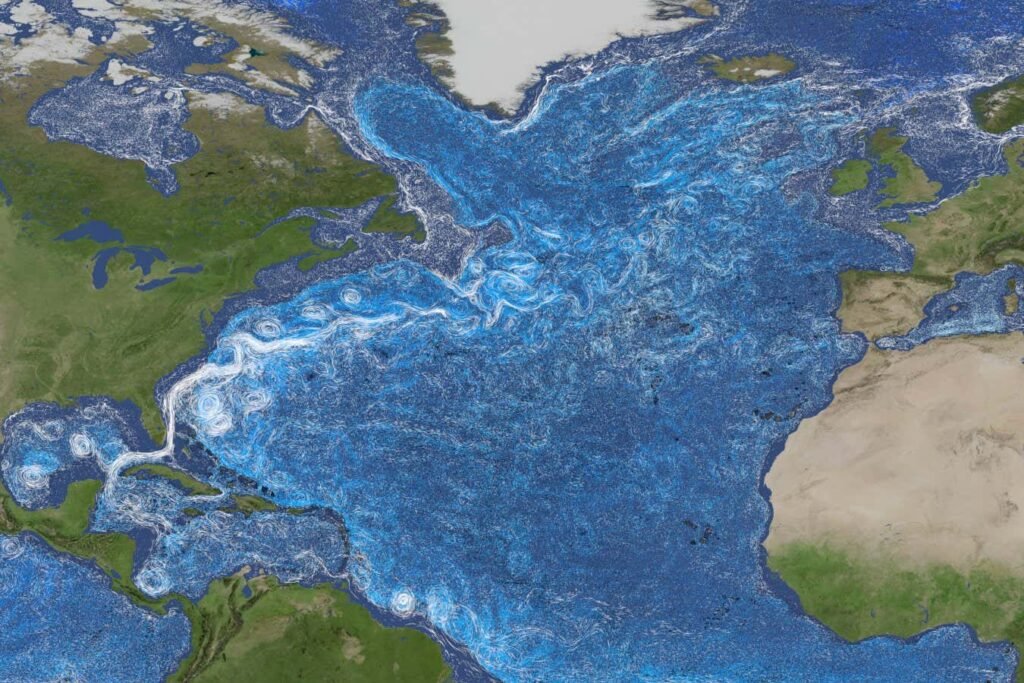

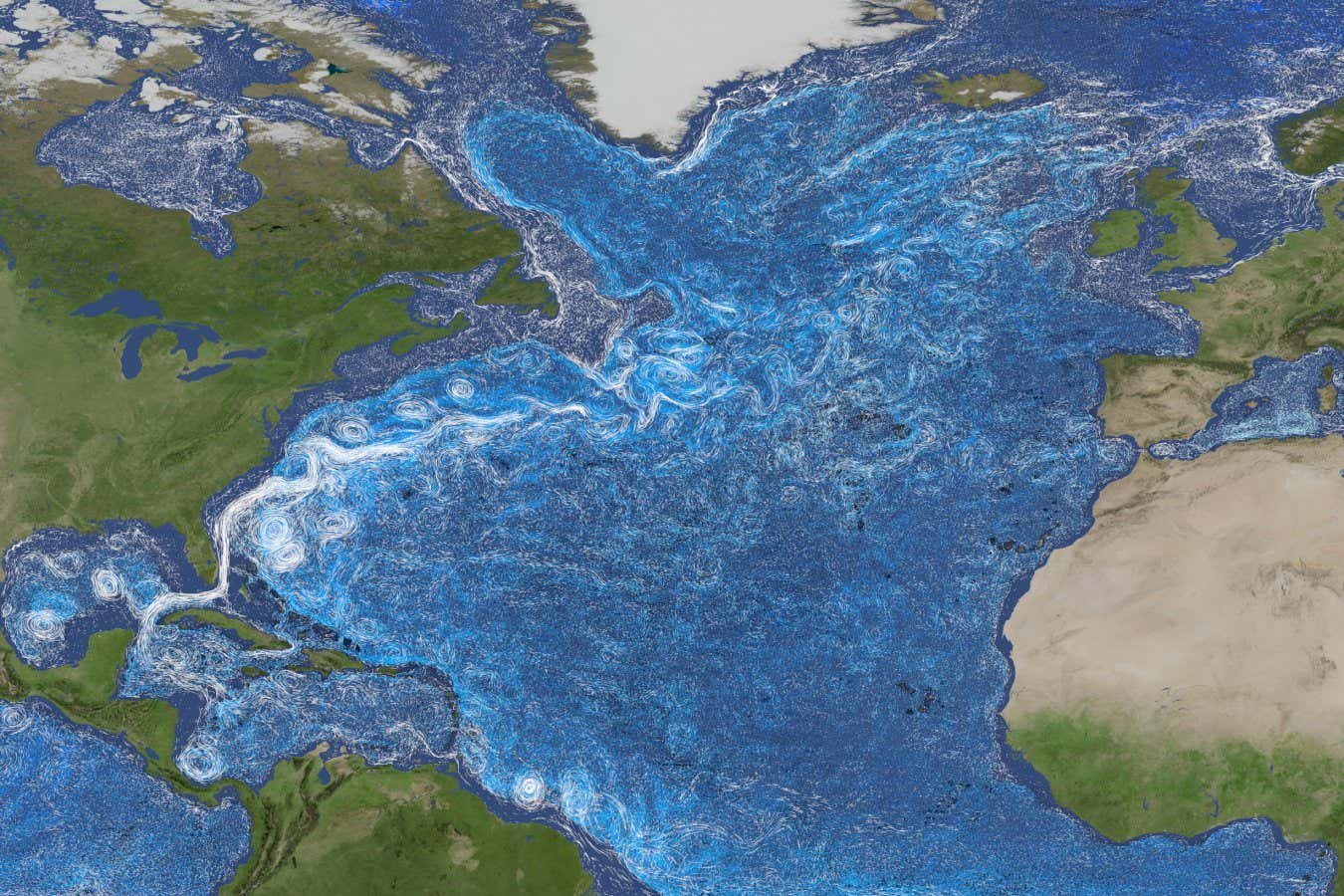
Understanding the Atlantic’s Climate Engine (Image Credits: Images.newscientist.com)
Researchers have identified a northward drift in the Gulf Stream near Cape Hatteras as a potential harbinger of weakening in the Atlantic Meridional Overturning Circulation, the ocean system that regulates climate across much of the Northern Hemisphere.[1][2]
Understanding the Atlantic’s Climate Engine
The Atlantic Meridional Overturning Circulation, or AMOC, functions like a global conveyor belt. Warm surface waters flow northward through the Gulf Stream, release heat over Europe, cool, become denser, and sink to drive deep currents southward.
Weakening in this system disrupts heat distribution. Reconstructions from sea surface temperatures indicated the AMOC had declined by about 15 percent since the mid-20th century.[1] Direct measurements since 2004 captured fluctuations but lacked long-term trends amid natural variability.
The Gulf Stream, a key upper limb of the AMOC, hugs the U.S. East Coast before veering east. Its path responds to changes in the underlying Deep Western Boundary Current, which pulls it southward along the seafloor.
Models Predict Gradual Then Sudden Path Changes
A high-resolution ocean model simulation by researchers at Utrecht University demonstrated how AMOC slowdown alters the Gulf Stream. Over hundreds of simulated years with increasing freshwater input – mimicking Greenland melt – the current shifted northward by 133 kilometers gradually near 71.5 degrees west longitude.[2]
This gave way to an abrupt jump of 219 kilometers within two years, accompanied by a 6.5 degrees Celsius temperature rise in the upper ocean layers. The sudden displacement occurred roughly 25 years before full AMOC collapse in the model.[1][2]
René van Westen, lead author of the study, noted, “This is something we can measure… So it is very likely that this reflects that the AMOC is indeed weakening.”[1] He emphasized the shift’s detectability: “There is now a very proper early warning indicator that actually goes off… You can measure this very easily.”
Real-World Data Confirms the Trend
Satellite altimetry from 1993 to 2024 revealed a statistically significant northward Gulf Stream trend of 0.16 degrees latitude per decade near Cape Hatteras, equivalent to about 50 kilometers over three decades (p less than 0.05).[2] Subsurface temperature profiles since 1965 corroborated this, showing the Gulf Stream’s northern boundary – the 15 degrees Celsius isotherm at 200 meters depth – had moved poleward (p less than 0.01).[2]
Positions since 2015 appeared unusually far north compared to prior decades. These observations aligned with model dynamics, where reduced deep current strength lessened the Gulf Stream’s southward tug.
| Indicator | Model Behavior | Observed Trend (1993-2024) |
|---|---|---|
| Gulf Stream Path at 71.5°W | 133 km gradual + 219 km abrupt | 0.16°N/decade (p<0.05) |
| North Wall (15°C isotherm) | Northward with AMOC decline | Northward since 1965 (p<0.01) |
| Deep Boundary Current | Weakens pre-shift | -2.0 Sv/decade (p<0.05) |
Far-Reaching Climate Disruptions Loom
An AMOC collapse would cool northwest Europe dramatically. Model scenarios projected London facing cold snaps of minus 20 degrees Celsius and Oslo dropping to minus 48 degrees Celsius.[1] The U.S. East Coast could see rising seas from sluggish currents.
- Reduced heat to Europe triggers severe winters and altered weather patterns.
- Disrupted rainfall affects agriculture from the U.S. to Africa.
- Global ripple effects include shifted monsoons and intensified storms.
- Sea level rise accelerates along eastern North America.
Key Takeaways
- Abrupt Gulf Stream shifts could precede AMOC tipping by decades, offering a measurable alert.
- Observations already show northward trends consistent with weakening circulation.
- Reducing emissions remains crucial to avert potential shutdown risks.
This emerging signal underscores the urgency of monitoring ocean currents closely. As patterns evolve, they remind us of the interconnected fragility of Earth’s climate systems. What do you think about these findings? Share in the comments.