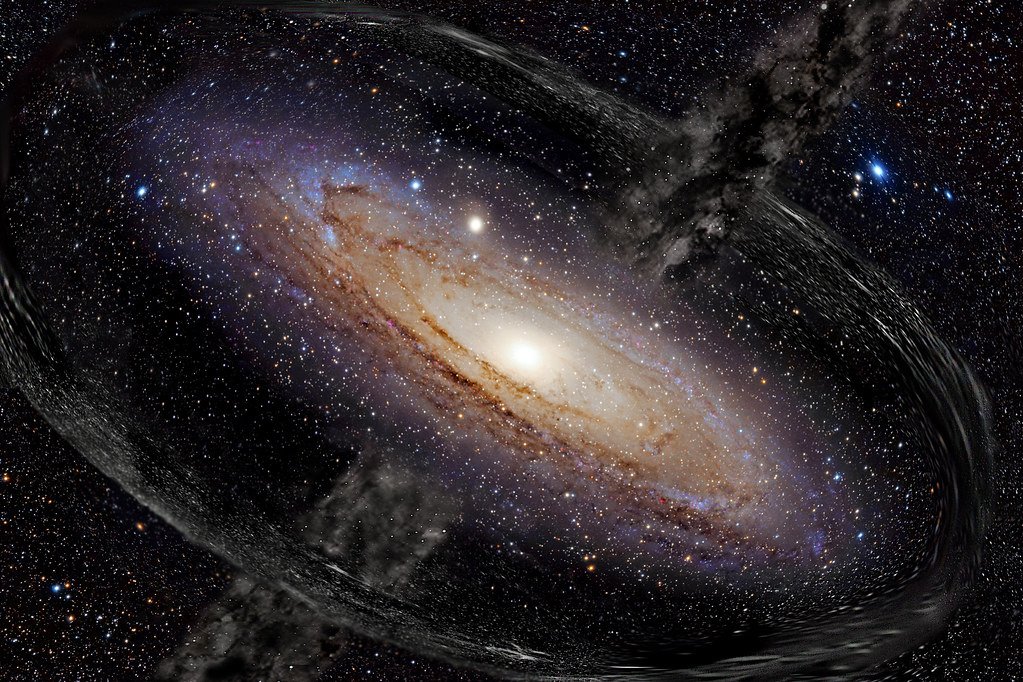
Milky Way’s Puzzling Gamma-Ray Glow (Image Credits: Flickr)
Astronomers have long relied on gravitational clues to map the unseen influence of dark matter across the cosmos. This mysterious substance accounts for about 85 percent of the universe’s matter, shaping galaxy rotations and cluster dynamics without emitting light. Yet, recent gamma-ray observations present a riddle: a potential excess from our Milky Way’s core suggests dark matter annihilation, while nearby dwarf galaxies remain conspicuously quiet despite their high dark matter concentrations.[1][2]
Milky Way’s Puzzling Gamma-Ray Glow
NASA’s Fermi Gamma-ray Space Telescope captured an intriguing excess of gamma rays emanating from the Milky Way’s central bulge years ago. Researchers interpreted this as a possible signature of dark matter particles colliding and annihilating into gamma rays. The signal persisted across multiple analyses, fueling excitement about a breakthrough in particle astrophysics.
However, alternative explanations lingered, such as emissions from unresolved pulsars or other astrophysical sources. The observation challenged single-particle dark matter models, which predicted uniform annihilation rates regardless of environment. This discrepancy grew sharper when compared to other systems.[1]
The Silent Dwarf Galaxies
Dwarf spheroidal galaxies orbiting the Milky Way offer ideal testing grounds for dark matter searches. These compact systems boast extreme dark matter densities but minimal stellar interference, reducing background noise from conventional processes. Telescopes like Fermi scrutinized them for gamma-ray signals, yet found none convincing enough to confirm annihilation.
Examples include DDO 68, imaged by the Hubble Space Telescope, where dark matter dominates the mass budget. Standard models expected detectable emissions here if the Milky Way signal held true. The absence prompted questions about dark matter’s nature or even the validity of the galactic center excess.[1]
A Two-Component Dark Matter Paradigm
Physicists Asher Berlin, Joshua W. Foster, Dan Hooper, and Gordan Krnjaic introduced a compelling alternative in a study published in the Journal of Cosmology and Astroparticle Physics. Their “dSph-obic dark matter” model envisions two distinct dark matter particles, labeled A and B, that annihilate only upon mutual encounters – not with their own kind.[2]
The annihilation rate hinges on the local mix of A and B. Balanced proportions yield frequent collisions and bright gamma rays, as potentially seen in the Milky Way. A dominance of one type suppresses signals, fitting the dwarf galaxy quietude. “Dark matter could straightforwardly be two different particles, and the two different particles need to find each other in order to annihilate,” Krnjaic explained.[1]
| Aspect | Standard Single-Particle Model | Two-Component Model |
|---|---|---|
| Annihilation | Any particle pair | Only A-B pairs |
| Signal Dependence | Uniform or velocity-based | Abundance ratio |
| Milky Way Fit | Possible | Balanced mix |
| Dwarf Galaxies | Expects signal | One-type dominance |
Paths Forward for Detection
This framework shifts the narrative: non-detections become informative rather than disqualifying. Future Fermi observations or advanced telescopes could probe faint dwarf signals or refine Milky Way maps. The model accommodates varied galactic histories, where assembly processes dictate particle ratios.
Key evidence supporting dark matter’s existence includes:
- Galaxy rotation curves defying visible mass predictions.
- Gravitational lensing in clusters.
- Patterns in the cosmic microwave background.
- Structure formation simulations requiring extra mass.
- Large-scale cosmic web filaments.
“If certain theories of dark matter are true, we should see it in every galaxy,” Krnjaic noted, highlighting the puzzle’s stakes.[1]
Key Takeaways:
- Two-particle dark matter explains gamma-ray contrasts without discarding signals.
- Dwarf galaxies’ silence points to imbalanced compositions, not absence.
- Enhanced observations will test abundance variations across systems.
This dual-particle vision enriches dark matter’s story, portraying it as a dynamic cosmic ingredient rather than a monolithic force. As telescopes grow sharper, the universe may reveal whether dark matter indeed comes in multiples. What do you think of this two-type proposal? Share your views in the comments.