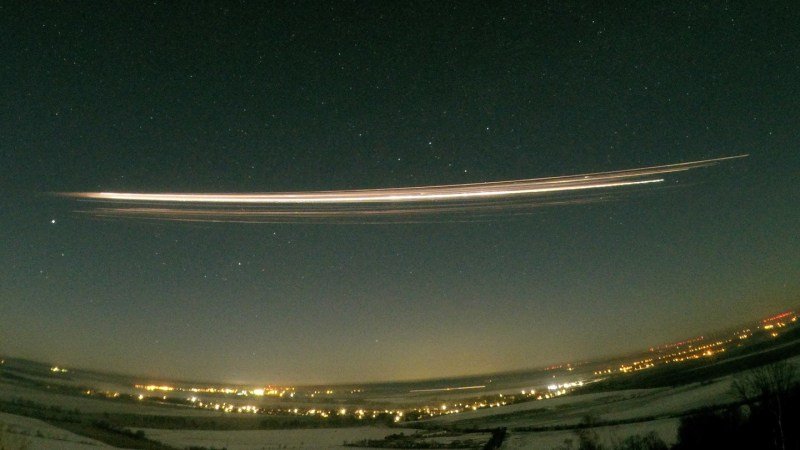
Fireball Over Europe Triggers Groundbreaking Observation (Image Credits: Sciencenews.org)
Northern Germany witnessed a unprecedented surge in lithium particles high in the sky, directly tied to a SpaceX Falcon 9 upper stage that burned up over the Atlantic Ocean.[1][2]
Fireball Over Europe Triggers Groundbreaking Observation
On February 19, 2025, a Falcon 9 upper stage plummeted uncontrollably into Earth’s atmosphere around 03:42 UTC, igniting visible fireballs as it streaked over Ireland, England, and Germany before scattering debris in Poland.[1][3] Scientists at the Leibniz Institute of Atmospheric Physics in Kühlungsborn seized the moment, firing up their specialized lidar system the following night.
The instrument captured a plume of lithium atoms at 96 kilometers altitude starting around 00:21 UTC on February 20 – roughly 20 hours after reentry.[1] Lithium density spiked tenfold, reaching 31 atoms per cubic centimeter compared to the typical 3 atoms per cubic centimeter.[2] “A few hours after the reentry of this rocket, we could see 10 times more lithium than we would have observed otherwise,” said Claudia Stolle, a meteorologist at the institute.[2] This marked the first direct measurement linking space debris burn-up to upper-atmospheric pollution.[4]
Lidar and Models Pinpoint the Source
Researchers employed a resonance fluorescence lidar tuned to lithium’s specific wavelength of 670.8 nanometers, pulsing laser energy into the night sky to excite and detect backscattered photons from metal atoms.[1] The system resolved vertical profiles every 200 meters, revealing the plume’s narrow band between 94.5 and 96.8 kilometers.
Advanced trajectory modeling with the UA-ICON circulation model, nudged to European Centre for Medium-Range Weather Forecasts data and radar winds, traced air parcels backward from Germany to the reentry path west of Ireland – over 1,600 kilometers away.[1] Lead author Robin Wing noted, “For the first time, we could directly show that we have the capability to trace and observe the plume of pollution from space debris to a single re-entry event.”[4] Geomagnetic and ionospheric data ruled out natural sources like meteors.
Rising Tide of Orbital Debris Fuels Concerns
The Falcon 9 carried about 30 kilograms of lithium in its aluminum-lithium hull and batteries – far exceeding the atmosphere’s natural daily influx of 80 grams from cosmic dust.[4][3] SpaceX’s Starlink constellation alone orbits nearly 10,000 satellites, with plans for over 40,000, each designed to deorbit and burn up after five years.[2]
Projections indicate reentries could soon contribute 40 percent more metal mass than natural meteors, introducing alloys absent in cosmic material.[1] The European Space Agency estimates three debris objects reenter daily, vaporizing hundreds of tons annually.[4]
- Aluminum and its oxides, which form rapidly and persist.
- Copper, lead, and titanium from spacecraft components.
- Rare earth elements not found in meteors.
- Lithium as a tracer for human-made reentries.
- Sodium, distinguishing natural meteor ablation.
Ozone Layer Faces New Pressure from Above
These metals catalyze reactions that deplete stratospheric ozone and alter aerosol formation, potentially disrupting the layer shielding Earth from ultraviolet radiation.[1] A 2023 study already found 10 percent of stratospheric particles laced with spacecraft remnants.[2]
Wing highlighted aluminum’s risks: “Our largest concern is aluminium and aluminium oxides interacting with the ozone layer.”[3] Persistent nano-sized particles could influence temperatures, winds, and radiative balance for years, echoing past threats like chlorofluorocarbons.
Key Takeaways
- First ground-based lidar captured pollution from a specific rocket reentry, proving traceability.
- Reentries now rival natural metal inputs, with mega-constellations accelerating the trend.
- Lithium serves as an ideal marker, enabling future multi-element monitoring.
This breakthrough equips scientists to track space traffic’s environmental toll before it overwhelms the atmosphere – what steps should regulators take next? Share your thoughts in the comments.