
A Tilt Too Far for Standard Theories (Image Credits: Upload.wikimedia.org)
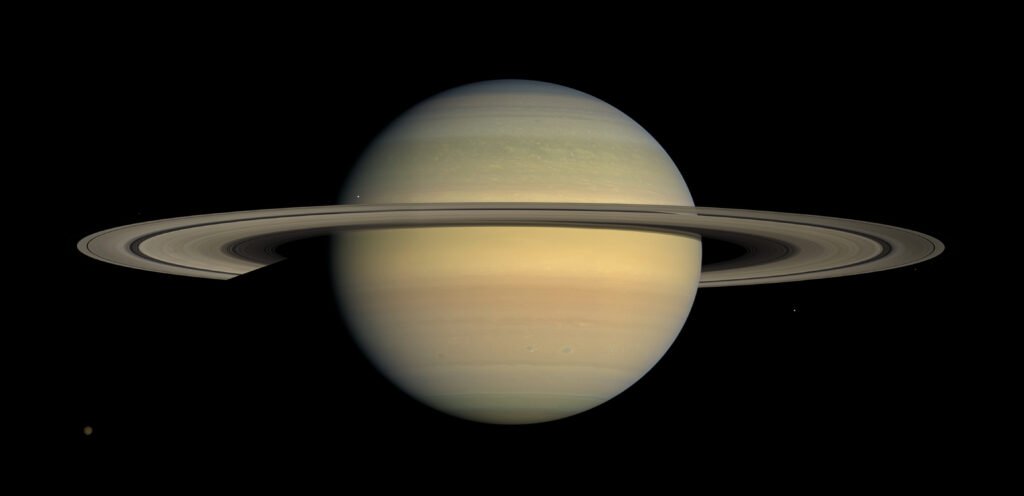
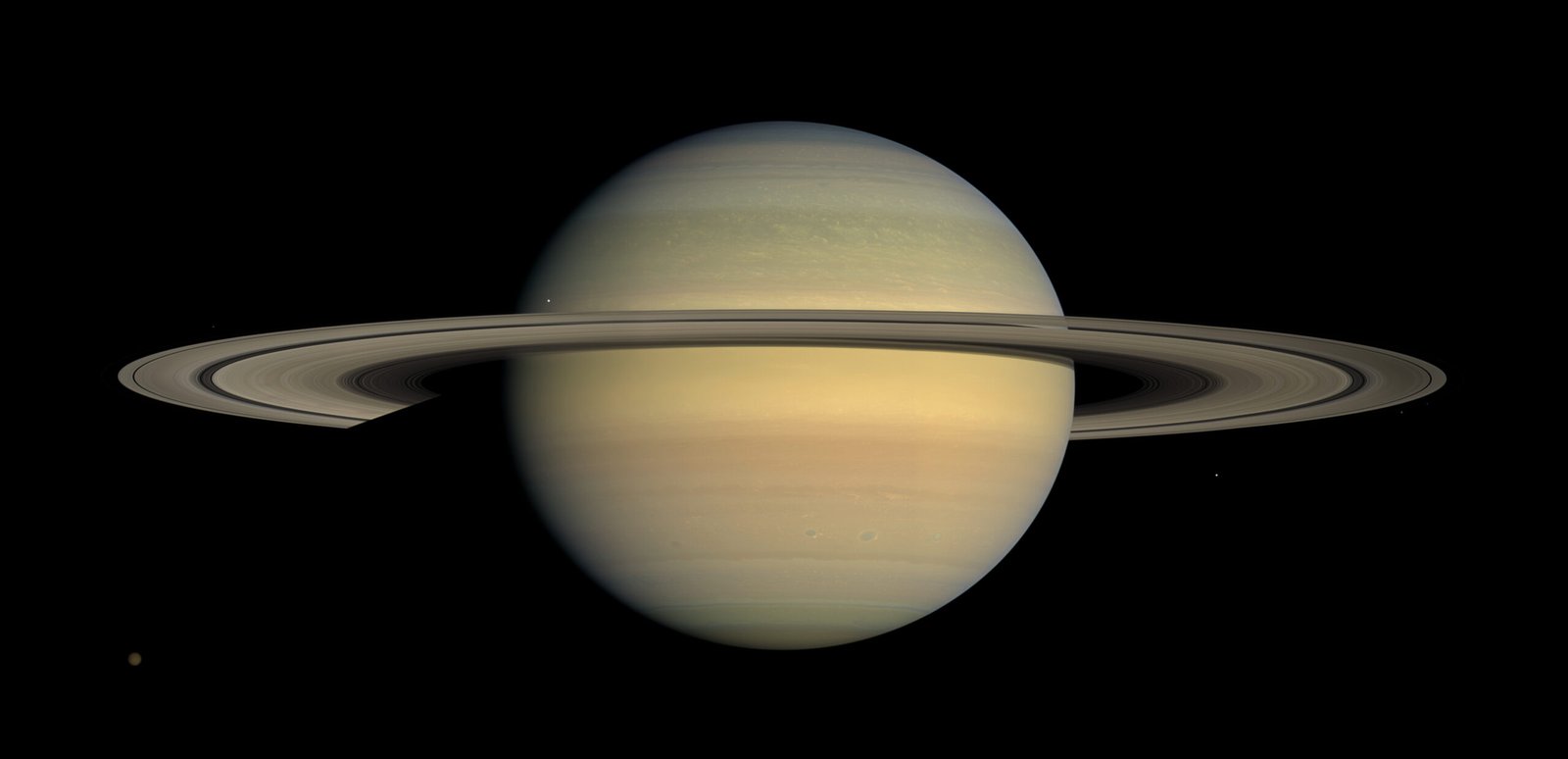
Saturn’s ethereal rings have long puzzled astronomers with their apparent youth and pristine icy composition. Recent computer models propose that these structures emerged from the dramatic destruction of a former satellite dubbed Chrysalis. This same event also accounts for the gas giant’s distinctive 26.7-degree axial tilt, resolving two enduring mysteries of the Saturnian system.[1][2]
A Tilt Too Far for Standard Theories
Astronomers have grappled with Saturn’s obliquity for decades. Most giant planets exhibit minimal tilts, shaped by their formation in flattened disks of gas and dust. Yet Saturn leans at nearly 27 degrees, a configuration that defies simple explanations from protoplanetary dynamics or massive impacts.[1]
Cassini spacecraft data from 2017 provided crucial measurements of Saturn’s moment of inertia and angular momentum. These refined values revealed that the planet sat just outside the parameters for a key resonance with Neptune’s orbital precession. Without an additional factor, the tilt made little sense. Lead researcher Jack Wisdom noted, “The tilt is too large to be a result of known formation processes in a protoplanetary disk or from later, large collisions.”[1]
Chrysalis Emerges from Orbital Simulations
Researchers hypothesized an extra moon, comparable in size to Iapetus – Saturn’s third-largest satellite. They named it Chrysalis, evoking the butterfly pupa that transforms into something grander. This icy body once orbited between Titan and Iapetus, stable for billions of years.[3])
Titan’s gradual outward migration, clocked at about 11 centimeters per year, perturbed the system. Numerical simulations demonstrated how this shift destabilized Chrysalis roughly 160 million years ago. The moon’s orbit decayed, leading to a grazing pass by Saturn where tidal forces tore it apart.[2]
Up to 99 percent of the debris plunged into Saturn’s atmosphere. The remaining fraction settled into orbit, fragmenting into the vast ring system we observe today. This scenario matched the rings’ estimated mass and composition, primarily water ice akin to Saturn’s moons.
Tying Rings’ Youth to a Catastrophic Past
Cassini observations pegged the rings at around 100 million years old – remarkably young compared to Saturn itself. Pollution from micrometeoroids and orbital dynamics supported this timeline. The Chrysalis disruption provided a natural origin point, aligning perfectly with independent age estimates.[1]
Prior theories invoked comet swarms or primordial leftovers, but none explained both rings and tilt cohesively. Wisdom highlighted the elegance: “The cool thing is that the previously unexplained young age of the rings is naturally explained in our scenario.” The model also preserved orbital peculiarities of moons like Iapetus.[1]
| Mystery | Chrysalis Explanation |
|---|---|
| Saturn’s 26.7° tilt | Resonance with Neptune amplified by Chrysalis; its loss adjusted obliquity |
| Rings’ ~100 million-year age | Debris from tidal disruption event |
| Rings’ icy composition | Fragments of water-ice moon |
Resonances, Migrations, and Neptune’s Role
Saturn’s spin precessed in sync with Neptune’s orbit until Titan’s expansion broke the pattern. Chrysalis maintained the resonance, boosting the tilt. Its demise allowed Saturn’s axis to relax slightly, matching current observations.
- Titan migrated outward due to tidal interactions, at 11 cm/year.
- Chrysalis orbit destabilized between 100-200 million years ago.
- Grazing encounter crossed Roche limit, shredding the moon.
- Neptune resonance explains absence of larger tilt changes.
- Model consistent with Cassini-derived moment of inertia.
The international team included experts from MIT, UC Berkeley, UC Santa Cruz, University of Arizona, and Wellesley College. Their findings appeared in Science in September 2022.[2]
Challenges and Evolving Views
While compelling, the hypothesis faced scrutiny. Some models suggested Chrysalis remnants might collide with Titan, complicating ring formation. Recent 2026 simulations by Matija Ćuk and colleagues explored a variant: an earlier impact with Titan around 400 million years ago, resurfacing the moon and indirectly spawning rings through orbital chaos.[4]
These updates underscore ongoing debate, yet the core Chrysalis idea endures. Future missions or telescopes like JWST could probe ring composition further, testing predictions.
Key Takeaways
- Chrysalis, Iapetus-sized, shattered 160 million years ago to form rings.
- Explains Saturn’s tilt via lost Neptune resonance.
- Rings’ youth (~100 million years) matches disruption timeline.
The Chrysalis saga transforms our view of Saturn from static jewel to dynamic arena of destruction and rebirth. As simulations refine the narrative, one question lingers: what other secrets hide in the rings’ icy particles? What do you think about this cosmic drama? Tell us in the comments.