

Record Discoveries from Engineering Data (Image Credits: Unsplash)
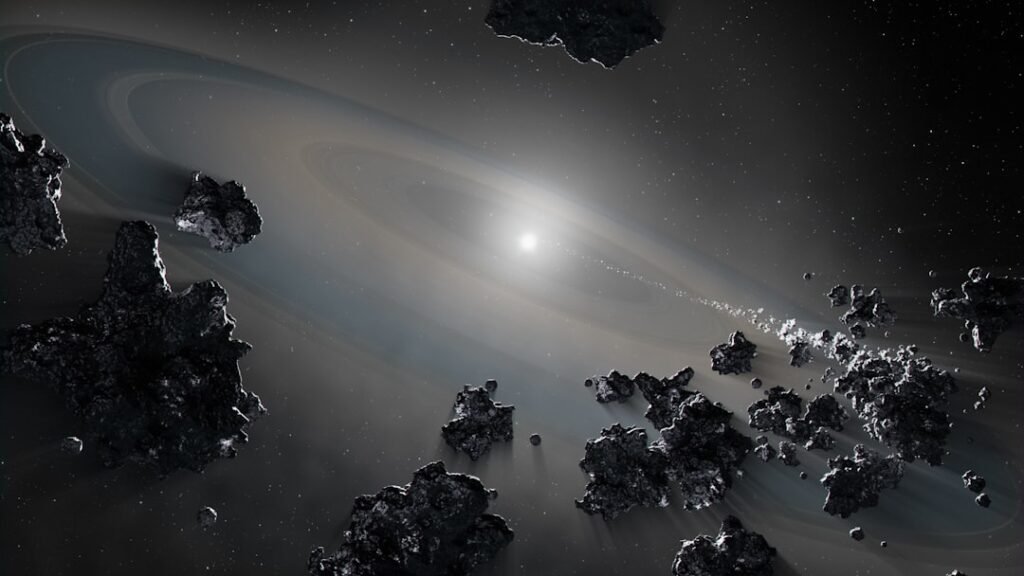
Chile – The Vera C. Rubin Observatory produced its largest asteroid haul yet from preliminary data, uncovering more than 11,000 previously unknown asteroids.[1] Scientists confirmed the findings through the International Astronomical Union’s Minor Planet Center, marking the biggest single batch submitted in the past year.[2] This achievement, based on roughly one million observations over six weeks in mid-2025, also refined orbits for tens of thousands of known objects.[3] The results preview the observatory’s potential to reshape our map of the solar system.
Record Discoveries from Engineering Data
Ari Heinze, a research scientist at the University of Washington, noted the significance: “We built it, and it works. Even with just early, engineering-quality data, Rubin discovered 11,000 asteroids and measured more precise orbits for tens of thousands more.”[1] The dataset captured faint, fast-moving objects amid crowded skies, including some asteroids previously lost due to uncertain paths.
Over 80,000 known asteroids appeared in the observations alongside the newcomers. This batch built on prior Rubin successes: 73 asteroids from late 2024 commissioning tests and 1,514 from the First Look phase in spring 2025. In total, the observatory tallied nearly 12,700 new finds across 1.6 years.[2]
Near-Earth Objects and Outer Reaches
Among the highlights stood 33 newly identified near-Earth objects, or NEOs – rocky bodies with orbits bringing them within 1.3 astronomical units of the sun. None presented a threat to Earth, though the largest measured about 500 meters across.[4] Rubin also detected roughly 380 trans-Neptunian objects, icy relics beyond Neptune’s orbit.
Two extreme TNOs, temporarily dubbed 2025 LS 2 and 2025 MX 348, traced highly elongated paths extending 1,000 times farther from the sun than Earth. These distant wanderers offered clues to the solar system’s formative chaos and fueled speculation about a possible ninth planet.[1] Kevin Napier, a research scientist at the Harvard-Smithsonian Center for Astrophysics, described them as “a tantalizing probe of the Solar System’s outermost reaches.”
Advanced Software Fuels the Breakthrough
Rubin’s Simonyi Survey Telescope, equipped with an 8.4-meter mirror and the world’s largest digital camera, scanned vast sky areas at unprecedented sensitivity. Yet software innovations proved equally vital. Developers at the University of Washington’s DiRAC Institute crafted pipelines to handle the observatory’s rapid imaging cadence.[2]
Mario Jurić, leader of Rubin’s solar system team, called the submission “just the tip of the iceberg.” He explained that processes once spanning years or decades would soon unfold in months.[1] Novel algorithms sifted billions of sky sources to pinpoint TNOs, likened by Matthew Holman to finding needles in haystacks.
- Late 2024: 73 asteroids via Commissioning Camera tests.
- April-May 2025: 1,514 from First Look observations.
- Mid-2025: Over 11,000 in early optimization surveys.
- Total to date: About 12,700 new asteroids.
Transforming Solar System Knowledge
Perched atop Cerro Pachón, the NSF- and DOE-funded facility prepares for its decade-long Legacy Survey of Space and Time, set to image the southern sky every few nights. Early projections suggested Rubin could uncover 11,000 asteroids every two or three nights once underway.[4] The survey promised to triple the catalog of known asteroids, nearly double NEOs larger than 140 meters, and multiply TNO counts tenfold.
Planetary defense stood to gain most, with alerts for nearly 90% of hazardous NEOs approaching within 7 million kilometers. The observatory’s real-time system already detected 800,000 cosmic changes in one night this February.[3]
Key Takeaways
- Over 11,000 new asteroids from six weeks of test data, plus orbit refinements for tens of thousands more.
- 33 NEOs and 380 TNOs, including extreme orbit outliers.
- Preview of LSST’s power to triple known asteroids and bolster planetary defense.
Rubin’s initial strikes confirmed its readiness to catalog the solar system’s small bodies like never before. As full operations approach later this year, astronomers anticipate revelations that could redefine our cosmic neighborhood. What do you think about these finds? Tell us in the comments.