
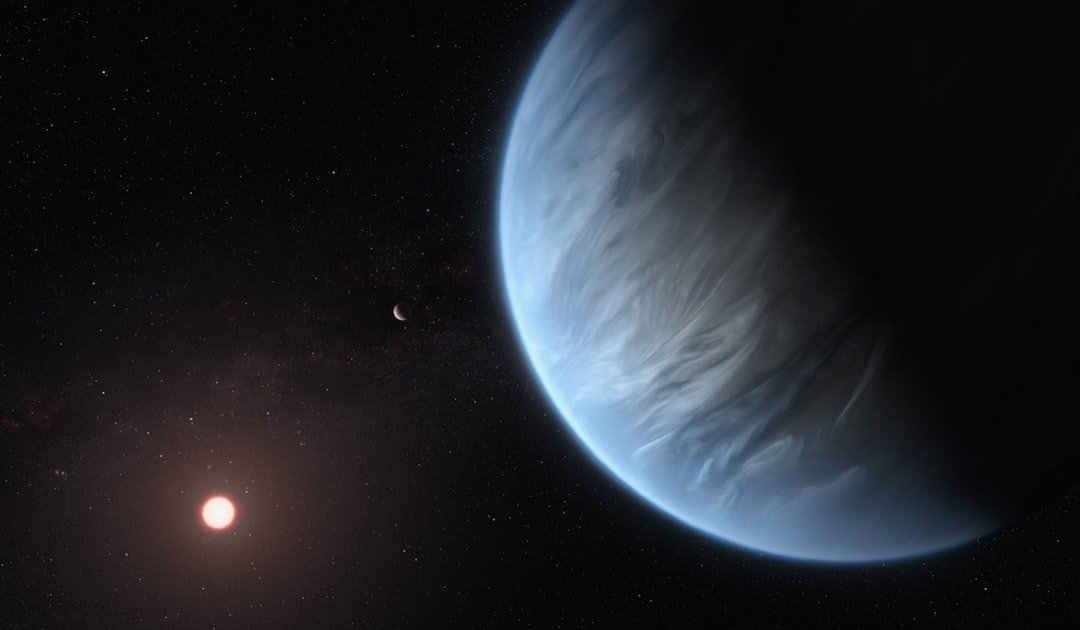
A Breakthrough in Extreme Exoplanet Observation (Image Credits: Unsplash)
Researchers using NASA’s James Webb Space Telescope have detected evidence of a substantial atmosphere enveloping TOI-561 b, a rocky exoplanet long considered too hostile to retain any gaseous layer. This finding challenges prior assumptions about such extreme worlds, revealing temperatures cooler than those predicted for a barren rock surface. The discovery points to a dynamic system where heat circulates efficiently, potentially fueled by underlying volcanic activity.
A Breakthrough in Extreme Exoplanet Observation
The James Webb Space Telescope captured data that revealed TOI-561 b’s surprising thermal profile. Scientists expected the planet to radiate intense heat directly from its surface, given its proximity to its star. Instead, measurements showed it runs cooler, suggesting a thick atmospheric blanket redistributes energy.
This observation marks a pivotal moment in studying super-Earths. Previous models dismissed the possibility of atmospheres on planets this close to their stars, where stellar winds should strip away gases rapidly. TOI-561 b upends that view, offering fresh insights into planetary retention mechanisms.
TOI-561 b: A World of Contrasts
TOI-561 b orbits its star at a blistering pace, completing a full revolution in just over 10 hours. This rapid cycle classifies it as an ultra-short-period planet, baking under constant stellar radiation. Tidal forces have locked one hemisphere in perpetual daylight, while the other remains in shadow.
Despite these harsh conditions, the planet maintains a rocky composition with potential for abundant volatiles. Researchers describe it as resembling a “wet lava ball,” where a molten ocean beneath the atmosphere churns and releases gases. Such volatility could sustain the observed atmospheric thickness against erosive forces.
- Orbital period: Just over 10 hours.
- Surface locking: Tidally locked with eternal day on one side.
- Temperature anomaly: Cooler than bare-rock predictions.
- Atmospheric hint: Heat distribution from magma activity.
- Composition clue: Possible volatile-rich interior.
Unraveling the Atmospheric Mystery
The detected atmosphere likely plays a crucial role in moderating the planet’s heat. It traps and circulates thermal energy, preventing the dayside from overheating beyond measurable limits. Below this layer, a magma ocean may supply continuous vapors, replenishing any losses.
Spectroscopic analysis from JWST supports this model. The planet’s emission spectrum aligns with a gas envelope capable of efficient convection. This setup echoes early Earth-like processes but amplified by the super-Earth’s mass and heat budget.
Broader Implications for Planetary Science
TOI-561 b’s case expands the habitable zone concept beyond traditional bounds. While too hot for liquid water, its atmosphere demonstrates gas retention on rocky worlds in extreme orbits. Future observations could confirm volatile abundance, refining models of super-Earth evolution.
This discovery encourages targeted JWST campaigns on similar planets. It highlights how ancient, scorched worlds preserve geological activity, potentially mirroring lost histories of our own solar system. Astronomers now anticipate more such revelations as telescope capabilities advance.
| Expected for Bare Rock | Observed on TOI-561 b |
|---|---|
| Extreme surface heat radiation | Cooler overall temperature |
| No gas retention | Thick, heat-distributing atmosphere |
| Static, eroded surface | Churning magma ocean activity |
- JWST data confirms a thick atmosphere on TOI-561 b, cooler than predicted.
- The planet’s 10-hour orbit and tidal lock create a unique “wet lava ball” environment.
- This challenges models of gas loss on close-in rocky exoplanets.
TOI-561 b stands as a testament to the unexpected resilience of exoplanetary atmospheres, urging scientists to rethink boundaries for life-bearing potential. As JWST continues its survey, more such enigmas may surface, reshaping our cosmic neighborhood. What surprises might the next observation bring?