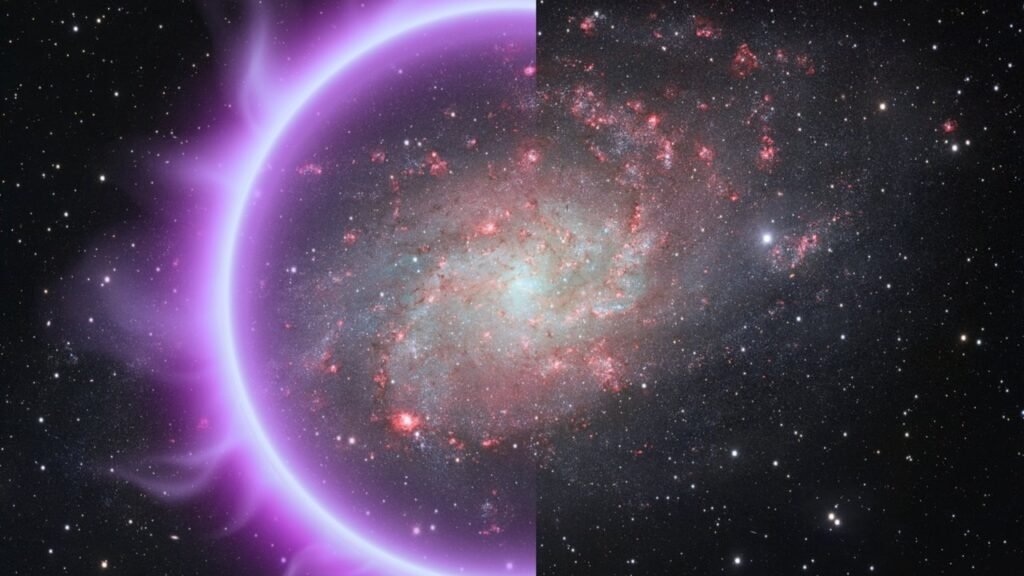

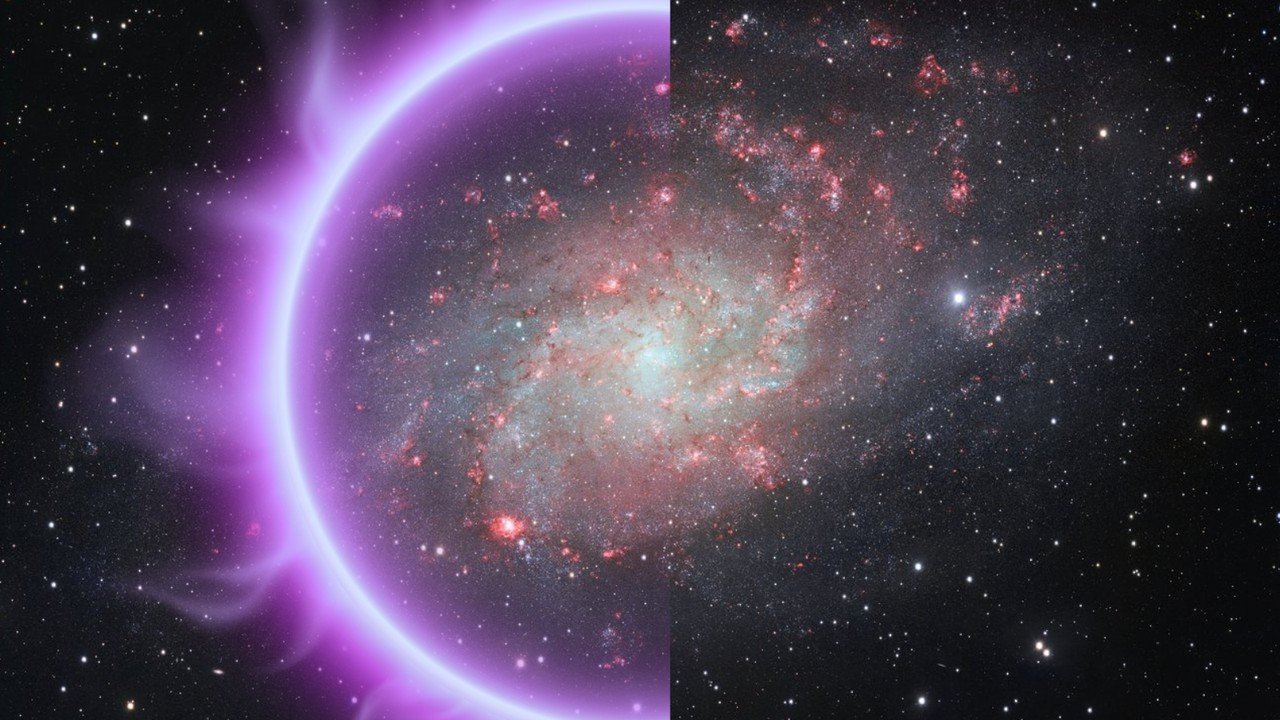
Dark Matter’s Persistent Mystery (Image Credits: Cdn.mos.cms.futurecdn.net)
A provocative new theory challenges the longstanding assumption that dark matter permeates the universe, proposing instead that gravity operates in unexpected ways on the grandest scales.
Dark Matter’s Persistent Mystery
Researchers inferred dark matter’s presence decades ago to account for discrepancies in galactic rotations and gravitational lensing. Galaxies rotate faster than expected based on visible matter alone, suggesting unseen mass holds them together. This invisible component reportedly makes up about 85 percent of the universe’s matter.
Despite extensive searches, direct detection of dark matter particles has eluded experiments like those at the Large Hadron Collider. The substance interacts gravitationally but evades electromagnetic detection, fueling ongoing hunts through underground detectors and space telescopes.
Enter Modified Gravity
A recent study shifts focus from elusive particles to gravity itself. The researcher argues that rather than invoking new matter, gravitational laws might deviate subtly on cosmic scales. This approach echoes earlier ideas like Modified Newtonian Dynamics but applies to even larger structures.
The proposal suggests gravity strengthens or alters in low-acceleration environments, such as galaxy outskirts, mimicking dark matter’s influence without requiring it. Such modifications could explain observations traditionally attributed to the hidden mass.
Key Observations Fueling the Debate
Galaxy clusters and cosmic microwave background data have long supported dark matter models. Yet anomalies persist, including the “missing satellites” problem, where fewer dwarf galaxies appear than predicted. Proponents of alternative gravity point to these as potential cracks in the standard model.
The theory draws on wide binary star systems and galaxy rotation curves for validation. These systems show dynamics that standard gravity struggles to match precisely.
- Rotation curves of spiral galaxies flatten at large radii.
- Gravitational lensing in clusters exceeds visible mass predictions.
- Cosmic voids expand differently than expected.
- Dwarf galaxies exhibit irregular mass distributions.
- Wide binaries display anomalous accelerations.
Implications for Cosmology
Adopting modified gravity would reshape understandings of the universe’s evolution. Standard models rely on cold dark matter for structure formation from the Big Bang onward. A gravity-only framework demands revisions to simulations and predictions for future observations.
Critics note that modified gravity falters in explaining the early universe’s uniformity or bullet cluster collisions, where dark matter appears separated from normal matter. Still, the new perspective invites fresh tests with telescopes like the James Webb Space Telescope.
Key Takeaways
- Dark matter explains gravitational oddities but remains undetected.
- New theory posits gravity changes on vast scales, eliminating need for hidden mass.
- Pending observations could validate or refute this paradigm shift.
This debate underscores cosmology’s dynamic nature, where bold ideas continually test established views. As data from upcoming missions pours in, the true architect of cosmic structure – be it dark matter or quirky gravity – may soon reveal itself. What do you think about this challenge to dark matter? Tell us in the comments.