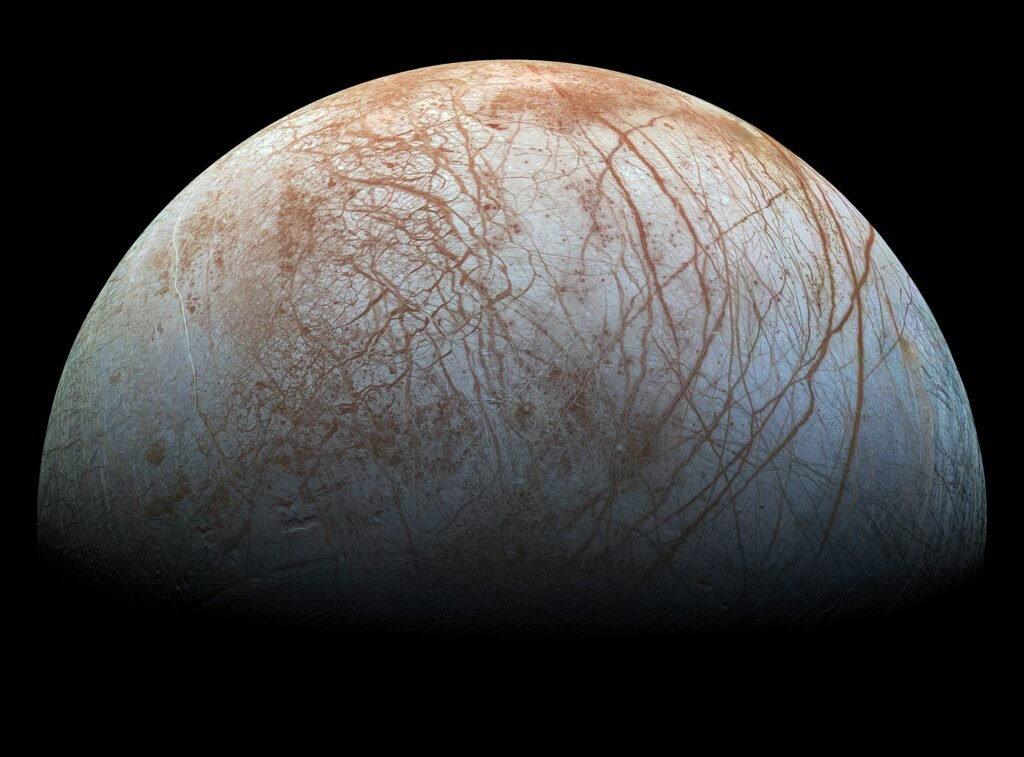

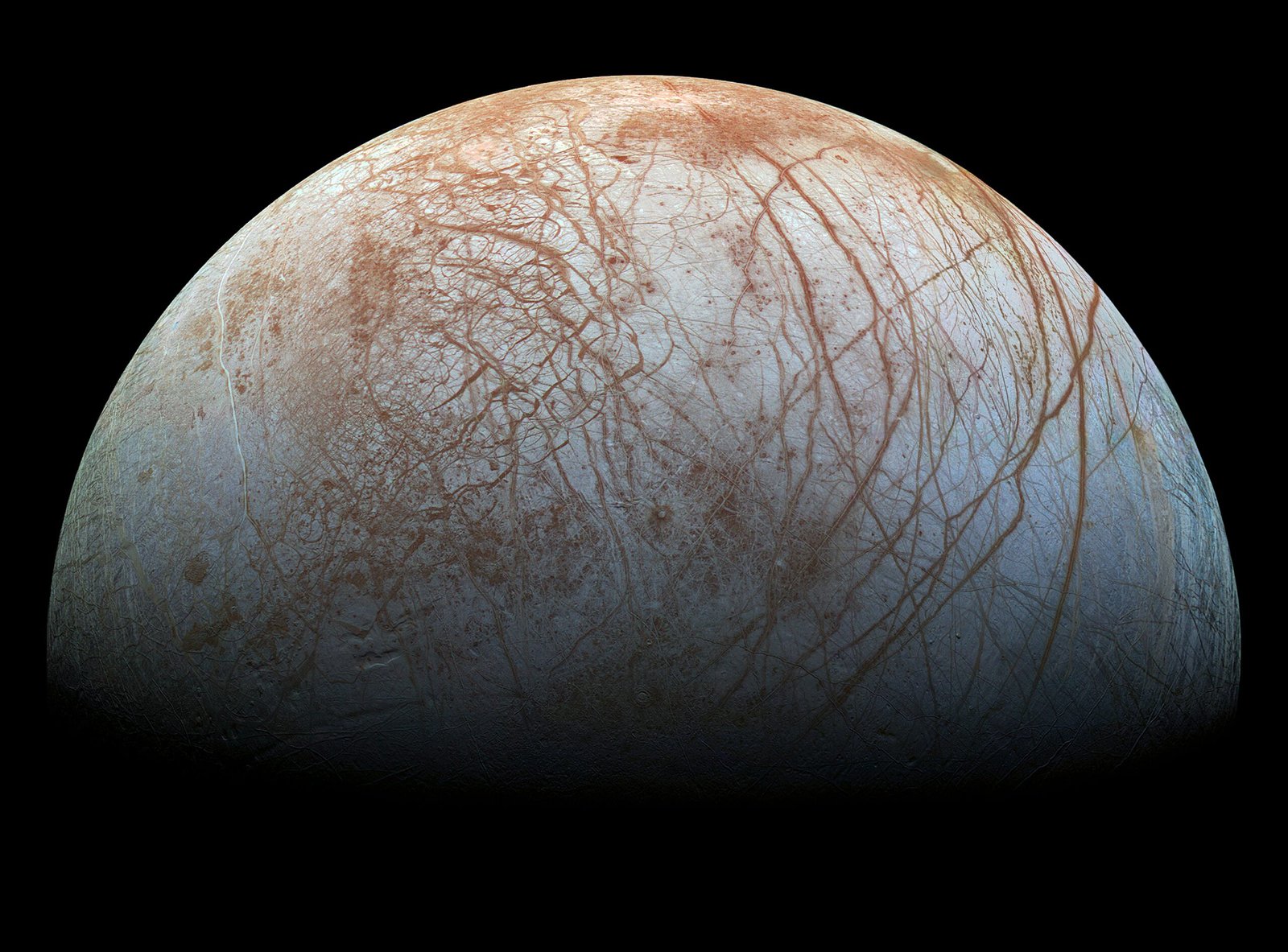
Rediscovering Clues in 1997 Images (Image Credits: Upload.wikimedia.org)
Researchers examining decades-old images from NASA’s Galileo spacecraft have identified ammonia compounds on the surface of Jupiter’s moon Europa, offering fresh clues to its dynamic interior.
Rediscovering Clues in 1997 Images
A startling revelation emerged from a 1997 photograph taken during Galileo’s 11th orbit around Jupiter. Red pixels in the Near-Infrared Mapping Spectrometer data highlighted ammonia deposits across a 250-mile-wide region near prominent surface fractures.[1][2]
Al Emran at NASA’s Jet Propulsion Laboratory led the reanalysis, published in The Planetary Science Journal on November 7, 2025. Spectral modeling pinpointed NH3 hydrate and NH4 chloride as the likely forms. NASA highlighted the findings in an announcement on January 29, 2026.[3]
Previous examinations of Galileo data from 1995 to 2003 overlooked these signatures. The absorption feature at 2.2 micrometers proved decisive in confirming ammonia’s presence.
Unpacking the Spectral Evidence
Galileo’s NIMS instrument captured infrared spectra that revealed ammonia’s distinctive footprint. Deposits appeared concentrated near chaotic terrain and lineae, the long fractures crisscrossing Europa’s icy shell. Purple pixels in composites marked areas without detections, underscoring the targeted nature of the find.
Ammonia cannot endure long on Europa’s vacuum-exposed surface or under radiation bombardment. Its survival points to recent delivery from below. Emran’s study modeled how these compounds matched observed data better than alternatives like hydrates alone.[1]
Evidence of Cryovolcanic Activity
The positioning near fractures suggests cryovolcanism transported ammonia upward. Liquid from subsurface reservoirs likely erupted through cracks, depositing brownish residues observed in visible light images. This process links Europa’s ocean chemistry directly to its exterior.
Such activity implies a thinner ice shell over a chemically reduced, high-pH ocean. Ammonia acts as an antifreeze, stabilizing liquid water despite frigid conditions. Geological youthfulness emerges from these indicators of ongoing upheaval.[2]
“Ammonia-bearing materials were transported to the surface via effusive cryovolcanism or similar mechanisms during Europa’s recent geological past,” Emran noted in the paper.
Implications for Life in the Ocean
Nitrogen from ammonia serves as a cornerstone for biomolecules, including amino acids and DNA. This marks the first evidence of nitrogen-bearing species on Europa, elevating its astrobiological profile. Even without vigorous seafloor volcanism, crustal processes could supply nutrients.
The discovery bolsters models of a habitable subsurface environment. Upcoming missions stand to test these ideas further. NASA’s Europa Clipper, set to arrive in 2030, will map the surface and probe the interior composition in unprecedented detail.
- Confirms nitrogen availability, key for life.
- Supports active material exchange between ocean and surface.
- Enhances prospects for detecting biosignatures.
Key Takeaways
- Ammonia deposits indicate recent geological activity via cryovolcanism.[1]
- Nitrogen presence strengthens Europa’s case as a prime target for habitability studies.
- Europa Clipper mission will build on this with advanced instruments.
Europa’s ammonia revelation transforms old data into a window on potential alien worlds. As scientists anticipate Clipper’s revelations, the moon’s secrets draw closer to revelation. What does this mean for the search for life beyond Earth? Share your thoughts in the comments.