
Picture a ball of iron roughly seventy percent the size of the moon, buried almost five thousand kilometers beneath your feet, quietly shaping your existence in ways you never imagined. It keeps your compass pointing north, shields you from deadly solar radiation, and even subtly influences the length of your day. For decades, scientists treated it like a sleeping giant. Turns out, it is anything but asleep.
Recent discoveries have sent shockwaves through the geoscience community, revealing that the heart of our planet is far more restless, complex, and frankly strange than anyone previously expected. From shape-shifting surfaces to atoms behaving like flowing liquids inside solid metal, the story of Earth’s core is being completely rewritten right now. So let’s dive in.
The Inner Core Is Not the Solid Sphere You Were Taught About
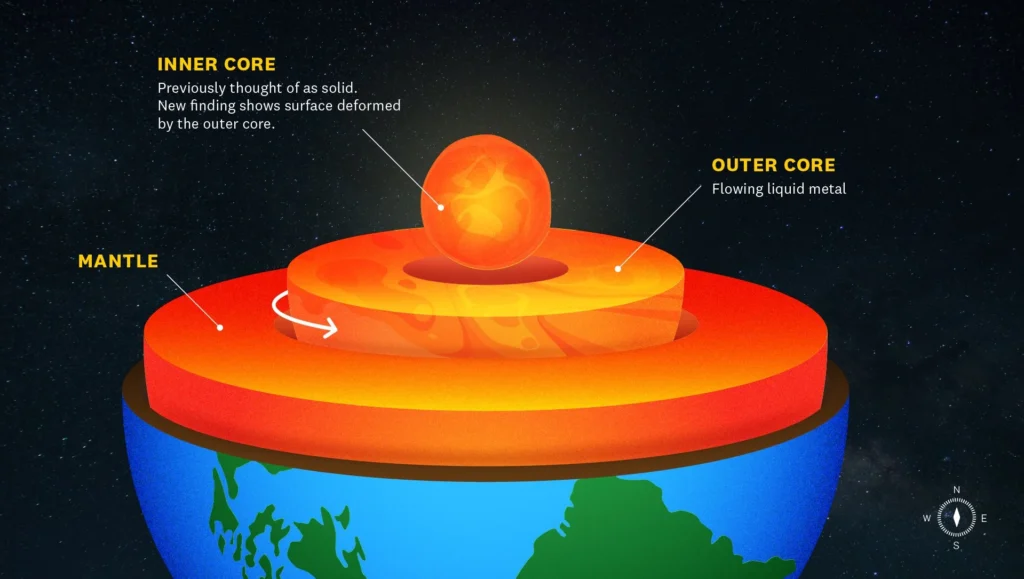
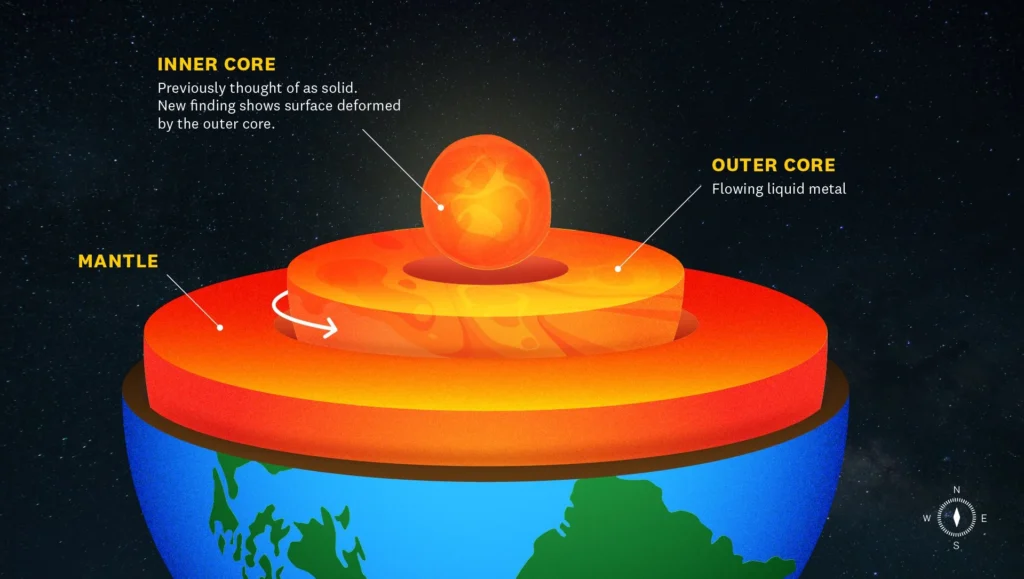
Here’s the thing most of us learned in school: the inner core is solid iron. Full stop. It was one of those facts that felt settled, like knowing the sky is blue. But a landmark study published in Nature Geoscience in early 2025 has fundamentally challenged that picture. Until recently, the inner core was widely thought of as a solid sphere, but new research indicates that its near surface may undergo viscous deformation, changing its shape and shifting at its shallow boundary.
The study found evidence that Earth’s inner core, a hot, mostly solid ball of iron roughly 1,500 miles wide, deforms at its boundary with the liquid outer core. Think of it less like a steel ball and more like a very dense, slow-moving blob of putty. As Cornell geophysicist Guanning Pang put it, even though the inner core is really solid, its boundary is really soft, perhaps as soft as jelly.
Seismic Waves Caught the Core in the Act

You might wonder, how do scientists even know what’s happening thousands of kilometers underground? The answer is earthquake waves. They act like natural X-rays, slicing through the planet’s layers and revealing details about density, temperature, and structure that no drill could ever reach. The pivotal study used seismic waveform data from 121 repeating earthquakes at 42 locations near Antarctica’s South Sandwich Islands between 1991 and 2024, analyzing signals at receiver stations near Fairbanks, Alaska, and Yellowknife, Canada, where one dataset displayed uncharacteristic properties never seen before.
That unexpected physical activity is best explained as temporal changes in the shape of the inner core, with its near surface undergoing viscous deformation and shifting at the shallow boundary. What’s even more striking is that researchers hadn’t set out looking for this at all. The clearest cause of the structural change turned out to be interaction between the inner and outer core, with scientists noting that while the molten outer core is widely known to be turbulent, its turbulence had never before been observed disrupting the inner core on a human timescale.
A New State of Matter Discovered at the Planet’s Center
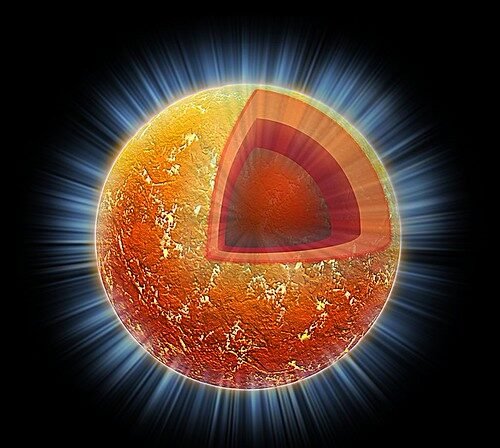
If a shape-shifting core wasn’t enough to wrap your head around, researchers dropped another bombshell in December 2025. New research reveals that Earth’s solid inner core is actually in a superionic state, where carbon atoms flow freely through a solid iron lattice, and this unusual behavior makes the core soft, matching seismic observations that had puzzled scientists for decades. Honestly, when I first read that, it sounded like science fiction. A material that is simultaneously solid and has atoms flowing through it like a liquid? That is the stuff of physics textbooks, not planet Earth.
Using a dynamic shock compression platform, researchers propelled iron-carbon samples to 7 kilometers per second, achieving pressures of up to 140 gigapascals and temperatures near 2,600 kelvin, closely reproducing the environment found in the inner core. On an atomic level, the data showed carbon atoms moving freely through iron’s orderly structure, weakening it without causing the lattice to collapse. This superionic behavior explains why the core feels oddly soft to seismic waves, a mystery that had stumped researchers for a very long time.
Carbon: The Unexpected Architect of the Solid Core
The role of carbon keeps coming up in all these new discoveries, and it deserves its own spotlight. Researchers have long struggled to explain how Earth’s solid inner core formed, cooled, and crystallized without undergoing extreme supercooling, but a study published in Nature Communications reveals that carbon may play a far more significant role than previously believed, with an international team led by scientists from Oxford, Leeds, and University College London using atomic-scale simulations to show that carbon accelerates the nucleation process necessary for the core to freeze.
While silicon and sulfur, long thought to be important core components, actually slowed the crystallization process, carbon had the opposite effect. This suggests that carbon not only enables the inner core to form, but also ensures that it happens under realistic geophysical conditions, and without this element, Earth might have failed to develop a solid inner core, potentially compromising the generation of the planet’s magnetic field, which shields life from harmful solar radiation. In other words, carbon may be the hidden reason life on Earth is even possible. Let’s be real, that’s extraordinary.
The Core Is Spinning Strangely and Leaking Material Upward
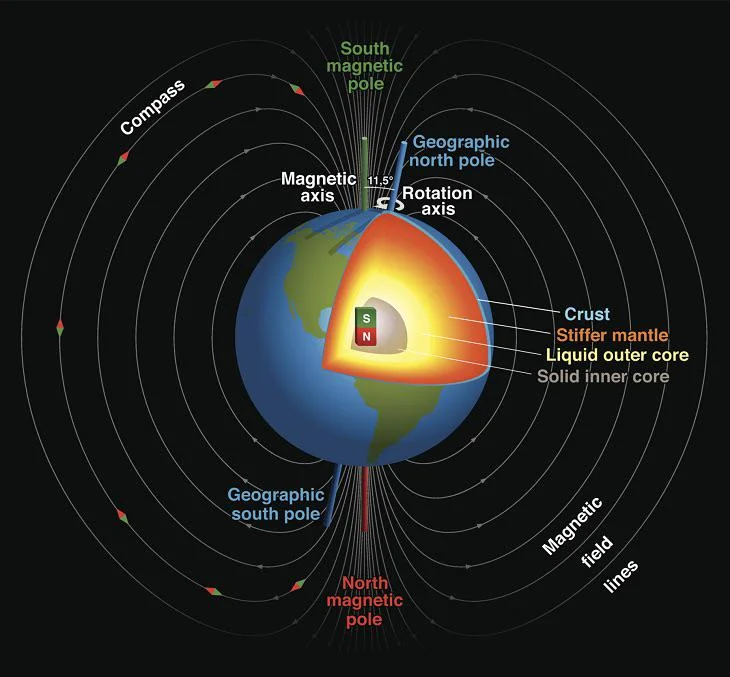
Traditionally, scientists believed that the inner core rotated slightly faster than the rest of the planet, a phenomenon known as super-rotation, supported by seismic data showing earthquake-generated waves traveled at different speeds through the inner core over time, but new findings challenge this assumption, revealing that the core’s rotation is far more complex and dynamic than previously thought. In a study published in Nature Geoscience, researchers Yi Yang and Xiaodong Song presented compelling evidence that Earth’s inner core has slowed its rotation and may have begun reversing direction, with seismic data from repeating earthquakes suggesting the inner core’s rotation appeared to pause and possibly reverse around 2009.
It gets stranger still. Recent research has uncovered signs that Earth’s core is leaking material upward into the mantle, a revelation that has left scientists both fascinated and unsettled, and the idea is no longer just a wild theory since it’s based on chemical evidence found in volcanic rocks and deep-sea minerals. Studies published in leading journals have identified traces of isotopes like helium-3 and certain forms of tungsten that are rarely found on the surface but are abundant in the core. Material from the very center of the planet is apparently making its way toward the surface. That, to me, changes everything about how we think of Earth as a closed system.
What All This Means for Earth’s Magnetic Field and Your Daily Life
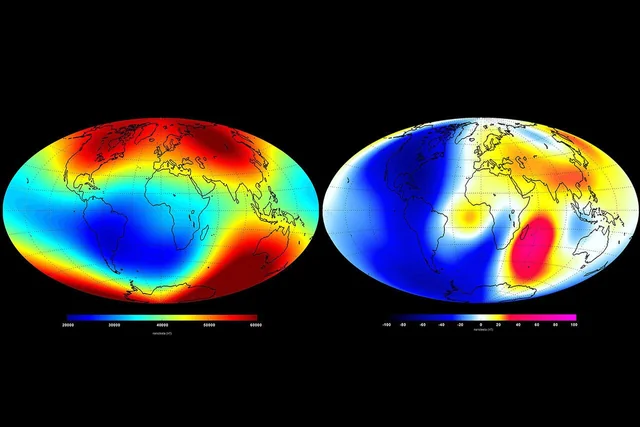
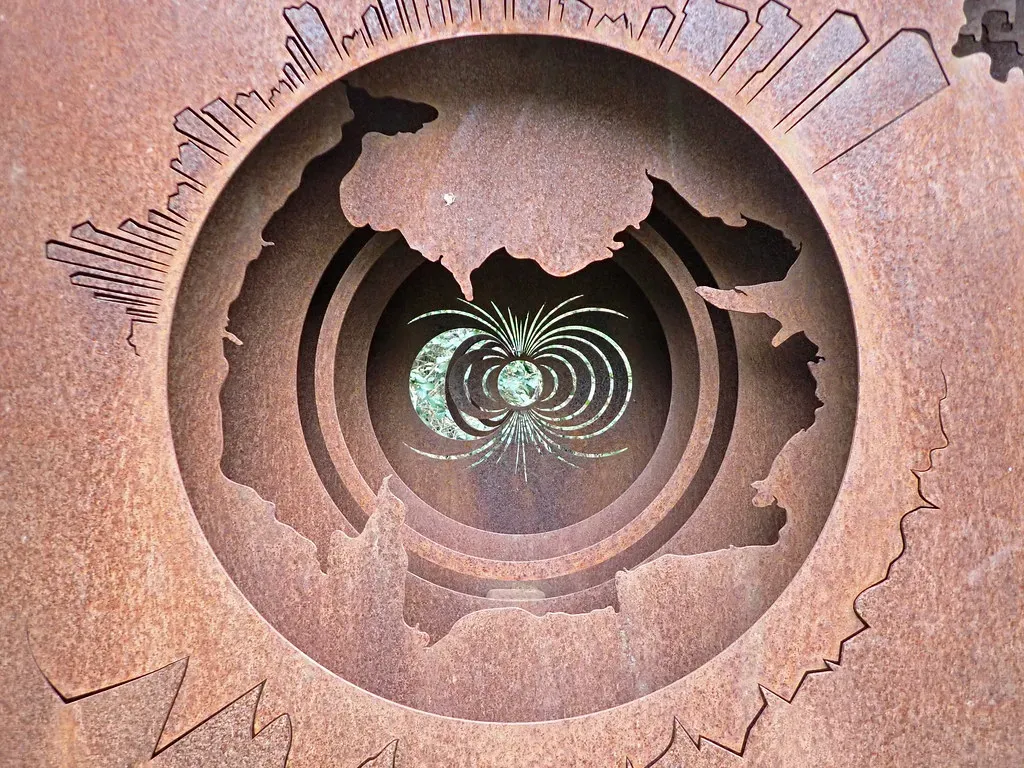
A research team led by the University of Liverpool found magnetic evidence that two massive, intensely hot rock formations at the base of Earth’s mantle influence the liquid outer core beneath them. These structures sit about 2,900 kilometers below Africa and the Pacific Ocean, and the findings suggest these enormous bodies of solid, superheated rock have played a role in shaping Earth’s magnetic field for millions of years. The magnetic field, remember, is the invisible shield keeping you alive every single day by deflecting solar wind and cosmic radiation.
Shape changes in the core could hold clues about the forces deep inside Earth that power the magnetosphere, the invisible lines of magnetic energy that protect our planet from solar weather and deadly radiation. Research indicates that changes in the rotation of the Earth’s inner core may be associated with small variations in the length of days, usually on the millisecond scale, and scientists are investigating possible relationships between these changes and broader natural processes, including variations in Earth’s magnetic field and influence on seismic activity. It’s hard to say for sure how much the surface world will feel these changes long-term, but one thing is increasingly clear: the core is not a passive bystander in the story of life on Earth.
Conclusion
What’s unfolding beneath your feet right now is nothing short of a scientific revolution. The Earth’s core, once dismissed as a predictable lump of iron, is shape-shifting, spinning erratically, hosting exotic states of matter, and leaking ancient material toward the surface. Every new study seems to peel back another layer of mystery, revealing a planet that is dynamic, interconnected, and very much alive from its center outward.
The implications stretch far beyond academic journals. Understanding the core means understanding the magnetic shield that makes life possible, the subtle rhythms that set the length of your day, and the volcanic systems that have shaped civilization. This discovery has significant implications for our understanding of Earth’s dynamics, as the changing shape of the inner core could play a role in subtle variations in Earth’s rotation and provide valuable insights into the generation and maintenance of Earth’s magnetic field.
We have been living on this planet for hundreds of thousands of years, and we are only now beginning to understand what is truly happening in its heart. That should fill you with awe rather than worry. The Earth is not breaking. It is just finally starting to reveal its secrets. What surprises you most about what’s stirring at the center of our world?