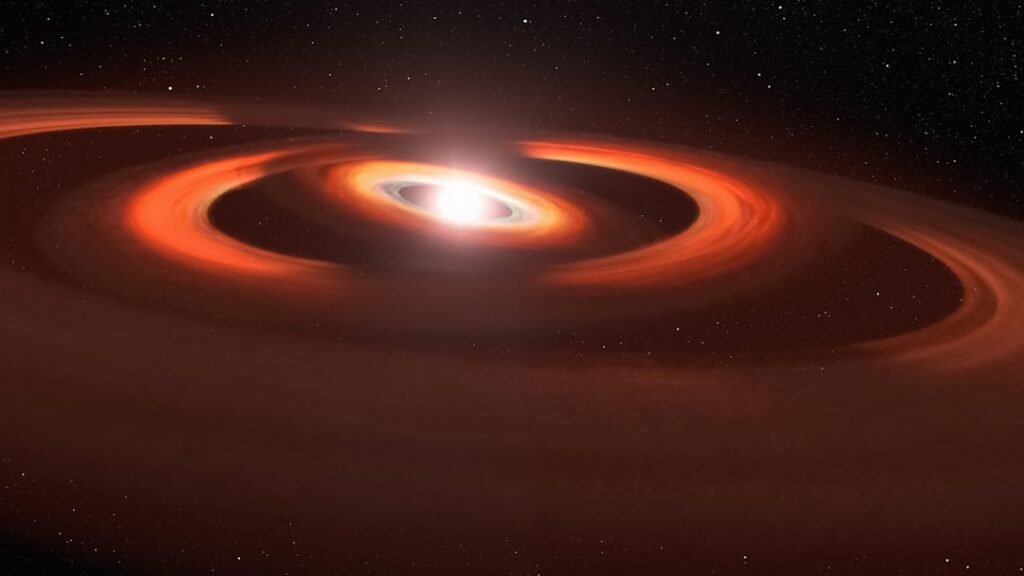
The Unexpected Heat in Cosmic Youth (Image Credits: Upload.wikimedia.org)
Astronomers have unveiled a galaxy cluster from the universe’s early days that challenges fundamental ideas about how cosmic structures formed, revealing intense heat where models predicted none.
The Unexpected Heat in Cosmic Youth
Researchers identified a massive group of about 30 galaxies huddled together just 1.4 billion years after the Big Bang, a time when the universe was still in its toddler phase. This cluster, dubbed SPT2349-56, stands out because its intergalactic gas reaches temperatures five times higher than theoretical predictions. Such extreme conditions suggest rapid processes at work that accelerated the cluster’s development far beyond what simulations anticipated.
The discovery came from observations that pierced through the cosmic veil, showing not just the galaxies but the scorching plasma binding them. This hot gas, detected at over 50 million degrees Fahrenheit, indicates vigorous activity that fueled the cluster’s growth. Scientists now ponder how such maturity emerged so soon in cosmic history, prompting a reevaluation of formation timelines.
Unraveling the Cluster’s Fiery Core
At the heart of SPT2349-56 lie supermassive black holes in several galaxies, which likely played a pivotal role in heating the surrounding gas. These black holes devoured matter at an astonishing rate, releasing energy that superheated the intergalactic medium and spurred star formation across the cluster. The process created a feedback loop, where the heat prevented gas from cooling and condensing too quickly, allowing the structure to bulk up faster than expected.
Unlike later galaxy clusters, which took billions of years to reach similar scales, this one assembled its mass in a fraction of the time. The intense radiation from active galactic nuclei illuminated the region, making it a beacon for study. This efficiency in growth highlights gaps in our understanding of early universe dynamics, where gravity alone seemed insufficient to explain the observations.
Challenging Established Cosmological Models
Current theories hold that galaxy clusters, the largest bound structures in the cosmos, formed gradually through mergers and accretion over eons. Yet SPT2349-56 arrived fully formed and blazing, contradicting these slow-build models. The findings suggest that unknown mechanisms, possibly tied to dark matter interactions or exotic energy sources, influenced early clustering.
Astronomers from the University of British Columbia and international collaborators emphasized how this outlier exposes limitations in simulations. Without adjustments, these models fail to account for the cluster’s temperature and mass, which together imply a more turbulent infancy for the universe. Future studies may need to incorporate rapid black hole growth or altered physics to align predictions with reality.
Tools and Techniques Behind the Breakthrough
The Atacama Large Millimeter/submillimeter Array in Chile captured the subtle signals from this distant cluster, using its radio telescopes to map the hot gas emissions. This instrument excelled at detecting the faint millimeter waves from the early universe, filtering out interference from foreground objects. Complementary data from other observatories helped confirm the cluster’s redshift, placing it firmly at 1.4 billion years post-Big Bang.
Analysis involved sophisticated algorithms to reconstruct the gas distribution, revealing filaments of plasma threading through the galaxies. The team’s approach combined archival surveys with new targeted observations, yielding the clearest picture yet of such an ancient structure.
Key Features of the Discovery
- Age: Formed 1.4 billion years after the Big Bang, among the earliest known clusters.
- Temperature: Gas reaches five times the predicted heat, exceeding 50 million degrees Fahrenheit.
- Size: Comprises around 30 galaxies with a total mass rivaling modern clusters.
- Potential Driver: Supermassive black holes accelerating gas heating and star birth.
- Impact: Questions standard models of cosmic structure formation.
Key Takeaways
- This cluster’s heat defies expectations, signaling faster early universe evolution.
- Black hole activity may explain the anomaly, urging model refinements.
- Further observations could reshape our view of cosmic history.
This groundbreaking find not only expands the catalog of known cosmic phenomena but also invites deeper exploration into the universe’s formative years. As telescopes grow more powerful, discoveries like SPT2349-56 promise to refine our cosmic narrative. What aspects of this fiery cluster intrigue you most? Share your thoughts in the comments.