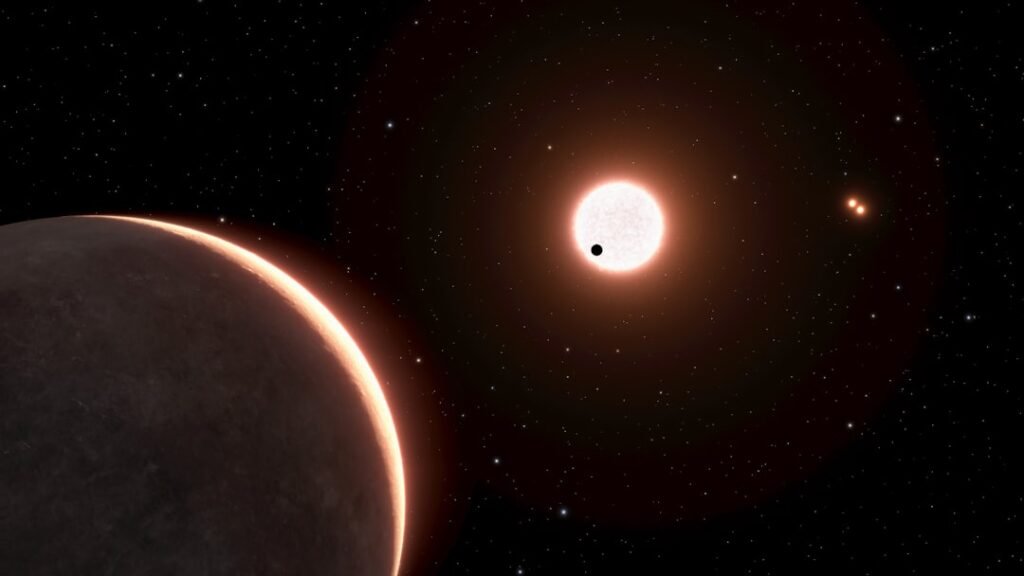

For decades, scientists have clung to a beautifully simple idea: find oxygen in a planet’s atmosphere, and you might have found life. It sounds almost too clean, doesn’t it? Like a cosmic fingerprint left behind by living, breathing creatures on some distant world. Honestly, the logic is hard to argue with, given that here on Earth, nearly all of our atmospheric oxygen comes from biology.
Yet a new and rather unsettling discovery is forcing researchers to rethink that assumption from the ground up. The universe, as usual, turns out to be far more complicated than our best theories. What scientists have uncovered could fundamentally change how we search for life beyond our solar system. Let’s dive in.
The Big Assumption Scientists Have Been Making

Here’s the thing about oxygen: it’s reactive. It bonds with rocks, metals, and all sorts of other chemicals so readily that, without something constantly replenishing it, it should disappear from any atmosphere relatively quickly. That’s why, on Earth, we assume only life can explain its persistent abundance.
This logic has driven the entire field of biosignature research for years. Space telescopes like the James Webb Space Telescope have been partly designed with the hope of detecting oxygen and similar gases in the atmospheres of distant exoplanets. The assumption was considered solid. Almost unshakeable, really.
The trouble is, science has a habit of shattering its own assumptions at the most inconvenient times.
A Non-Biological Source Nobody Expected
Researchers have now identified a geochemical process that can produce significant quantities of oxygen without any involvement from living organisms whatsoever. The mechanism involves chemical reactions between water and certain types of rock minerals under specific conditions. Think of it like a geological oxygen factory quietly humming away beneath a planet’s surface, with no life required.
This finding isn’t just a minor asterisk in a scientific paper. It genuinely opens the door to a scenario where a planet could show atmospheric oxygen signatures that look, from a distance, almost indistinguishable from those produced by biological processes. That’s a problem when you’re trying to use oxygen as your primary evidence of life.
The implications are, to put it plainly, a little inconvenient for everyone hunting alien life.
How the Geochemical Process Actually Works
The process centers on what happens when water interacts with iron-bearing minerals deep inside a rocky planet. During this reaction, known broadly as serpentinization and related oxidation chemistry, hydrogen is released and oxygen can be generated as a byproduct. It’s a slow process, but on geological timescales, it can accumulate into genuinely detectable quantities.
What makes this particularly tricky is that the conditions required are not exotic or rare. Rocky planets with liquid water and iron-rich geology are actually fairly common in our current models of planetary formation. In other words, this isn’t some fringe edge case limited to one unusual world.
Roughly speaking, a large portion of the rocky exoplanets scientists are actively studying could theoretically produce abiotic oxygen through exactly this kind of mechanism.
Why This Makes Exoplanet Research So Much Harder
Imagine you’ve spent years building one of the most expensive telescopes in human history, and you finally detect a clear oxygen signal from a planet orbiting a distant star. You’d want to celebrate, right? Well, now you have to stop and ask a much harder question: is that oxygen coming from life, or is it coming from rocks reacting with water?
That distinction, which once seemed almost philosophical, is now a very practical scientific problem. Researchers will need to develop more sophisticated methods to differentiate between biotic and abiotic oxygen sources. Simply detecting oxygen is no longer enough to get excited about.
This shifts the goalposts considerably. The search for life just got measurably more complicated, and honestly, that’s both humbling and fascinating at the same time.
What Scientists Are Proposing as a Solution
The scientific community isn’t panicking, but it is pivoting. Researchers are now pushing for a more holistic approach to biosignature detection, one that looks at combinations of atmospheric gases rather than any single compound in isolation. The idea is to search for what scientists call a biosignature “ensemble,” where multiple gases together paint a more convincing picture of life.
For instance, the simultaneous presence of oxygen, methane, and nitrous oxide in certain ratios would be far harder to explain through purely geological means. Life, after all, tends to leave a messy, multi-chemical fingerprint. A lone oxygen signal, on the other hand, is starting to look less like a smoking gun and more like a clue that needs serious backup.
It’s a smarter approach, though it does demand far more observational data and significantly more powerful detection technology.
The Broader Impact on Astrobiology as a Field
Astrobiology, the science of searching for life beyond Earth, has always had to operate on assumptions. The field is young, after all, and has exactly one confirmed example of a life-bearing planet to work from. That one data point is Earth, and scientists have arguably leaned on it a little too heavily.
This discovery is a healthy reminder that what works as a rule on our planet might not translate universally across the cosmos. Other planets follow their own chemical rules, shaped by their geology, their star, their history. Let’s be real, assuming Earth is the template for all possible life-bearing worlds has always been a bit of a stretch.
The field will adapt, as it always does. Stronger frameworks will emerge. This kind of disruption, uncomfortable as it is, tends to push science forward in the most productive ways.
What This Means for Future Space Missions
Several upcoming missions are being designed specifically to study exoplanet atmospheres in far greater detail than anything currently operational. The challenge now is to incorporate this new understanding into mission planning before those spacecraft are built and launched. Retrofitting a space mission’s scientific goals after the hardware is finalized is, to put it gently, not ideal.
Scientists are advocating for instruments capable of detecting a wider range of atmospheric compounds simultaneously, not just the obvious headline gases like oxygen or carbon dioxide. Missions targeting nearby rocky worlds in habitable zones will need to come equipped with a more nuanced toolkit. The bar for what counts as convincing evidence of life has been raised, and that’s probably a good thing in the long run.
Conclusion: A More Honest Search for Life
This discovery doesn’t mean alien life doesn’t exist. It doesn’t even mean oxygen is useless as a biosignature. What it means is that scientists need to be more careful, more thorough, and more humble in how they interpret what telescopes find floating in the atmospheres of distant worlds.
The search for life beyond Earth is arguably the most profound scientific endeavor humanity has ever undertaken. It deserves rigorous, honest methodology, even when that means dismantling assumptions we’ve held for generations. I think, in the end, this kind of course correction makes the eventual discovery, if and when it comes, far more credible and far more meaningful.
So here’s something to chew on: if oxygen alone can’t tell us a planet is alive, what signal would truly convince you?