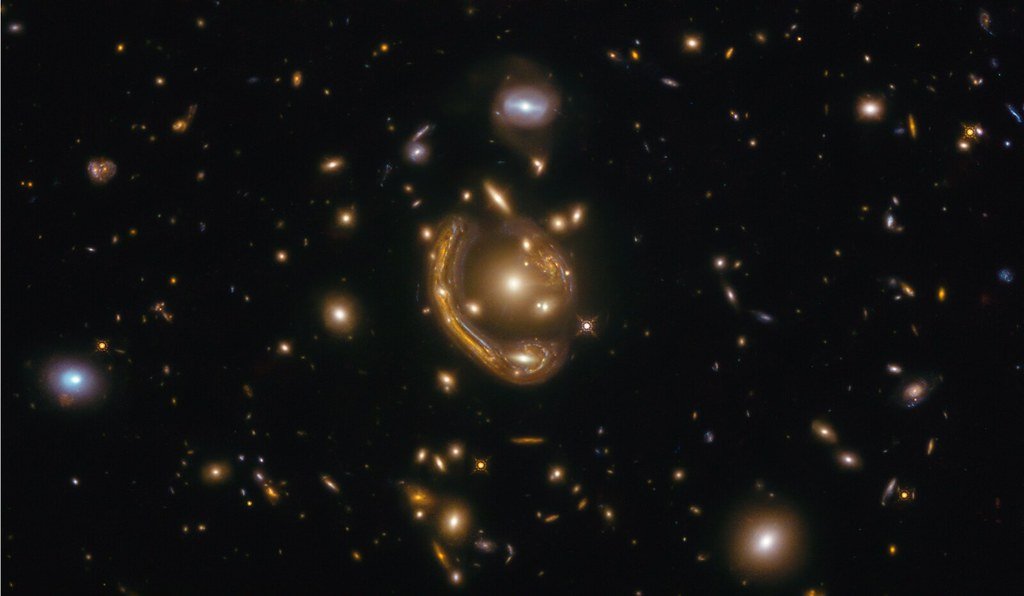
Clumps: Windows into Galaxy Evolution (Image Credits: Flickr)
Clumpy galaxies shaped the early universe billions of years ago, with bright knots of star formation dominating their structures. Today, astronomers struggle to locate similar features in closer galaxies due to limitations in observational data. Researchers recently developed a machine learning tool that automatically identifies these giant star-forming clumps, offering a scalable way to explore their properties in the local cosmos.[1][2]
Clumps: Windows into Galaxy Evolution
Giant star-forming clumps represent regions of intense stellar birth, spanning hundreds of parsecs and containing millions of solar masses. These structures prevailed in galaxies at redshifts around z=2, when the universe was just a few billion years old. They contributed significantly to the galaxies’ light profiles and played key roles in processes like gas collapse or mergers.
Locally, such clumps appear far less frequently, raising questions about their evolution over cosmic time. Did they migrate inward to form bulges, disperse into galactic disks, or fade away? Understanding this transition requires large samples of nearby examples, which have remained elusive until now.[1]
Overcoming Observational Challenges
Surveys like the Sloan Digital Sky Survey (SDSS) and the Dark Energy Camera Legacy Survey (DECaLS) captured images of thousands of nearby galaxies. However, their relatively low resolution often obscured the compact nature of star-forming clumps, making manual identification labor-intensive and inconsistent.
Astronomers needed a reliable method to scan vast datasets efficiently. Traditional approaches fell short, as human classifiers could not keep pace with the volume of images. This gap prompted the integration of advanced computational techniques tailored to astronomical data.[1]
Citizen Science Fuels AI Training
The Galaxy Zoo Clump Scout project mobilized volunteers to annotate clumps in approximately 50,000 SDSS galaxy images. Each image received scrutiny from about 20 participants, who drew bounding boxes around potential features. After rigorous cleaning, researchers obtained around 18,000 high-quality images containing roughly 40,000 verified clumps.
This crowdsourced dataset became the foundation for training machine learning models. Volunteers’ efforts provided diverse examples, capturing variations in clump appearance across different galaxy types and orientations. The approach combined human intuition with scalable automation.[1]
Transfer Learning Powers Precise Detection
The team employed Faster Region-based Convolutional Neural Networks (Faster R-CNN), a proven object detection framework. This model extracts features from images, proposes potential clump locations, and refines bounding boxes around them. A critical innovation involved transfer learning, where pre-trained “backbones” accelerated the process.
Researchers compared two backbones: ImageNet, trained on everyday objects like animals and vehicles, and Zoobot, specialized on over a million galaxy images. Zoobot excelled by recognizing astrophysical patterns without overfitting to limited training data. They tested five model variants, adjusting dataset sizes from 5,000 to full sets.
| Model Backbone | Training Size | Completeness | Purity |
|---|---|---|---|
| ImageNet | 5,000 galaxies | Low (<0.5) | Low (<0.5) |
| Zoobot | 5,000 galaxies | ~0.8 | ~0.8 |
| ImageNet | Full (~18,000) | Moderate (~0.6) | Moderate (~0.6) |
| Zoobot | Full (~18,000) | >0.8 | >0.8 |
Zoobot models achieved high completeness – detecting most true clumps – and purity – minimizing false positives – even on smaller datasets. ImageNet versions required far more data and still lagged behind.[1]
- Domain-specific pre-training reduces data needs dramatically.
- Astronomy-tuned models avoid memorization pitfalls common in generic ones.
- Bounding box outputs enable precise measurement of clump properties like size and position.
- Scalability supports analysis of tens of thousands of images quickly.
Pathways to Deeper Insights
The new tool opens avenues for systematic studies of clump origins and fates. Astronomers can now compare local clumps to their high-redshift counterparts, tracing evolutionary paths. Upcoming surveys from the Rubin Observatory and Euclid will generate even larger datasets ripe for this method.
By blending citizen science with AI, the approach exemplifies efficient astronomy in the data-rich era. It promises to illuminate how these star factories influenced galaxy assembly over billions of years.[1]
This innovation not only bridges the gap between ancient and modern galaxies but also equips researchers to tackle broader questions in cosmic structure formation. What role did clumps play in quenching star formation or building central bulges? The answers lie in the datasets now within reach.
Key Takeaways
- Zoobot-enhanced Faster R-CNN detects star-forming clumps with 80% accuracy using minimal training data.
- Citizen science from Galaxy Zoo provided essential annotations for model training.
- The method scales to future surveys, enabling redshift evolution studies of galaxy clumps.
As machine learning transforms astronomical discovery, these findings underscore the power of specialized tools. What do you think about the fusion of human and AI efforts in space research? Tell us in the comments.