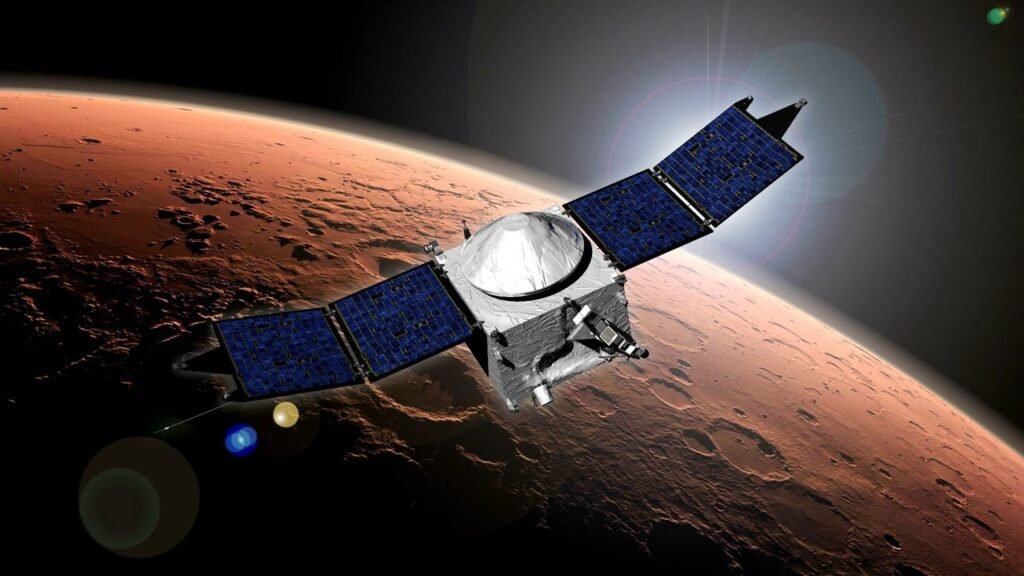

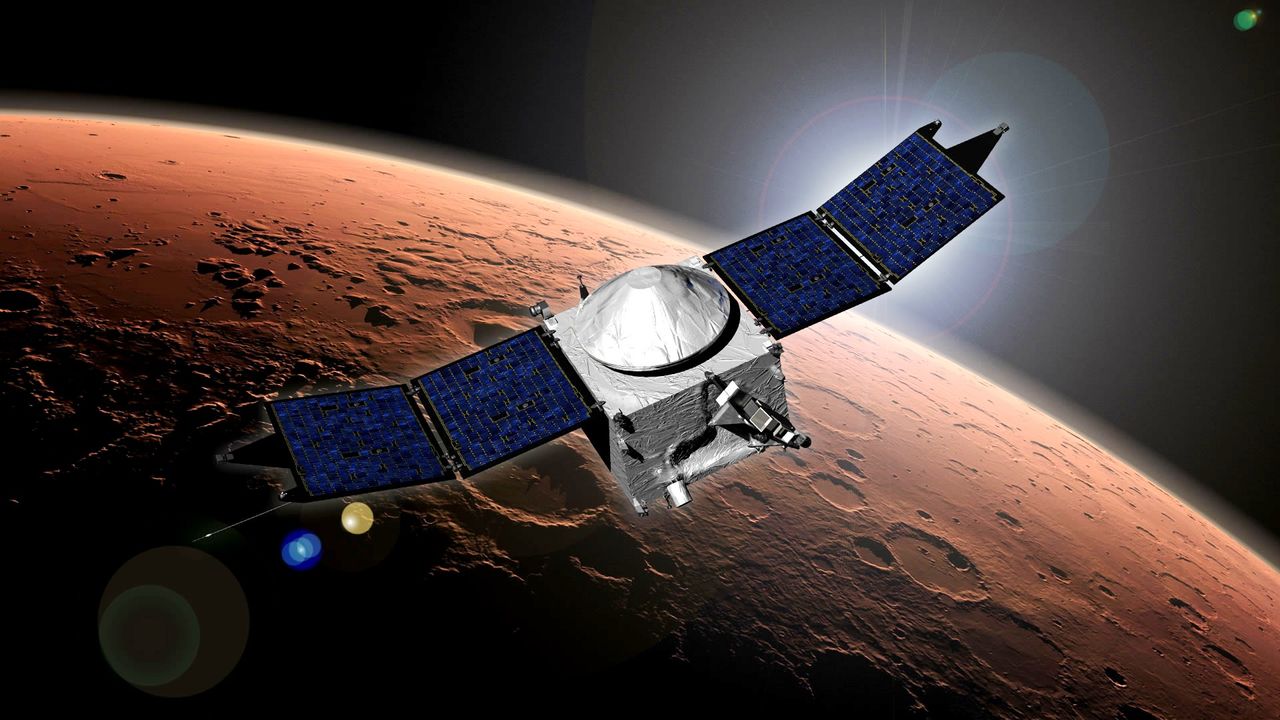
The Sudden Loss of MAVEN’s Signal (Image Credits: Cdn.mos.cms.futurecdn.net)
Engineers at NASA prepared to resume efforts on January 16, 2026, to reestablish communication with the MAVEN spacecraft, which has orbited Mars silently for over a month since its last contact on December 6, 2025.
The Sudden Loss of MAVEN’s Signal
A decade-long mission to unravel Mars’s atmospheric secrets faced an abrupt challenge when the Mars Atmosphere and Volatile EvolutioN spacecraft vanished from ground controllers’ view. The orbiter, launched in 2014, had been performing routine operations, including relaying data from surface rovers to Earth. Its trajectory appeared normal as it dipped behind the planet during a planned blackout period, but no signal emerged when it should have reappeared.
Teams initially suspected a temporary glitch, perhaps tied to the spacecraft’s aging systems or orbital mechanics. MAVEN’s instruments continued to indicate stable health in the final telemetry received, ruling out immediate catastrophe. However, repeated pings through NASA’s Deep Space Network yielded nothing, stretching the silence into weeks. This event marked a stark contrast to the mission’s reliable track record, which included safe mode recoveries in prior years.
By mid-December, officials acknowledged the anomaly as serious, prompting a coordinated response involving multiple ground stations. The blackout’s duration tested the limits of remote diagnostics across 140 million miles of space.
Recovery Attempts and Technical Hurdles
NASA’s strategy shifted to exhaustive listening sessions after the initial two-week solar conjunction, a period when Mars’s position near the sun disrupts signals. Operators scheduled passes with the Deep Space Network to hail the orbiter along its predicted path, assuming no major orbital deviation occurred. Earlier efforts, including visual searches by the Curiosity rover’s Mastcam, failed to spot MAVEN against the Martian sky.
Propellant depletion emerged as a prime suspect, potentially leaving the spacecraft unable to maintain attitude control or execute maneuvers. Engineers explored commands to trigger emergency modes, but the vast distance complicated real-time adjustments. Partner agencies, such as the European Space Agency’s ExoMars Trace Gas Orbiter, assisted by monitoring relay frequencies.
- Deep Space Network passes: Multiple daily attempts since December to detect any faint signals.
- Solar conjunction wait: A mandatory pause ending mid-January to avoid interference.
- Rover imaging: Unsuccessful bid using Perseverance and Curiosity for visual confirmation.
- Safe mode triggers: Remote commands designed to reset systems if power or orientation faltered.
MAVEN’s Enduring Contributions to Mars Science
Since entering Mars orbit, MAVEN transformed understanding of the planet’s volatile history, revealing how solar wind stripped away its ancient atmosphere. The spacecraft’s data illuminated why Mars shifted from a wetter world to the arid desert observed today, informing models of habitability. It also supported ongoing rover missions by forwarding critical updates during gaps in other orbiters’ coverage.
Key discoveries included measurements of escaping hydrogen and oxygen, linking to water loss over billions of years. MAVEN’s ultraviolet spectrometers captured auroras and ion escape rates, enriching global climate studies. Even in silence, its archived dataset remains a cornerstone for researchers analyzing Mars’s evolution.
The mission’s relay role proved vital for Perseverance and Curiosity, ensuring uninterrupted science flow. Without MAVEN, reliance on alternatives like Mars Reconnaissance Orbiter and Odyssey increases, but coverage gaps could slow data returns.
Implications for Future Mars Missions
A permanent loss of MAVEN would close a chapter in NASA’s Mars exploration, highlighting the fragility of long-duration space assets. The agency already plans next-generation orbiters to bolster communications, addressing vulnerabilities exposed by this incident. Propellant management and redundancy in deep-space tech will likely see renewed focus in upcoming designs.
Still, the three active relay spacecraft orbiting Mars provide a safety net, maintaining links for surface operations. This episode underscores the resilience required in interplanetary endeavors, where silence can span months before resolution – or finality – emerges.
Key Takeaways
- MAVEN’s silence since December 6, 2025, stems from possible propellant issues, with recovery odds now low.
- The spacecraft’s decade of data has reshaped views on Mars’s atmospheric past and water history.
- Alternative orbiters ensure continued support for rovers, though MAVEN’s unique science role ends if contact fails.
As NASA listens once more for MAVEN’s voice amid the cosmic static, the mission’s legacy endures, reminding explorers of the thin line between breakthrough and blackout in the pursuit of planetary knowledge. What challenges do you see for future Mars missions? Share your thoughts in the comments.