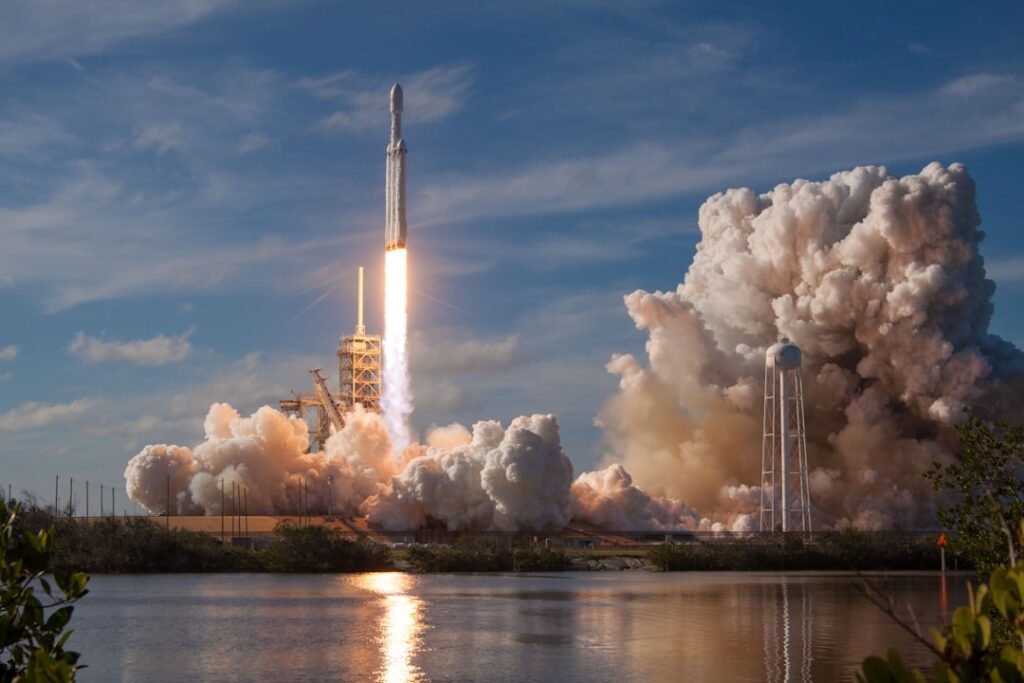

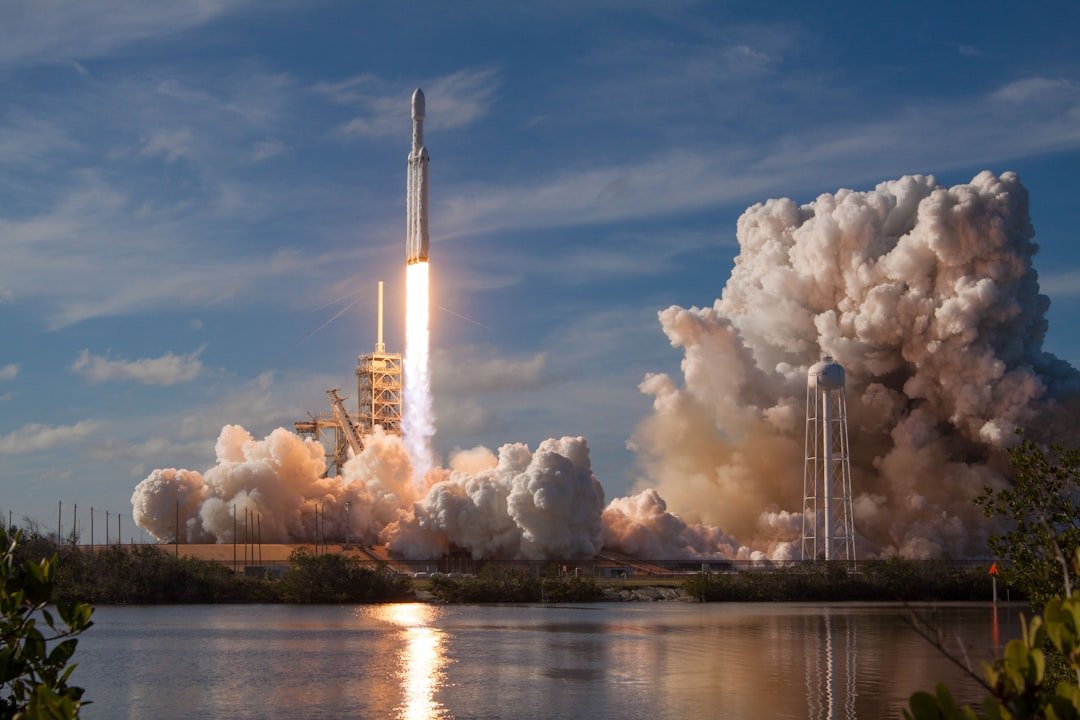
A Flawless Liftoff Marks New Era (Image Credits: Unsplash)
Kennedy Space Center, Florida – NASA’s Artemis II mission has entered its critical phase after a successful launch, with the crew on track to surpass the longest distance any humans have traveled from Earth. The Orion spacecraft, carrying four astronauts, departed Launch Complex 39B on April 1, 2026, and now races toward a lunar flyby that will etch their names in history. On April 6, the mission will reach a maximum of 252,757 miles (406,773 kilometers) from Earth, eclipsing the record held by Apollo 13 since 1970.[1]
A Flawless Liftoff Marks New Era
The SLS rocket ignited at 6:35 p.m. EDT, generating massive thrust from its solid rocket boosters and RS-25 engines to propel Orion into space. Flight controllers monitored every step, from solid rocket booster separation two minutes after liftoff to core stage engine cutoff eight minutes in. Minor issues, such as a sensor anomaly on the launch abort system, resolved without halting progress.[2]
Solar arrays deployed shortly after, ensuring power for the journey. The crew conducted proximity operations with the interim cryogenic propulsion stage before the translunar injection burn on April 2 set the free-return trajectory. As of April 4, Orion had passed the midpoint between Earth and the Moon, with all systems performing nominally.[3]
Surpassing Apollo 13’s Legendary Feat
Apollo 13 holds the current record at approximately 248,655 miles from Earth, achieved during its aborted landing attempt in April 1970 when the crew looped around the Moon’s far side. Artemis II’s path extends farther, calculated post-translunar injection to hit 252,757 miles precisely.[1] NASA ascent flight director Judd Freiling confirmed this during a briefing, noting the mission’s design pushes boundaries for deep space exploration.
The extra distance stems from the trajectory’s geometry, flying about 4,700 miles beyond the Moon’s far side at closest approach of roughly 4,000 miles above the surface. This free-return path relies on lunar gravity for the sling back to Earth, minimizing propulsion needs.
| Mission | Max Distance from Earth | Year |
|---|---|---|
| Apollo 13 | ~248,655 miles | 1970 |
| Artemis II | 252,757 miles | 2026 |
Diverse Crew Pioneers Deep Space Milestones
Commander Reid Wiseman leads the team on his second flight, supported by pilot Victor Glover, mission specialist Christina Koch – all NASA veterans – and Canadian Space Agency’s Jeremy Hansen on his debut. This lineup shatters barriers: Glover as the first person of color, Koch the first woman, Wiseman the oldest, and Hansen the first non-American beyond low Earth orbit since the Apollo era.[3]
- Reid Wiseman: Commander, oversees operations.
- Victor Glover: Pilot, handles spacecraft maneuvers.
- Christina Koch: Mission specialist, conducts science and tests.
- Jeremy Hansen: Mission specialist, international partner representative.
Backup crew members Andre Douglas and Jenni Gibbons stand ready on the ground. The quartet now holds the record for most people in deep space simultaneously, topping Apollo 8’s three.
Testing the Foundations for Lunar Return
Artemis II validates the SLS rocket and Orion spacecraft for crewed deep space travel, building on the uncrewed Artemis I in 2022. Objectives include human-rated systems checks, life support validation, and navigation demos during the 10-day outbound and return legs.[4] The crew will perform a flyby at 3,000 to 9,000 miles altitude over the lunar far side, gathering data without orbiting or landing.
Reentry speeds near 25,000 mph test Orion’s heat shield, crucial for future missions. Trajectory corrections ensure a Pacific Ocean splashdown around April 11. Delays from heat shield probes and leaks pushed the launch from earlier targets, but recent rehearsals succeeded.[3]
Key Takeaways
- Artemis II reaches 252,757 miles from Earth on April 6, topping Apollo 13 by over 4,000 miles.
- First crewed lunar mission since 1972, with diverse astronauts breaking multiple records.
- Paves way for Artemis III lunar landing and Mars ambitions.
As Artemis II hurtles toward its peak distance, it reignites humanity’s lunar legacy while forging paths to Mars. This feat underscores reliable deep space hardware after years of preparation. What records will future Artemis flights chase next? Share your thoughts in the comments.