
Space travel is full of breathtaking moments, but few are as raw and terrifying as the moment a crew capsule slams back into Earth’s atmosphere at thousands of kilometers per hour. It’s the part of the mission that doesn’t get enough attention in the highlight reels.
For the four astronauts aboard the Artemis II mission, the journey home will be anything but gentle. A wall of superheated plasma, brutal deceleration forces, and a heat shield that has to perform perfectly – all of it standing between the crew and survival. Here’s what that actually looks like, and why the science behind it is genuinely extraordinary.
The Mission That’s Taking Humans Back to the Moon’s Doorstep

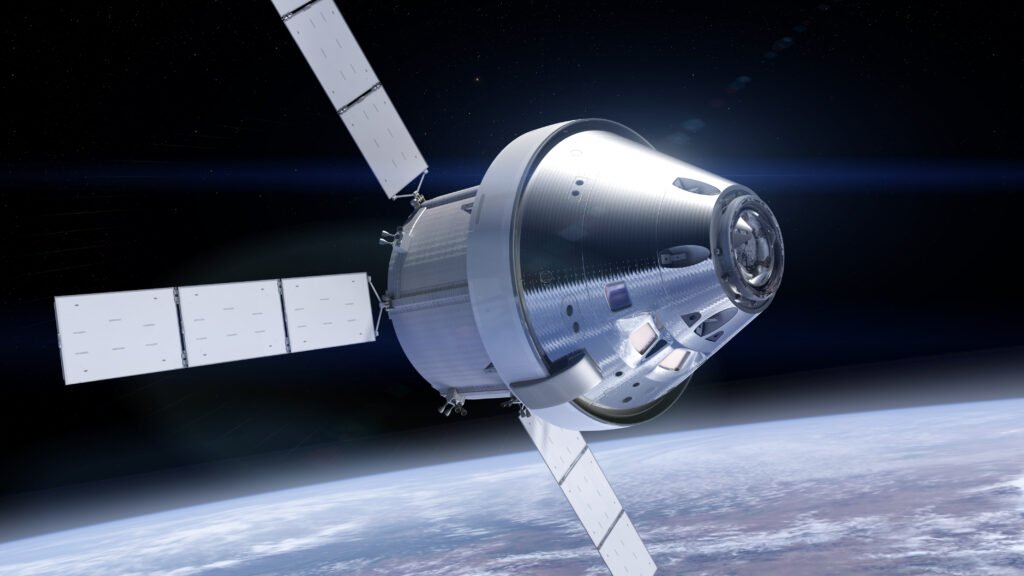
Artemis II is NASA’s first crewed lunar flyby mission since the Apollo era, scheduled to launch in 2026. The crew, consisting of NASA astronauts Reid Wiseman, Victor Glover, Christina Koch, and Canadian Space Agency astronaut Jeremy Hansen, will travel around the Moon without landing. It’s a dress rehearsal for the eventual lunar landing, and it carries enormous symbolic and technical weight.
The mission will take the Orion capsule farther from Earth than any crewed spacecraft has ventured in over fifty years. That kind of distance comes with a price, though. When the crew returns, the capsule will re-enter Earth’s atmosphere at speeds approaching around 11 kilometers per second, generating one of the most violent thermal environments a human-made structure can endure.
Why 3,000°C Is Not Just a Number
Here’s the thing – 3,000 degrees Celsius isn’t just hot. It’s the temperature at which many metals simply cease to exist in solid form. For context, that’s roughly half the surface temperature of the sun. When the Orion capsule hits the upper atmosphere at lunar return speed, the air molecules in front of it can’t move out of the way fast enough, so they compress and heat up to that almost incomprehensible temperature.
This phenomenon is called aerodynamic heating, and it creates a sheath of ionized plasma around the capsule. During this phase, radio communications are actually blocked because the plasma is so dense it absorbs signals. The crew is essentially unreachable for several minutes. Honestly, that detail alone gives me chills every time I think about it.
What makes Artemis II’s reentry particularly challenging compared to missions returning from low Earth orbit is the velocity. Returning from the Moon means coming in roughly forty percent faster than a spacecraft returning from the International Space Station, and that translates to dramatically more heat energy that the heat shield must absorb and dissipate.
The Heat Shield That Stands Between Life and Oblivion
The Orion spacecraft uses a heat shield made from a material called AVCOAT, an ablative material that literally chars and burns away during reentry. As it ablates, it carries heat energy away from the capsule’s structure, keeping the interior at a survivable temperature. Think of it like a sacrificial layer – it gives itself up so the crew doesn’t have to.
The heat shield on Orion is the largest of its kind ever built, measuring about five meters in diameter. During the Artemis I uncrewed test flight in December 2022, engineers noticed unexpected behavior in the heat shield material, with more char loss than anticipated in certain areas. NASA investigated the issue thoroughly before proceeding with the crewed mission, and the findings shaped adjustments to the reentry trajectory for Artemis II.
The solution involves a skip reentry technique. Rather than a straight plunge into the atmosphere, the capsule briefly dips in, uses aerodynamic lift to bounce back up slightly, and then makes its final descent. This two-phase approach reduces peak heating by spreading the thermal load over a longer period of time.
Skip Reentry: A Clever Trick Borrowed from Physics
The skip reentry maneuver is genuinely elegant when you think about it. Imagine skipping a flat stone across the surface of a pond. The capsule does something conceptually similar with the upper atmosphere, using the thin upper layers to slow down gradually rather than punching straight through in one violent plunge.
This approach gives the crew a slightly longer reentry time but significantly reduces the peak heat rate the shield must handle. It also gives mission controllers more precision over where in the ocean the capsule will land. For Artemis II, the planned splashdown zone is in the Pacific Ocean, off the coast of San Diego, California, where recovery teams will be waiting.
The skip reentry was actually validated during Artemis I, so engineers now have real flight data to work with rather than just computer models. That data has been invaluable in refining exactly how the Artemis II reentry will be executed.
What the Crew Will Actually Experience Inside the Capsule
Inside the Orion capsule, the crew will be strapped into their seats experiencing deceleration forces of several times the force of gravity. It’s physically demanding, the kind of sensation that makes your vision tunnel and your body feel crushingly heavy. For astronauts who’ve been in the near-weightlessness of deep space for over ten days, the sudden return of intense g-forces is a significant physiological shock.
Outside the windows, the plasma glow will be visible. Astronauts on previous missions have described it as an otherworldly orange and pink light surrounding the capsule. The communication blackout lasts only a few minutes, but during that time, the crew is completely on their own. Mission control can do nothing but wait.
The interior of the capsule is engineered to remain well within survivable temperatures throughout, thanks to the combination of the heat shield, thermal insulation layers, and the precision of the reentry trajectory. Still, it’s a reminder that spaceflight is never truly routine.
Lessons From Artemis I That Are Protecting This Crew
Artemis I’s uncrewed flight in late 2022 was invaluable precisely because it exposed things that simulations hadn’t predicted. The unexpected ablation patterns on the heat shield triggered a detailed NASA investigation, and engineers ultimately traced the behavior to the reentry conditions specific to lunar return velocity. It wasn’t a catastrophic flaw, but it was a real finding that demanded a real response.
As a result, the Artemis II trajectory was adjusted. The skip reentry profile was refined to manage thermal loads more evenly across the heat shield surface. It’s a good example of why test flights matter so much – not because engineers expect failure, but because real-world conditions always reveal something that even the best models miss.
There’s something almost poetic about the fact that a machine that flew with no one aboard is now directly protecting the four people who will fly on its successor. Every sensor reading from Artemis I feeds into keeping Reid Wiseman, Victor Glover, Christina Koch, and Jeremy Hansen alive on the way home.
A Splashdown in the Pacific and the Road Back to the Moon
When the capsule finally clears the plasma phase and parachutes deploy, the tension doesn’t immediately vanish. The three main parachutes slow Orion from hundreds of kilometers per hour down to roughly 30 kilometers per hour before splashdown in the Pacific Ocean near San Diego. Recovery ships and helicopters will be pre-positioned to retrieve the crew as quickly as possible.
The Artemis II mission represents the final crewed checkout before NASA attempts an actual lunar landing with Artemis III. Everything learned from this reentry, from heat shield performance to crew physiological response, feeds directly into that next mission. The stakes extend well beyond this single flight.
What we’re really watching with Artemis II is humanity slowly, carefully, and almost obsessively methodically rebuilding the capability to go beyond low Earth orbit with human beings aboard. The 3,000 degree wall of fire they have to survive on the way home is just one more problem that human ingenuity has, remarkably, already solved.
What do you think – does knowing the sheer physics of what these astronauts face on reentry make you see space missions differently? Drop your thoughts in the comments below.